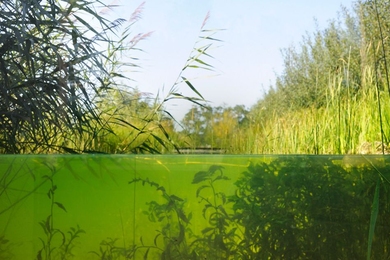
Predicting sediment flow in coastal vegetation Model could help engineers design erosion-prevention strategies in marshes, wetlands, aquatic forests. June 16, 2015 Read full story →
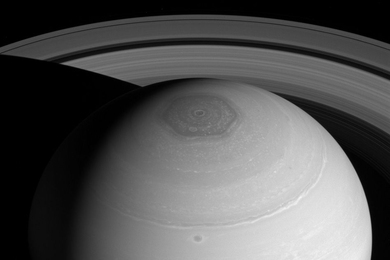
Small thunderstorms may add up to massive cyclones on Saturn New model may predict cyclone activity on other planets. June 15, 2015 Read full story →
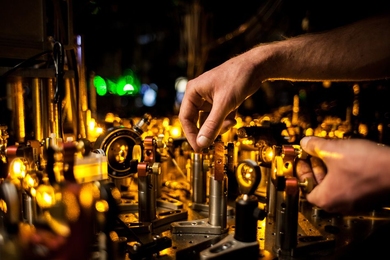
MIT team creates ultracold molecules At near absolute zero, molecules may start to exhibit exotic states of matter. June 10, 2015 Read full story →
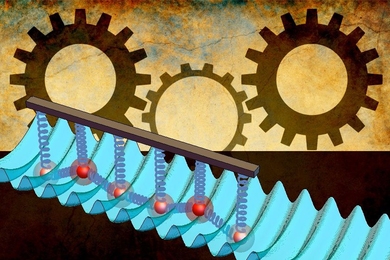
Vanishing friction In tuning friction to the point where it disappears, technique could boost development of nanomachines. June 4, 2015 Read full story →
A check on runaway lake drainage Draining lakes are unlikely to increase the Greenland ice sheet’s contribution to sea-level rise. June 3, 2015 Read full story →
A new tool measures the distance between phonon collisions Tabletop setup provides more nuanced picture of heat production in microelectronics. June 1, 2015 Read full story →
Circular orbits identified for small exoplanets Observations of 74 Earth-sized planets around distant stars may narrow field of habitable candidates. June 1, 2015 Read full story →
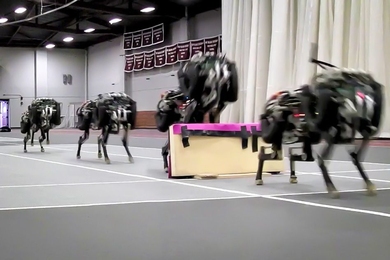
MIT cheetah robot lands the running jump Robot sees, clears hurdles while bounding at 5 mph. May 29, 2015 Read full story →
Researchers build new fermion microscope Instrument freezes and images 1,000 individual fermionic atoms at once. May 13, 2015 Read full story →
Plugging up leaky graphene New technique may enable faster, more durable water filters. May 8, 2015 Read full story →
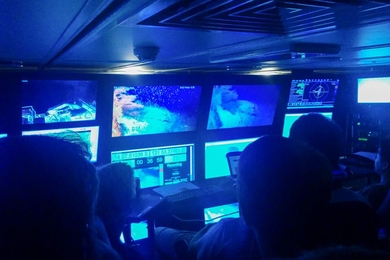
MIT engineers hand “cognitive” control to underwater robots With MIT-developed algorithms, robots plan underwater missions autonomously. May 6, 2015 Read full story →
Tracing the evolution of a landscape Geologist Taylor Perron explores river networks on Earth and beyond. May 6, 2015 Read full story →
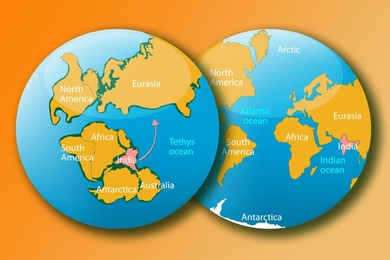
India drift MIT researchers explain mystery of India’s rapid move toward Eurasia 80 million years ago. May 4, 2015 Read full story →
A memorial built “with big hearts, and all love” Inspired by an open hand, newly dedicated Collier Memorial opens a gateway to the MIT campus. April 29, 2015 Read full story →
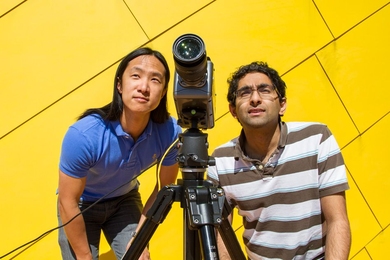
Magnifying vibrations in bridges and buildings Researchers apply computer vision technique to see tiny vibrations in large structures. April 23, 2015 Read full story →