
Longstanding problem put to rest
Proof that a 40-year-old algorithm is the best possible will come as a relief to computer scientists.
Proof that a 40-year-old algorithm is the best possible will come as a relief to computer scientists.
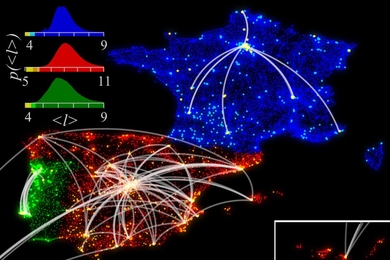
New research finds urban social networks are not determined geographically, but socially.

At near absolute zero, molecules may start to exhibit exotic states of matter.

Teen offenders who serve time finish school less often, become repeat offenders more often.

New book argues that economic development is a special case of the growth of information.

Prototype boosts production of versatile fibers fourfold, while cutting energy consumption by 92 percent.

Cycling of nitrous oxide, a potent greenhouse gas, is more intense than thought, and emissions are increasing.

In tuning friction to the point where it disappears, technique could boost development of nanomachines.

Process that allows brains to learn and remember also leads to degeneration with age.

Draining lakes are unlikely to increase the Greenland ice sheet’s contribution to sea-level rise.

Algorithm for planning multirobot collaborations makes complex models practical.

Senior biology and chemistry major Daniel Zhang helps build noninvasive cancer diagnostic tools.

Stretchable, biocompatible hydrogels with complex patterning could be used in tissue engineering.

Tabletop setup provides more nuanced picture of heat production in microelectronics.

Observations of 74 Earth-sized planets around distant stars may narrow field of habitable candidates.