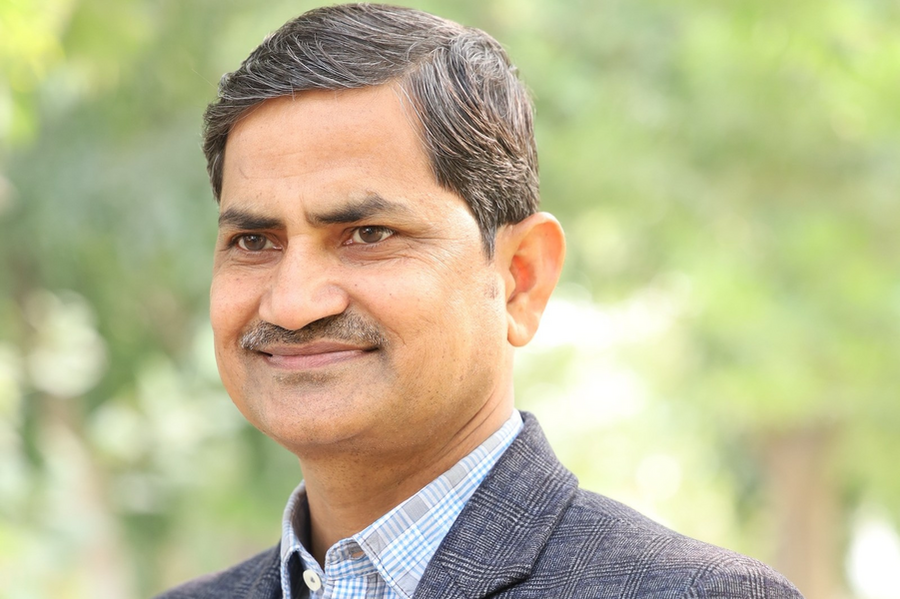
Mohammad Imran Khan Mewati teaches grades 6-12 at a school in rural India. His students are largely from economically disadvantaged families, and the school itself has limited resources. But the biggest problem, he says, is absenteeism.
“If a student is not coming into your class, how are you going to teach?” says Mewati, a teacher for 26 years. “That’s why I’m using technology in my classroom and outside the classroom, so that they can learn a little bit using their smartphones.”
MIT Open Learning’s free educational resources have been a boon for Mewati as he develops Hindi-language digital resources for his students.
“I am a self-taught app developer,” he explains. “MIT Open Learning has had a deep and practical impact on my professional life as a teacher. Many concepts I learned influenced how I design digital learning activities, simple educational games, and classroom strategies. My students may not know they are indirectly benefiting from MIT, but they are.”
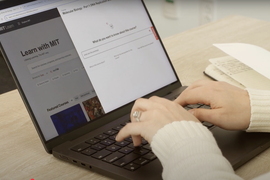
Through MIT Open Learning, Mewati has used in his classroom OpenCourseWare’s free, online library of educational resources from more than 2,500 courses spanning the MIT undergraduate and graduate curriculum. Learners can browse content at their own pace, watch lectures, read course notes, and hear from faculty experts. All materials can be downloaded for offline use, and the website is fully responsive for smartphone use. These materials are also available on MIT Learn, an AI-enabled platform for all of MIT’s lifelong learning opportunities.
Mewati started using OpenCourseWare resources in the early 2010s and cites programming courses as the most useful. He dove deep into Introduction to CS and Programming Using Python, Introduction to C and C++, and Introduction to Programming Using Java. Introduction to Computational Thinking helped him bring together problem-solving approaches from mathematics and computer science as he built apps.
Closing the gap with technology
Mewati’s school is located 15 miles from the city of Alwar in Rajasthan, a state in northwestern India. Most of the students do not have access to desktop or laptop computers, but the majority live in a home where at least one person has a smartphone. Taking advantage of this technology, Mewati creates classroom groups on WhatsApp so that he can share resources with his students, regardless of whether they can make it to class.
Mewati began incorporating technology into his teaching in the early 2010s, when he had to engage 180 students in a lesson about the moon landing and Neil Armstrong. Mewati created a simple HTML page that included many iconic images — the American flag planted on the moon, the Apollo 11 spacecraft, the footprint on the moon’s surface — with Hindi explanations. Once he created it, he could use it again and again. When he tested students on what they’d learned, they got better results than when he’d taught the material using his previous approach.
“This is the incident that confirmed to me that technology can play an important role in the lives of the students, and particularly for the rural students, for the students who do not have equal opportunities,” says Mewati. “Technology is the equalizer.”
That belief has driven Mewati’s efforts to build his school’s technological resources. Through crowdfunding, he secured 15 used computers to create a computer lab, and teachers now share the responsibility for creating mobile hotspots so students can connect to the internet. Mewati’s mobile apps provide additional opportunities for students to explore topics in greater depth or catch up on lessons they may have missed.
Referring to his apps as his favorite topic, Mewati explains that he has developed several types to meet a variety of goals. Some allow students to play games that develop their math skills, while others include syllabi, reading recommendations, and class notes. Other apps help students prepare for exams required for government jobs. He also builds apps for audiences beyond his school, such as an app that provides Hindi-language resources related to maternal health, a topic he says is not openly discussed in India. The app has been popular, he explains, because it provides honest information that people can view privately.
“If I see an issue, I think, ‘Yes, let’s create an app,’” he says.
Collaboration, open sharing, and lifelong learning
Mewati shares the apps he has created, and the MIT Open Learning resources that support him, with a network of teachers across India. He has connected with other educators through India’s National Teacher Awards and earlier this year, he traveled to Dubai for the Global Teacher Prize.
“We share things with each other,” he says. “We have a huge group — more than 1,000 teachers connected across India. So, if we see resources, or useful things for a class, we’ll share. All the time, I talk about open-source materials, like MIT courses, for educational purposes.”
Through this culture of collaboration and open sharing, Mewati is able to bring new learning opportunities to his students. The apps he has built — made possible by what he has learned through MIT Open Learning — help extend access to educational resources beyond the classroom. As an educator, he says he’s happy about that. But he is also a learner, and it’s his journey as a learner that he wants people to know.
“I am from a rural area. My parents are not educated at all. And I am a Fulbright Scholar. I can reach the Global Teacher Prize stage. The reason is simple,” he says. “It is because I continued my learning, whenever possible, with the use of technology and availability of free courses from MIT.”
To anyone who is curious, who wants to learn, to push themselves or build something new, he says that with MIT Open Learning, the resources are out there.
“We should use it, we should grab it, and we should share it as much as we can,” says Mewati. “Because that’s how humanity can flourish.”