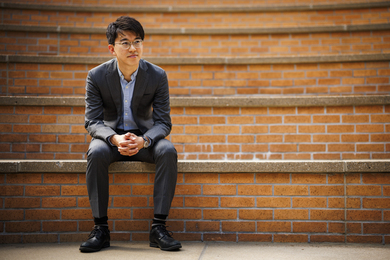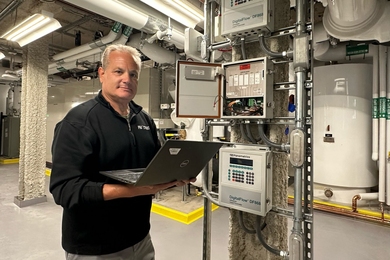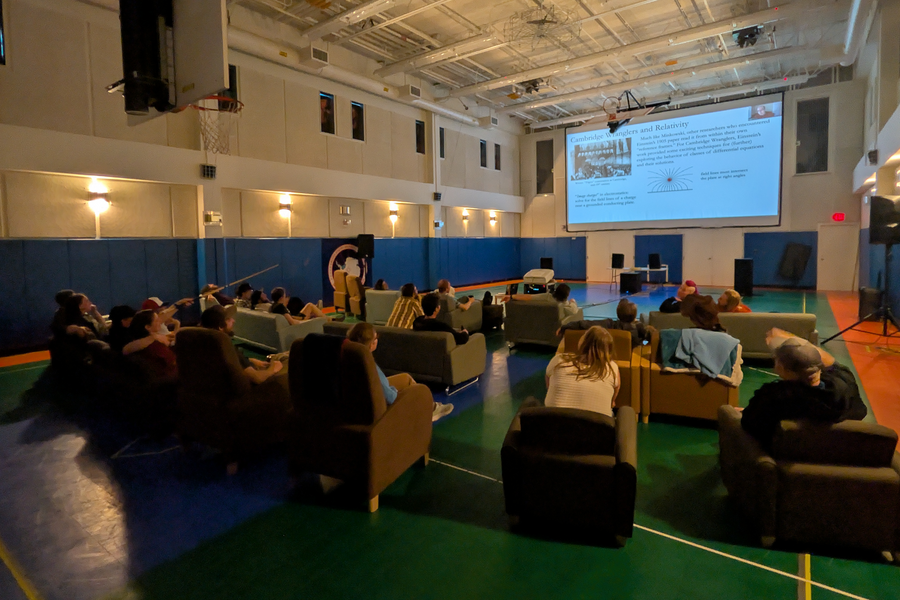
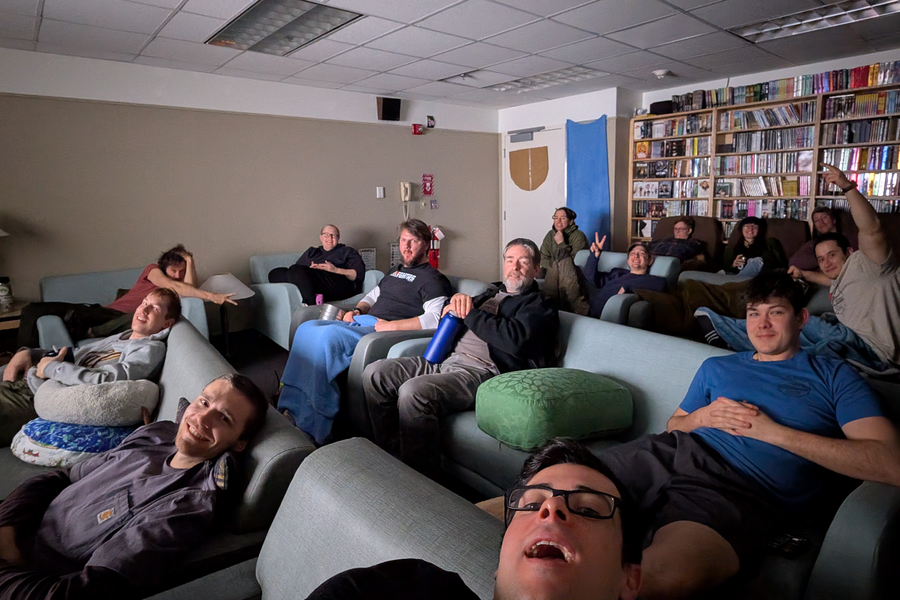
From the icy expanse of the South Pole, John Della Costa, a researcher on the Background Imaging of Cosmic Extragalactic Polarization (BICEP) project, watches STS.042/8.225 (Einstein, Oppenheimer, Feynman: Physics in the 20th Century), a free online class from MIT Open Learning’s OpenCourseWare, as part of a weekly “Fysics Fridays” series he started with his team.
MIT Professor David Kaiser, who teaches the course, often receives thoughtful notes from remote learners, but says an email from Della Costa stood out.
“Hearing that John and his team are spending a part of their time with this course was just the best message to receive,” says Kaiser.
The BICEP collaboration uses a series of radio telescopes at the South Pole to study the cosmic microwave background — the oldest light, emitted about 380,000 years after the start of the universe. The team is looking for signs of primordial gravitational waves, which would help to support MIT Professor Alan Guth’s theory of cosmic inflation that explains the rapid early expansion of the universe.
“Inflation is really important in making sense of our observations of our universe,” says Della Costa. “We have yet to discover the evidence for inflation that definitively proves that it did happen, and BICEP’s main role here at the South Pole is to discover gravitational waves from the very early universe.”
Kaiser co-directs a research group on early-universe cosmology with Guth. He says he has colleagues who have worked as Antarctica winter-overs, and can appreciate the immense challenge of this work.
“It’s very exciting to see this important research flourishing,” says Kaiser. “It takes enormous effort and dedication.”
Bringing Open Learning to the South Pole
Della Costa first discovered MIT OpenCourseWare, part of MIT Open Learning, as a graduate student at San Diego State University. At the time, the Covid-19 pandemic had altered his schedule and created more downtime to pursue additional independent learning. He was taking a nuclear physics course as part of his graduate program in astrophysics, and wanted to learn much more about the topic. A little bit of online research led to his discovery of class 22.01 (Introduction to Nuclear Engineering and Ionizing Radiation), taught by Professor Michael Short.
“I found the course so interesting, and I’ve been exploring OpenCourseWare ever since then,” says Della Costa.
Preparing to spend an entire year at the South Pole (from November 2025 to December 2026), he realized he would need a productive way to occupy his downtime and stay entertained while isolated from much of the world.
“The station is completely isolated. After a certain point, no planes can fly in because it’s too cold,” says Della Costa. “The station closed on February 14, and it will reopen at the end of October or early November, depending on the weather.”
Because internet access is so limited at the South Pole, he downloaded several courses ahead of time, including: STS.042/8.225, 8.02 (Physics II: Electricity and Magnetism), 8.03 (Physics III: Vibrations and Waves), and Guth’s course, 8.286 (The Early Universe).
Like Della Costa’s discovery of OpenCourseWare, STS.042/8.225 was rooted in the disruptive days of the Covid-19 pandemic. Kaiser had taught the course in its traditional, in-person format many times, until fall 2020, when the courses needed to be taught entirely remotely. He made slides and taught the course via Zoom — for synchronous and asynchronous learning — to approximately 100 students located throughout the world. The materials were initially posted on the course site. The online version was later refined and expanded, launching on OpenCourseWare in August 2022. Unlike many physics offerings, this course includes background readings by physicists, as well as historians, philosophers, and sociologists.
“In this course, we get to talk about some really amazing ideas from modern physics,” says Kaiser. “We start in the middle of the 19th century, still in an era of what we would now call classical physics, and we rapidly go through things like relativity, quantum theory, nuclear physics, and particle physics. We end up with some of my favorite material about cosmology and the Big Bang — the kinds of things that John and his team are actively working on right now from their perch at the South Pole.”
Building community and learning together
Beyond finding ways to stay occupied during downtime from his research, Della Costa realized the importance of engaging the 45-person community at the South Pole. He describes it as a tight-knit group that needs to work together and look out for one another, especially given the extreme isolation, cold, and darkness, which can take a serious toll on mental health during the winter months.
“It’s very important to have community activities here,” says Della Costa, who thought of the idea to launch the “Fysics Fridays” series a couple of months ago.
The group gathers to watch lectures and documentaries about physics every Friday. The series kicked off with a documentary about atomic bombs, drawing strong interest from the very beginning.
Della Costa realized that STS.042/8.225 would be an ideal offering for Fysics Fridays.
“I thought this would be a perfect lecture series for us to watch, because it’s fairly introductory,” says Della Costa. “Not everyone here is a physicist, actually. It’s widely accessible, but still meaty, and worth people’s time to watch.”
Team members have been very interested in watching the course, and they’ve also started doing experiments before watching the lectures. Della Costa says that they’ve done the double-slit experiment and plan to also make a cloud chamber to see cosmic rays going through it.
Now that Della Costa and Kaiser are in contact, Kaiser has made plans to provide a special Zoom colloquium for the community at the South Pole.
“This use of the course is especially inspiring,” says Kaiser. “It really speaks to the excellence and far reach of OpenCourseWare and Open Learning.”