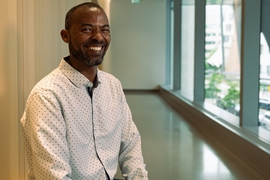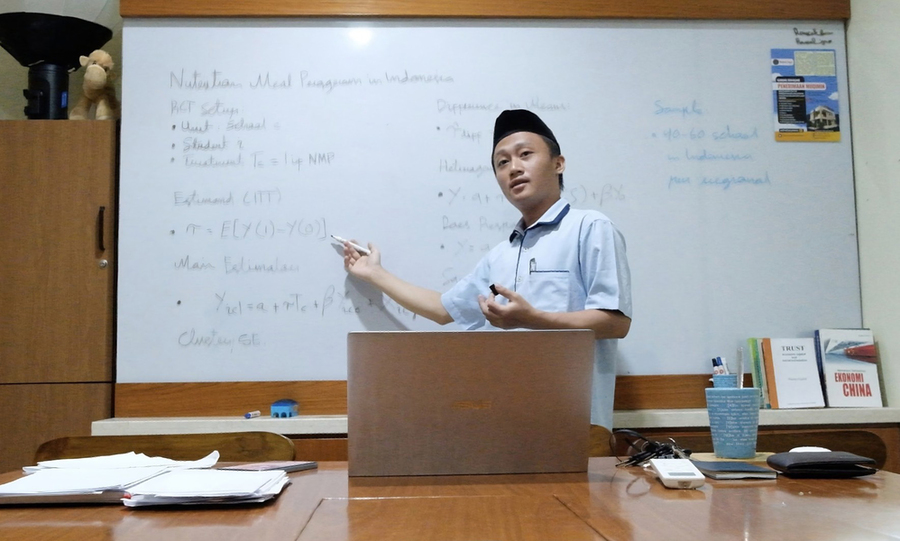
Through the MITx MicroMasters Program in Data, Economics, and Design of Policy, Munip Utama strengthened the skills he was already applying in his work with Baitul Enza, a nonprofit helping students in need via policy-shaping research and hands-on assistance.
Utama’s commitment to advancing education for underprivileged students stems from his own background. His father is an elementary school teacher in a remote area and his mother has passed away. While financial hardship has always been a defining challenge, he says it has also been the driving force behind his pursuit of education. With the assistance of special programs for high-achieving students, Utama attended top schools and completed his bachelor’s degree in economics at UIN Jakarta — becoming the second person in his family to earn a university degree.
Utama joined Baitul Enza two months before graduation, through a faculty-led research project, and later became its manager, leading its programs and future development. In this interview, he describes how his experiences with the MicroMasters Program in Data, Economics, and Design of Policy (DEDP), offered by the Abdul Latif Jameel Poverty Action Lab (J-PAL) and MIT Open Learning, are shaping his education, career, and personal mission.
Q: What motivated you to pursue the MITx MicroMasters Program in Data, Economics, and Design of Policy?
A: I was seeking high-quality, evidence-based courses in economics and development. I needed rigorous training in data analysis, economic reasoning, and policy design to strengthen our interventions at Baitul Enza. The MITx MicroMasters Program in Data, Economics, and Design of Policy offered exactly that: a curriculum grounded in real-world problem-solving, aligned with the challenges I face in Indonesia.
I deeply admire MIT’s commitment to transforming teaching and learning not only through innovation, but also through empathy. The DEDP program exemplifies this mission: It connects theory with practice, allowing learners like me to apply analytical tools directly to real development challenges. This approach has inspired me to adopt the same philosophy in my own teaching and mentoring, encouraging students to use data and critical thinking to solve problems in their communities.
Q: What have you gained from the MITx DEDP program?
A: The DEDP courses have provided me with rigorous analytical and quantitative training in data analysis, economics, and policy design. They have strengthened both my research and mentorship abilities by teaching me to approach poverty and inequality through evidence-based frameworks. My experience conducting independent and collaborative research projects has informed how I mentor students, guiding them to carry out their own evidence-based research projects. I continue to seek further academic dialogue to broaden my understanding and prepare for future graduate studies.
Another key component has been the program’s financial assistance offers. Even with DEDP’s personalized income-based course pricing, financial constraints remain a significant challenge for me, and Baitul Enza operates entirely on donations and volunteer support. The scholarships administered by DEDP have been crucial in enabling me to continue my studies. It has allowed me to focus on learning without the constant burden of financial insecurity, while staying committed to my mission of breaking cycles of poverty through education.
Q: How are you applying what you’ve learned from MIT Open Learning’s MITx programs, and how will you use what you’ve learned going forward?
A: The DEDP program has transformed how I lead Baitul Enza. I now apply data-driven and evidence-based approaches to program design, monitoring, and evaluation — enhancing cost-effectiveness and long-term impact. The program has enabled me to design case-based learning modules for students, where they analyze real-world data on poverty and education; mentor youth researchers to conduct small-scale projects using evidence-based methods; and improve program cost-effectiveness and outcome measurement to attract collaborators and government support.
Coming from a lower-middle-class family with limited access to education, MIT Open Learning has opened doors I never imagined possible. It has reaffirmed my belief that education, grounded in data and empathy, can break the cycle of poverty. The DEDP program continues to inspire me to mentor young researchers, empower disadvantaged students, and build a community rooted in evidence-based decision-making.
With the foundation built by MITx, I aim to produce policy-relevant research and scale up Baitul Enza’s impact. My long-term vision is to generate experimental evidence in Indonesia on scalable education interventions, inform national policy, and empower marginalized youth to thrive. MITx has not only prepared me academically, but has also strengthened my resolve to lead with clarity, design with evidence, and act with purpose. Beyond my own growth, MITx has multiplied its impact by empowering the next generation of students to use data and evidence in solving local development challenges.