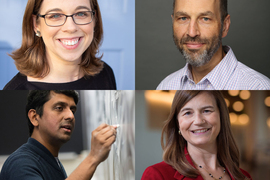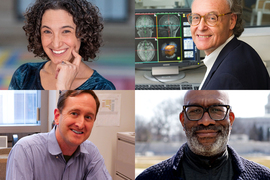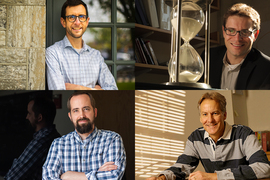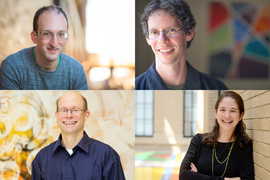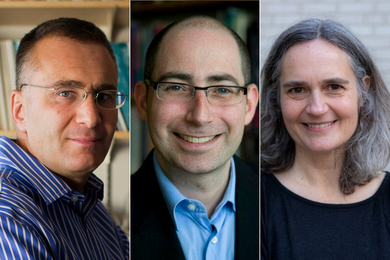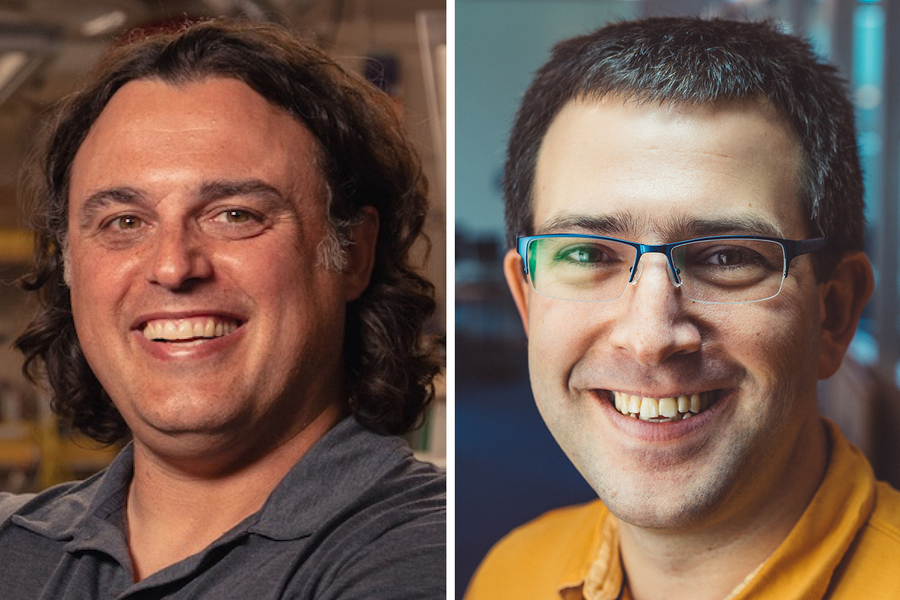
Two outstanding MIT educators have been named MacVicar Faculty Fellows: professor of mechanical engineering Amos Winter and professor of electrical engineering and computer science Nickolai Zeldovich.
For more than 30 years, the MacVicar Faculty Fellows Program has recognized exemplary and sustained contributions to undergraduate education at MIT. The program is named in honor of Margaret MacVicar, MIT’s first dean for undergraduate education and founder of the Undergraduate Research Opportunities Program (UROP). Fellows are chosen through an annual and highly competitive nomination process. The Registrar’s Office coordinates and administers the award on behalf of the Division of Graduate and Undergraduate Education. Nominations are reviewed by an advisory committee, and the provost selects the fellows.
Amos Winter: Bringing excitement to the classroom
Amos Winter is the Germeshausen Professor in the Department of Mechanical Engineering (MechE). He joined the faculty in 2012 and is best known for teaching class 2.007 (Design and Manufacturing I).
A hallmark of Winter’s pedagogy is the way he connects technical learning and core engineering science with real-world impacts. His approach keeps students actively engaged and encourages critical thinking while developing their competence and confidence as design engineers. Current graduate student Ariel Mobius ’24 writes, “Professor Winter is a transformative educator. He successfully blends rigorous technical instruction with lessons on problem scoping and hands-on learning and backs it all up with personalized mentorship. He is a committed advocate for his students and has fundamentally shaped my path as a mechanical engineer.”
Especially notable is Winter’s energetic style and use of interactive materials and demonstrations to make fundamental topics tangible. “He wheels in a large steamer trunk filled with demos he has built or collected to illustrate the day’s topic,” writes Class of 1948 Career Development Professor and assistant professor of mechanical engineering Kaitlyn Becker. “Some demos are enduring classics and others newly designed each year.” Through his “Gearhead Moment of Zen” Winter will share an astonishing car stunt to explain the mechanics using course material. “The theatrics stay in students’ minds,” says Becker, highlighting how Winter’s dramatic examples reinforce learning.
These techniques, combined with a supportive culture, allowed Winter to transform 2.007 from a core class and first subject in engineering design into a celebration of student effort and learning. Throughout the term, students learn how to design and build objects culminating in a robot competition in which their creations tackle themed challenges on a life-size game board. In the past, fewer than half the students were able to compete and today, boosted by Winter’s mentorship and enthusiasm, nearly 97 percent finish a competition-ready robot.
Ralph E. and Eloise F. Cross Professor of Mechanical Engineering David Hardt writes, “Thanks to Amos, this subject has become transformative for many MechE undergraduates.” Becker concurs: “He is the heart and captain of the 2.007 ‘cheer squad,’ cultivating a caring and motivated teaching team.”
Current graduate student Aidan Salazar ’25 notes, “His teaching philosophy is grounded in empowerment: he encourages students to take risks when designing while giving them the confidence and support needed to do so with thoughtful engineering analysis.”
Winter is also deeply invested in students’ growth outside the classroom. He serves as faculty supervisor for MIT’s Formula SAE (Society of Automotive Engineers) and Solar Car teams and guides related UROP projects. In fall 2025 alone, he advised nearly 50 UROP students from the teams, demonstrating his commitment to experiential learning and ability to mentor students at scale.
Salazar continues: “He has offered extraordinary contributions in helping MIT undergraduates embody the Institute’s ‘mens-et-manus’ [‘mind-and-hand’] motto, and I am grateful to be one of the individuals shaped by his teaching.”
“I have always looked up to my colleagues who are MacVicar Fellows as the best educators at the Institute,” writes Winter. “What makes this acknowledgement even more special to me is by earning it from teaching 2.007, which I often cite as one of the best parts of my job. The class is where most mechanical engineering undergraduates gain their first real engineering experience by physically realizing a machine of their own conception. It has been extremely gratifying to watch a generation of students translate their knowledge of engineering and design from the class into their careers … I am honored to have played a role in their intellectual growth and done so meaningfully enough to be recognized as a MacVicar Fellow.”
Nickolai Zeldovich: Inspiring independent thinkers and future teachers
Nickolai Zeldovich is the Joan and Irwin M. (1957) Jacobs Professor of Electrical Engineering and Computer Science (EECS). Student testimonials highlight his unique ability to activate their problem-solving skills, cultivate their intellectual curiosity, and infuse learning with joy.
Katarina Cheng ’25 writes, “From my first day of lecture in the course, I was immediately drawn in by Professor Zeldovich’s joy and enthusiasm for every facet of security and its power,” and Rotem Hemo ’17, ’18 says that Zeldovich “empowers students to find solutions themselves.”
Yael Tauman Kalai, the Ellen Swallow Richards (1873) Professor and professor of EECS concurs. She notes that his lectures — with back-and-forth discussion and probing questions — encourage independent thinking and ensure that “everyone feels a little smarter at the end. It is not surprising that students love him.”
Zeldovich’s affinity for problem-solving translates to his curricular work as well. When he arrived at MIT in 2008, Course 6 offered classes in theoretical and applied cryptography, but lacked a dedicated systems security subject. Recognizing this as a significant gap, Zeldovich took it upon himself to create class 6.566/6.858 (Computer Systems Security) in 2009. Since then, the subject has become a central part of the curriculum, but sustained interest from undergraduates revealed another need, and in 2021 he partnered with colleagues to create a dedicated introductory course: 6.1600 (Foundations of Computer Security).
Edwin Sibley Webster Professor of EECS Srini Devadas writes: “What our curriculum was sorely in need of was a systems security class, and Nickolai immediately and single-handedly created [it],” and has “taught this class to rave reviews ever since.”
The impact of Zeldovich’s thoughtful, inquiry-driven approach to pedagogy extends beyond the walls of his classroom, inspiring future educators, teaching assistants (TAs), and even his faculty colleagues at MIT.
Henry Corrigan-Gibbs, the Douglas Ross (1954) Career Development Professor of Software Technology and associate professor of computer science, writes that Zeldovich has “proven himself to be a dedicated teacher of teachers … One of the things that makes teaching with Nickolai so much fun is that he shares his passion with the undergraduates and MEng students who join the course staff as TAs.”
“[He] encourages the TAs to contribute their own creative ideas to the course,” continues Corrigan-Gibbs. “It should not be a surprise then that 100% of the TAs that we have had in our class have signed up to teach with Nickolai again.”
“Due, in no small part, to how I saw Nickolai lead his classroom, I was inspired to become an educator myself,” writes MIT alumna Anna Arpaci-Dusseau ’23, SM ’24. “I saw that the role of an instructor is not only to teach, but to innovate by thinking of creative projects, and to connect by listening to students’ concerns. As I go forward in my career, I am grateful to have such a wonderful example of an educator to look up to.”
Kalai adds, “I have learned a great deal from the two times that I have ‘taken’ (part of) the class from Nickolai. His extensive knowledge and experience are evident in every lecture. There is so much variety to Nickolai’s teaching.”
Nickolai Zeldovich is the recipient of numerous awards including the EECS Spira Teaching Award (2013), the Edgerton Faculty Achievement Award (2014), the EECS Faculty Research Innovation Fellowship (2018), and the EECS Jamieson Award for Excellence in Teaching (2024).
On receiving this award, Zeldovich says, “MIT has a culture of strong undergraduate education, so being selected as a MacVicar Fellow was truly an honor. It’s a joy to teach smart students about computer systems, and the tradition of co-teaching classes in the EECS department helped me improve as a teacher. Most of all, I look forward to continuing to teach MIT’s students!”
Learn more about the MacVicar Faculty Fellows Program on the Registrar’s Office website.