
In late October 2025, Tropical Storm Melissa moved through the Caribbean Sea with moderate winds that didn’t get much attention. But on Oct. 25, aided by a patch of warm ocean, the storm rapidly intensified. By the time it made landfall in Jamaica, it was one of the strongest Atlantic hurricanes on record, uprooting trees, tearing the roofs from buildings, and causing catastrophic flooding and power outages.
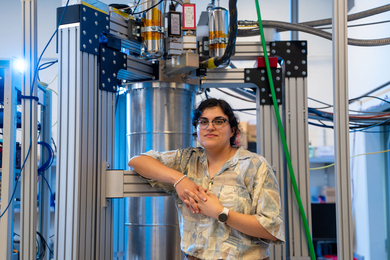
Ravi Pappu SM ’95, PhD ’01 blames the surprise on our inability to gather high-quality ocean data.
“The storm intensified because of a small pool of hot water in the Caribbean Ocean that fed it energy,” Pappu explains. “These pools are everywhere. They can be hundreds of kilometers wide and are literally invisible to us. If we knew about that pool, we could say very precisely how the hurricane would intensify and better deal with it.”
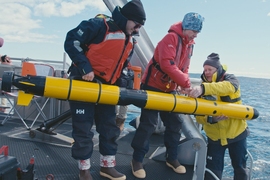
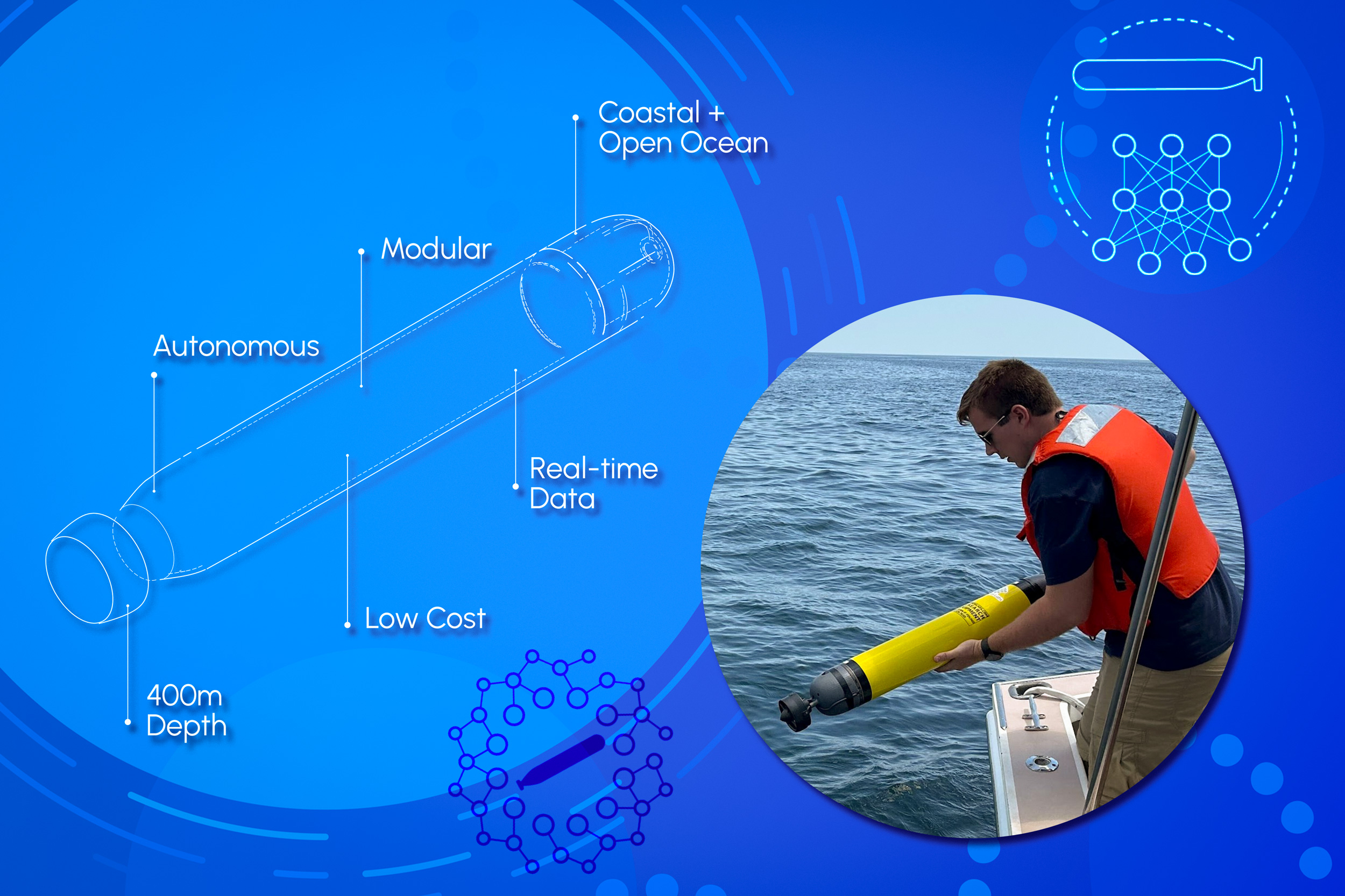
Pappu thinks he has a way to solve that problem. He is the founder of Apeiron Labs, a company deploying low-cost autonomous ocean sensors to capture more data, in more places, and at a lower cost than is possible today. The company’s devices roam the ocean up to a quarter mile below the surface and continuously gather data on temperature, acoustics, salinity, and more, providing a real-time look at one of the planet’s last known mysteries. He says the sensors can do for the ocean what small, modular CubeSat satellites did for Earth observation from space.
When the devices are ready to be recharged, trackers make it easy to scoop them from the ocean surface. Pappu envisions the recovery process being done by autonomous boats in the future.
“Humanity needs ocean measurements, and we need them at a scale that has never been attempted before,” Pappu says. “It’s a massively hard problem. In the last century, oceanographers resigned themselves to calling it the century of undersampling. If we are successful, we will have a much more fine-grained understanding of our oceans and how they impact humans. That’s what drives us.”
Homework
Pappu came to MIT after completing a 10-year homework assignment. It started when he was a child in India in the 1980s, when he saw a hologram on the cover of National Geographic for the first time.
“I was so taken by it that I decided I needed to learn how to make those three-dimensional images,” Pappu recalls. “I learned what I could by reading books and papers. I didn’t know who invented the hologram until I read a book about MIT’s Media Lab. The book named the person who invented the rainbow hologram, so I wrote him a letter. I didn’t know his address, so I just wrote on the envelope, ‘Steve Benton, holography researcher, MIT, USA.’”
To Pappu’s surprise, the letter reached Benton, and the former Media Lab professor even wrote back with some further topics he needed to learn about.
Pappu never forgot that. He earned a bachelor’s degree in electrical engineering in India, then earned his master’s degree at Villanova University, taking all the optics classes he could.
“Eventually, about 10 years after I saw my first hologram, I wrote to Steve and I said, ‘I did all these things you asked me, now I want to study with you,’” Pappu says. “That’s how I got into MIT.”
Pappu studied under Benton for the next three years. He also studied under Professor Neil Gershenfeld as part of his PhD. Following graduation, Pappu and four classmates started ThingMagic, a consulting company that eventually sold RFID readers. ThingMagic was acquired 2010. Pappu returned to MIT for two years as a visiting scientist around the time of the acquisition.
Following that experience, Pappu worked at In-Q-Tel, an organization that invested in ThingMagic and other companies with potential to advance national security. It was there that Pappu realized how badly the world needed large-scale, inexpensive ocean sensing.
“All of the ocean sensing up to that point, and even today, was about making a really expensive thing that cost $20 million, goes to the bottom of the ocean, and stays there for five years,” Pappu says. “We needed things that are cheap and scalable to deploy wherever you need them for as long as you want.”
Pappu officially founded Apeiron Labs in 2022.
“What we’re focused on is figuring out how the ocean works,” Pappu says. “How warm is it? What is the pH? How salty is it? These things vary from place to place every 10 kilometers or so. It varies over time, and it varies by season. If we knew the details of the ocean with the same fidelity we have for the atmosphere, we would be able to tell exactly when and where hurricanes hit. It would mean less uncertainty.”
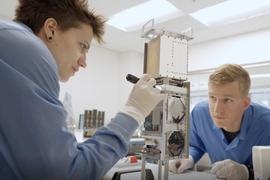
Apeiron’s ocean-sensing devices are each 3 feet long and about 20 pounds. They’re designed to be dropped off a boat or plane with biodegradable parachutes and stay in the ocean for six months. Each device continuously sends data to the cloud, is controllable through a cloud-based ocean operating system, and is accessible on a mobile phone.

“We lower the carbon footprint and cost of gathering ocean data because everything else needs a diesel ship — and a fully crewed ship costs $100,000 a day,” Rappu says. “By the time you collect the first data in the old model, you’ve already committed to a lot of money in addition to millions of dollars for the sensors. “
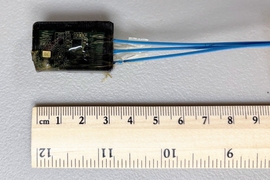
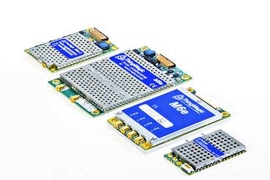
The company’s devices currently have two types of sensors: one for measuring salinity, temperature, and depth, and the other that uses a hydrophone to passively listen for things like submarines and whales.
That could be used to detect the low-frequency calls and clicks of endangered whales and other fish species. Currently, fishermen must look for whales manually with spotters on ships or planes. The data could also be used to improve weather forecasts, monitor noise from offshore energy projects, and track currents.
“Currents are determined by temperature and salinity, so if there’s an oil spill, our data could help determine where that spill is going,” Pappu says. “Or if you’re a fisherman, knowing where the water changes from warm to cold, which is where the fish hang out, is very useful.”
An ocean of possibilities
Apeiron Labs has worked with government defense agencies including the U.S. Navy over the last two years. The company has also tested its devices off the coast of California and in the Boston Harbor.
“The most important thing is, when we show people our approach and what we’ve demonstrated so far, they are no longer asking, ‘Can it be done?’ they’re asking, ‘What can we do with it?’” Pappu says. “Our customers have spent decades working in the ocean and they understand how novel these capabilities are.”
Of all the possibilities, improved storm forecasting could be the one Pappu is most excited about.
“Our mission is to lower the barriers to ocean data,” Pappu says. “The ocean is a huge determinant of weather, climate, and short-term forecasting. Despite our best efforts to predict the intensity of storms, sudden changes are still the norm, and much of that comes down to a lack of understanding of our oceans. If we were monitoring these things over long periods of time and finer spatial scales, we could see these storms coming much earlier with more certainty.”