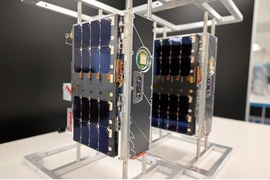
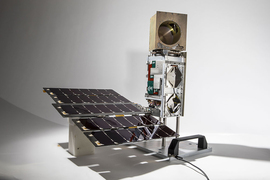
MIT Lincoln Laboratory has transformed weather intelligence by miniaturizing microwave sounders, instruments that measure Earth's atmospheric temperature, moisture, and water vapor. These instruments are 1/100th the size of traditional sounders aboard multibillion-dollar satellites, enabling them to fit on shoebox-sized CubeSats.
When deployed in a constellation, the CubeSats can observe rapidly intensifying storms near-hourly — providing fresh data to forecasting professionals during critical windows of storm development that have largely been undetectable by past remote-sensing technology.
Developed at Lincoln Laboratory, the mini microwave sounders were first demonstrated on NASA's TROPICS mission, which measured temperature and humidity soundings as well as precipitation. TROPICS concluded in 2025 with over 11 billion observations, providing scientists with key insights into tropical cyclone evolution.
Now the technology has been licensed by the commercial firm Tomorrow.io, allowing for the enhancement of global weather coverage for customers in aviation, logistics, agriculture, and emergency management. Tomorrow.io provides clients with hyperlocal forecasts around the globe and is set to launch their own constellation of satellites based on the TROPICS program. Says John Springman, Tomorrow.io's head of space and sensing: “Our overall goal is to fundamentally improve weather forecasts, and that'll improve our downstream products like our weather intelligence.”
Video by Tim Briggs/Lincoln Laboratory | 13 minutes, 58 seconds