When Freesia Gaul discovered MIT Open Learning’s OpenCourseWare at just 14 years old, it opened up a world of learning far beyond what her classrooms could offer. Her parents had started a skiing company, and the seasonal work meant that Gaul had to change schools every six months. Growing up in small towns in Australia and Canada, she relied on the internet to fuel her curiosity.
“I went to 13 different schools, which was hard because you're in a different educational system every single time,” says Gaul. “That’s one of the reasons I gravitated toward online learning and teaching myself. Knowledge is something that exists beyond a curriculum.”
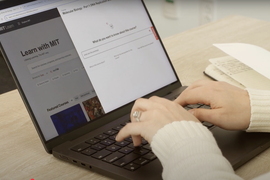
The small towns she lived in often didn’t have a lot of resources, she says, so a computer served as a main tool for learning. She enjoyed engaging with Wikipedia, ultimately researching topics and writing and editing content for pages. In 2018, she discovered MIT OpenCourseWare, part of MIT Open Learning, and took her first course. OpenCouseWare offers free, online, open educational resources from more than 2,500 MIT undergraduate and graduate courses.
“I really got started with the OpenCourseWare introductory electrical engineering classes, because I couldn’t find anything else quite like it online,” says Gaul, who was initially drawn to courses on circuits and electronics, such as 6.002 (Circuits and Electronics) and 6.01SC (Introduction to Electrical Engineering and Computer Science). “It really helped me in terms of understanding how electrical engineering worked in a practical sense, and I just started modding things.”
In true MIT “mens et manus” (“mind and hand”) fashion, Gaul spent much of her childhood building and inventing, especially when she was able to access a 3D printer. She says that a highlight was when she built a life-sized, working version of a Mario Kart, constructed out of materials she had printed.
Gaul calls herself a “serial learner,” and has taken many OpenCourseWare courses. In addition to classes on circuits and electronics, she also took courses in linear algebra, calculus, and quantum physics — in which she took a particular interest.
When she was 15, she participated in Qubit by Qubit. Hosted by The Coding School, in collaboration with universities (including MIT) and tech companies, this two-semester course introduces high schoolers to quantum computing and quantum physics.
During that time she started a blog called On Zero, representing the “zero state” of a qubit. “The ‘zero state’ in a quantum computer is the representation of creativity from nothing, infinite possibilities,” says Gaul. For the blog, she found different topics and researched them in depth. She would think of a topic or question, such as “What is color?” and then explore it in great detail. What she learned eventually led her to start asking questions such as “What is a hamiltonian?” and teaching quantum physics alongside PhDs.
Building on these interests, Gaul chose to study quantum engineering at the University of New South Wales. She notes that on her first day of university, she participated in iQuHack, the MIT Quantum Hackathon. Her team worked to find a new way to approximate the value of a hyperbolic function using quantum logic, and received an honorable mention for “exceptional creativity.”
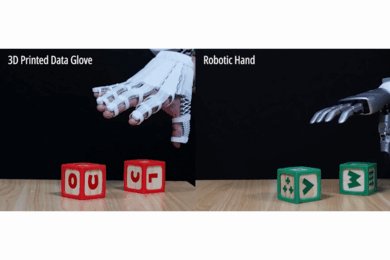
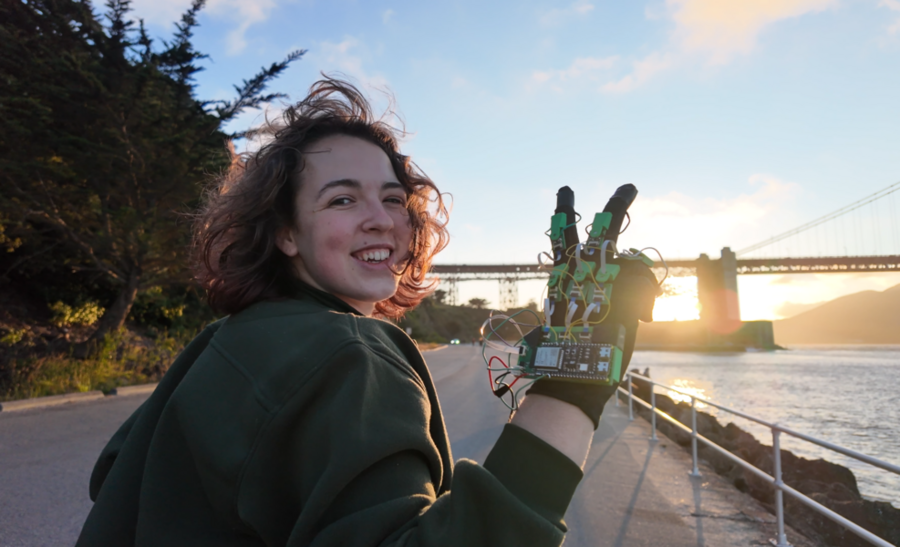
Gaul’s passion for making things continued during her college days, especially in terms of innovating to solve a problem. When she found herself on a train, wanting to code a personal website on a computer with a dying battery, she wondered if there might be a way to make a glove that can act as a type of Bluetooth keyboard — essentially creating a way to type in the air. In her spare time, she started working on such a device, ultimately finding a less expensive way to build a lightweight, haptic, gesture-tracking glove with applications for virtual reality (VR) and robotics.
Gaul says she has always had an interest in VR, using it to create her own worlds, reconstruct an old childhood house, and play Dungeons and Dragons with friends. She discovered a way to put into a glove some small linear resonant actuators, which can be found in a smartphone or gaming controller, and map to any object in VR so that the user can feel it.
An early prototype that Gaul put together in her dorm room received a lot of attention on YouTube. She went on to win the People’s Choice award for it at the SxSW Sydney 2025 Tech and Innovation Festival. This design also sparked her co-founding of the tech startup On Zero, named after her childhood blog dedicated to the love of creation from nothing.
Gaul sees the device, in general, as a way of “paying it forward,” making improved human-computer interaction available to many — from young students to professional technologists. She hopes to enable creative freedom in as many as she can. “The mind is just such a fun thing. I want to empower others to have the freedom to follow their curiosity, even if it's pointless on paper.
“I’ve benefited from people going far beyond what they needed to do to help me,” says Gaul. “I see OpenCourseWare as a part of that. The free courses gave me a solid foundation of knowledge and problem-solving abilities. Without these, it wouldn’t be possible to do what I’m doing now.”