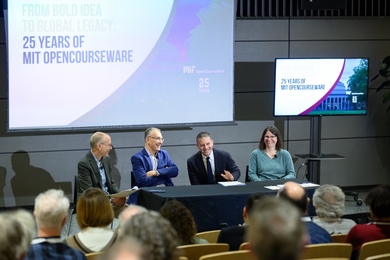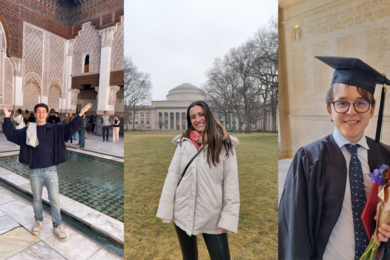
Teen builds an award-winning virtual reality prototype thanks to free MIT courses
Nineteen-year-old Freesia Gaul built a VR prototype thanks to MIT OpenCourseWare classes that provided “a solid foundation of knowledge and problem-solving abilities.”
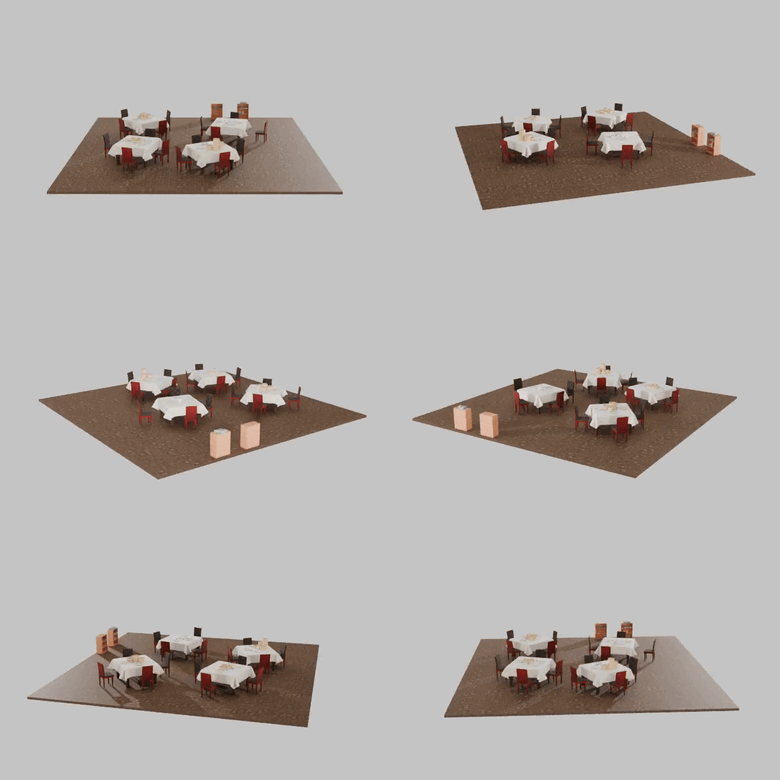
New tool from MIT CSAIL creates realistic virtual kitchens and living rooms where simulated robots can interact with models of real-world objects, scaling up training data for robot foundation models.
The flexible chip could boost the performance of current electronics and meet the more stringent efficiency requirements of future 6G technologies.
Ukrainian students and collaborators provide high-quality translations of MIT OpenCourseWare educational resources.
The 17-year-old student from Spain uses MIT resources to deepen her understanding of math and physics.
The MIT Festival of Learning sparked discussions on better integrating a sense of purpose and social responsibility into hands-on education.
In a new MIT course co-taught by EECS and philosophy professors, students tackle moral dilemmas of the digital age.
Researchers have developed a web plug-in to help those looking to protect their mental health make more informed decisions.
As a child, a civil war drove Mlen-Too Wesley out of Liberia. As an adult, he has returned and is applying what he learned in an MITx MicroMasters program to help the West African nation thrive.
Developed by MIT RAISE, the Day of AI curriculum empowers K-12 students to collaborate on local and global challenges using AI.
The MITx MicroMasters in Data, Economics, and Design of Policy program educates learners around the world using its data-driven approach to poverty alleviation.
The Trustnet browser extension lets individuals assess the accuracy of any content on any website.
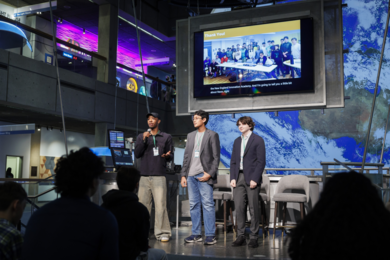
At MIT’s Festival of Learning 2024, panelists stressed the importance of developing critical thinking skills while leveraging technologies like generative AI.
Programming course for incarcerated people boosts digital literacy and self-efficacy, highlighting potential for reduced recidivism.
Lincoln Laboratory–developed Timely Address Space Randomization (TASR) was transferred to two commercial providers of cloud-based services.