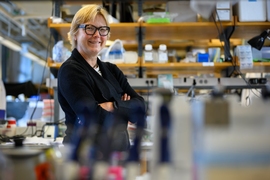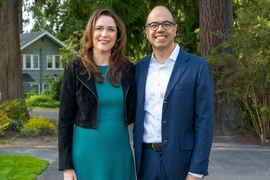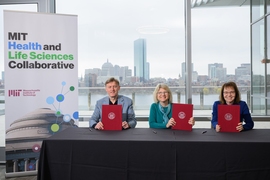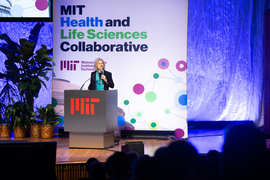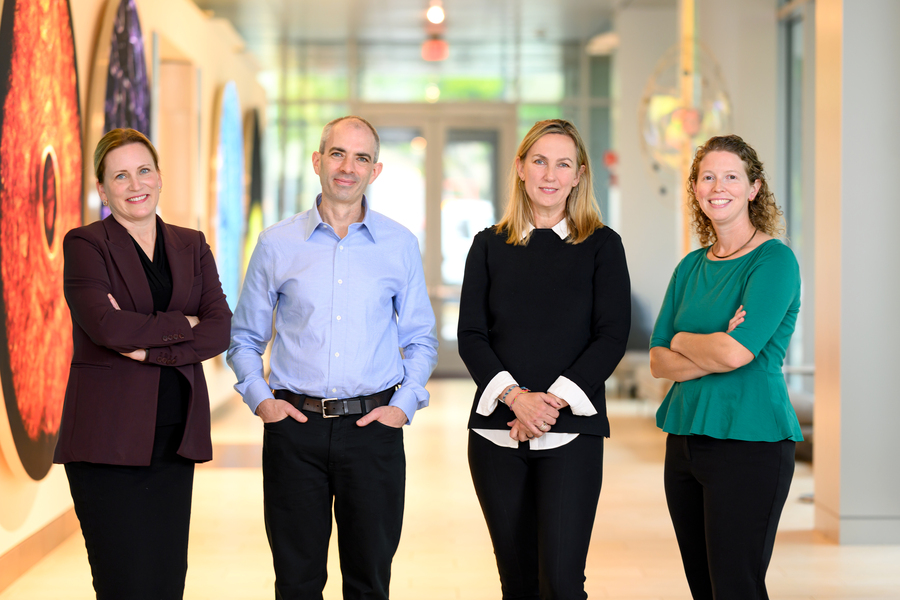
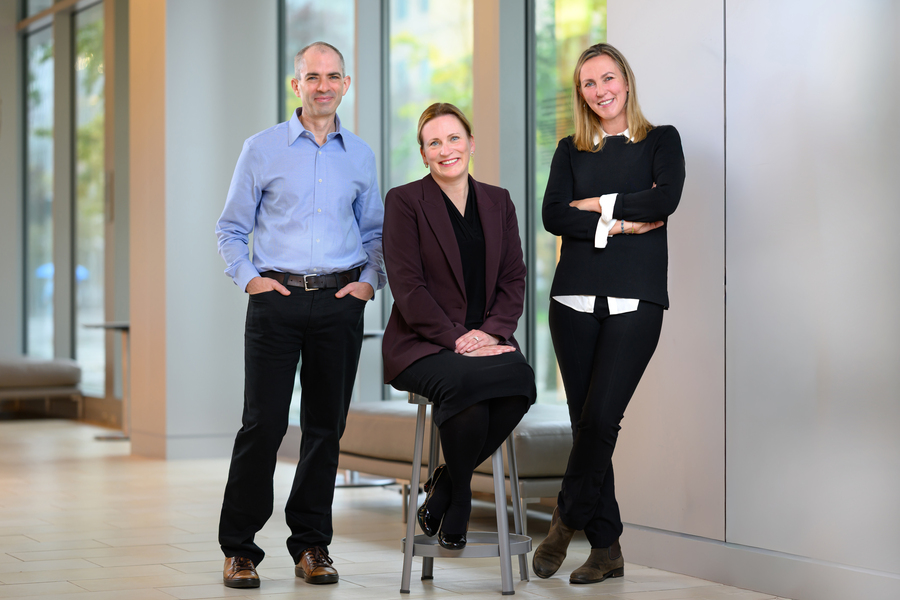
In February, President Sally Kornbluth announced the appointment of Professor Angela Koehler as faculty director of the MIT Health and Life Sciences Collaborative (MIT HEALS), with professors Iain Cheeseman and Katharina Ribbeck as associate directors. Since then, the leadership team has moved quickly to shape HEALS into an ambitious, community-wide platform for catalyzing research, translation, and education at MIT and beyond — at a moment when advances in computation, biology, and engineering are redefining what’s possible in health and the life sciences.
Rooted in MIT’s long-standing strengths in foundational discovery, convergence, and translational science, HEALS is designed to foster connections across disciplines — linking life scientists and engineers with clinicians, computational scientists, humanists, operations researchers, and designers. The initiative builds on a simple premise: that solving today’s most pressing challenges in health and life sciences requires bold thinking, deep collaboration, and sustained investment in people.
“HEALS is an opportunity to rethink how we support talent, unlock scientific ideas, and translate them into impact,” says Koehler, the Charles W. and Jennifer C. Johnson Professor in the Department of Biological Engineering and associate director of the Koch Institute for Integrative Cancer Research. “We’re building on MIT’s best traditions — convergence, experimentation, and entrepreneurship — while opening new channels for interdisciplinary research and community building.”
Koehler says her own path has been shaped by that same belief in convergence. Early collaborations between chemists, engineers, and clinicians convinced her that bringing diverse people together — what she calls “induced proximity” — can spark discoveries that wouldn’t emerge in isolation.
A culture of connection
Since stepping into their roles, the HEALS leadership team has focused on building a collaborative ecosystem that enables researchers to take on bold, interdisciplinary challenges in health and life sciences. Rather than creating a new center or department, their approach emphasizes connecting the MIT community across existing boundaries — disciplinary, institutional, and cultural.
“We want to fund science that wouldn’t otherwise happen — projects that bridge gaps, open new doors, and bring researchers together in ways that are genuinely constructive and collaborative,” says Iain Cheeseman, the Herman and Margaret Sokol Professor of Biology, core member of the Whitehead Institute for Biomedical Research, and associate head of the Department of Biology.
That vision is already taking shape through initiatives like the MIT HEALS seed grants, which support bold new collaborations between MIT principal investigators; the MIT–Mass General Brigham Seed Program, which supports joint research between investigators at MIT and clinicians at MGB; and the Biswas Postdoctoral Fellowship Program, designed to bring top early-career researchers to MIT to pursue cross-cutting work in areas such as computational biology, biomedical engineering, and therapeutic discovery.
The leadership team sees these programs not as endpoints, but as starting points for a broader shift in how MIT supports health and life sciences research.
For Cheeseman, whose lab is working to build on their fundamental discoveries on how human cells function to impact cancer treatment and rare human disease, HEALS represents a way to connect deep biological discovery with the translational insights emerging from MIT’s engineering and clinical communities. He puts it simply: “to me, this is deeply personal, recognizing the limitations that existed for my own work and hoping to unlock these possibilities for researchers across MIT.”
Training the next generation
Ribbeck, a biologist focused on mucus and microbial ecosystems, sees HEALS as a way to train scientists who are as comfortable discussing patient needs as they are conducting experiments at the bench. She emphasizes that preparing the next generation of researchers means equipping them with fluency in areas like clinical language, regulatory processes, and translational pathways — skills many current investigators lack. “Many PIs, although they do clinical research, may not have dedicated support for taking their findings to the next level — how to design a clinical trial, or what regulatory questions need to be addressed — reflecting a broader structural gap in translational training” she says.
A central focus for the HEALS leadership team is building new models for training researchers to move fluidly between disciplines, institutions, and methods of translation. Ribbeck and Koehler stress the importance of giving students and postdocs hands-on opportunities that connect research with real-world experience. That means expanding programs like the Undergraduate Research Opportunities Program (UROP), the Advanced UROP (SuperUROP), and the MIT New Engineering Education Transformation, and creating new ways for trainees to engage with industry, clinical partners, and entrepreneurship. They are learning at the intersection of engineering, biology, and medicine — and increasingly across disciplines that span economics, design, the social sciences, and the humanities, where students are already creating collaborations that do not yet have formal pathways.
Koehler, drawing from her leadership at the Deshpande Center for Technological Innovation and the Koch Institute, notes that “if we invest in the people, the solutions to problems will naturally arise.” She envisions HEALS as a platform for induced proximity — not just of disciplines, but of people at different career stages, working together in environments that support both risk-taking and mentorship.
“For me, HEALS builds on what I’ve seen work at MIT — bringing people with different skill sets together to tackle challenges in life sciences and medicine,” she says. “It’s about putting community first and empowering the next generation to lead across disciplines.”
A platform for impact
Looking ahead, the HEALS leadership team envisions the collaborative as a durable platform for advancing health and life sciences at MIT. That includes launching flagship events, supporting high-risk, high-reward ideas, and developing partnerships across the biomedical ecosystem in Boston and beyond. As they see it, MIT is uniquely positioned for this moment: More than three-quarters of the Institute’s faculty work in areas that touch health and life sciences, giving HEALS a rare opportunity to bring that breadth together in new configurations and amplify impact across disciplines.
From the earliest conversations, the leaders have heard a clear message from faculty across MIT — a strong appetite for deeper connection, for working across boundaries, and for tackling urgent societal challenges together. That shared sense of momentum is what gave rise to HEALS, and it now drives the team’s focus on building the structures that can support a community that wants to collaborate at scale.
“Faculty across MIT are already reaching out — looking to connect with clinics, collaborate on new challenges, and co-create solutions,” says Koehler. “That hunger for connection is why HEALS was created. Now we have to build the structures that support it.”
Cheeseman adds that this collaborative model is what makes MIT uniquely positioned to lead. “When you bring together people from different fields who are motivated by impact,” he says, “you create the conditions for discoveries that none of us could achieve alone.”