
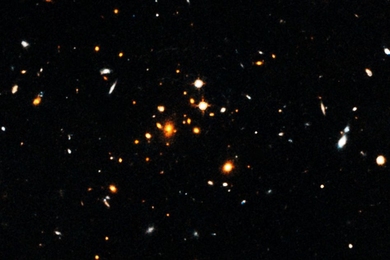
Most distant massive galaxy cluster identified
Formed in the first 4 billion years of the universe, cluster is 1,000 times more massive than the Milky Way.
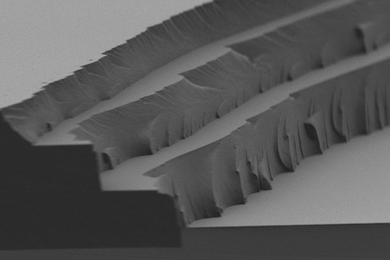
A new way to store solar heat
Material could harvest sunlight by day, release heat on demand hours or days later.
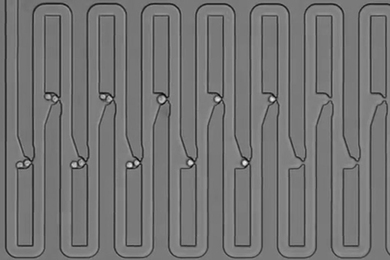
Tracing a cellular family tree
New technique allows tracking of gene expression over generations of cells as they specialize.
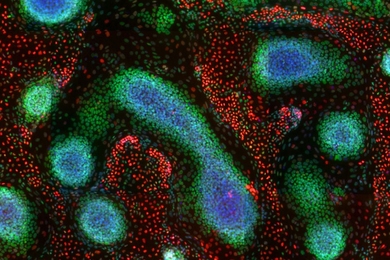
Organ-on-a-chip
In a step toward personalized drug testing, researchers coax human stem cells to form complex tissues.
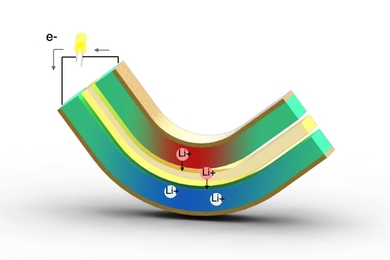
Harnessing the energy of small bending motions
New device could provide electrical power source from walking and other ambient motions.

Assessing nature's carbon sinks
Study estimates the annual carbon sequestration rate in protected areas such as rainforests will decline by about 40 percent between now and 2100.
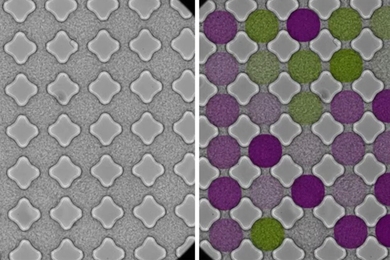
Study reveals shared behavior of microbes and electrons
Bacteria streaming through a lattice behave like electrons in a magnetic material.
![“I was always very interested in current events and fascinated by what was happening in the world around me,” MIT historian Tanalís Padilla says. “My parents were very political. I considered myself quite a political being. … I think [living in] Mexico and the United States and seeing the contrast to be so great, especially in rural Mexico, made me aware [of politics] early on.”](/sites/default/files/styles/term_page__news_article/public/images/201601/MIT-Tanalis-Padilla_0.jpg?itok=yaccQLL2)
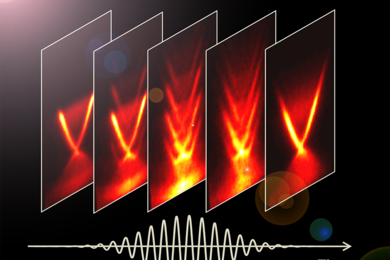
Clearing the way for Floquet-Bloch states
Team demonstrates pure quantum-mechanical mixture of electrons and photons in the solid topological insulator bismuth selenide.
Computer model matches humans at predicting how objects move
“3-D physics engine” from the Computer Science and Artificial Intelligence Laboratory simulates the human brain to infer physical properties.
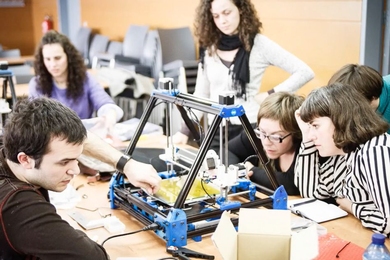
3 Questions: Neil Gershenfeld and the spread of Fab Labs
Ten years after launching Fab Lab, the project’s founder describes the program’s research, global impact.
New York magazine corrects misinformation about MIT Joint Program climate projection
"2015 Energy and Climate Outlook" sees international COP21 climate conference as progress, with more work ahead.

Global reductions in mercury emissions should lead to billions in economic benefits for U.S.
Benefits from international regulations may double those of domestic policy.

A healthy breakdown
Researchers discover how some organisms process oxalate, a molecule that can harm humans.