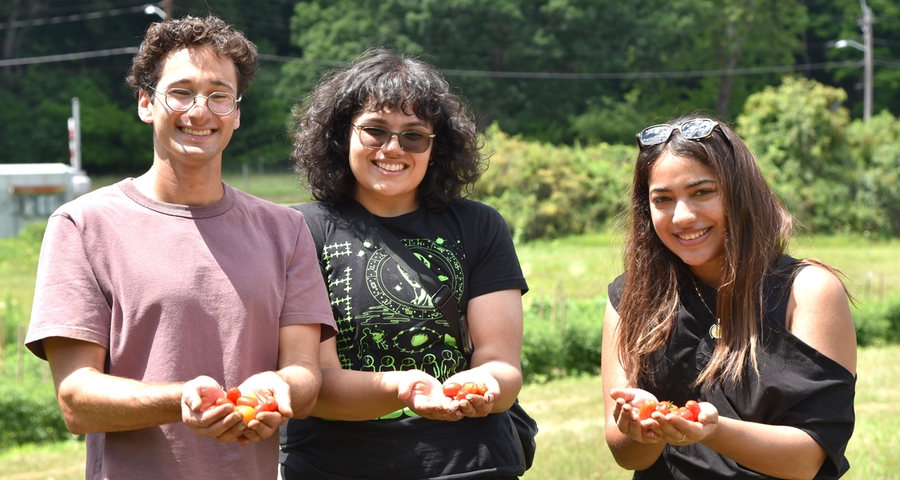
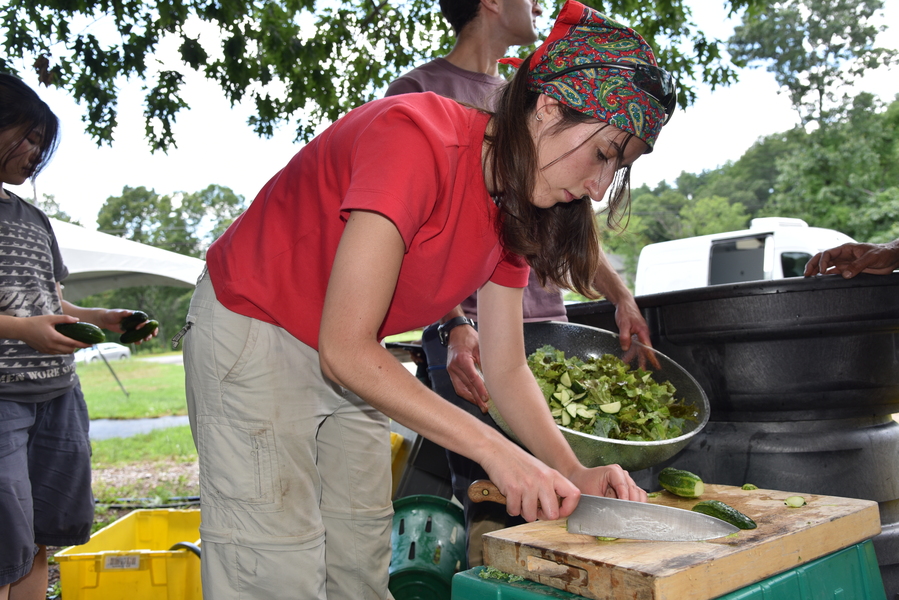
“This tomato is blowing my mind,” says Nermine Hassanin. The MIT graduate student in architecture is marveling at the fruit in her salad.
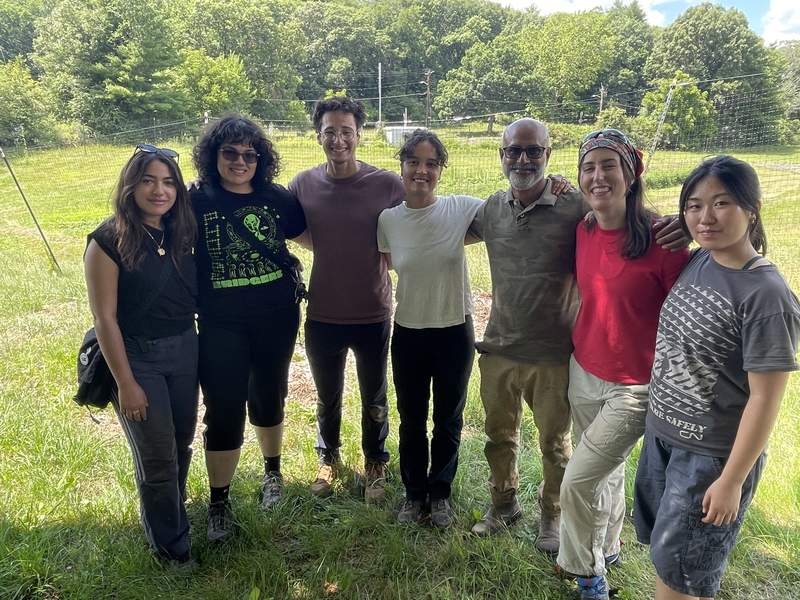
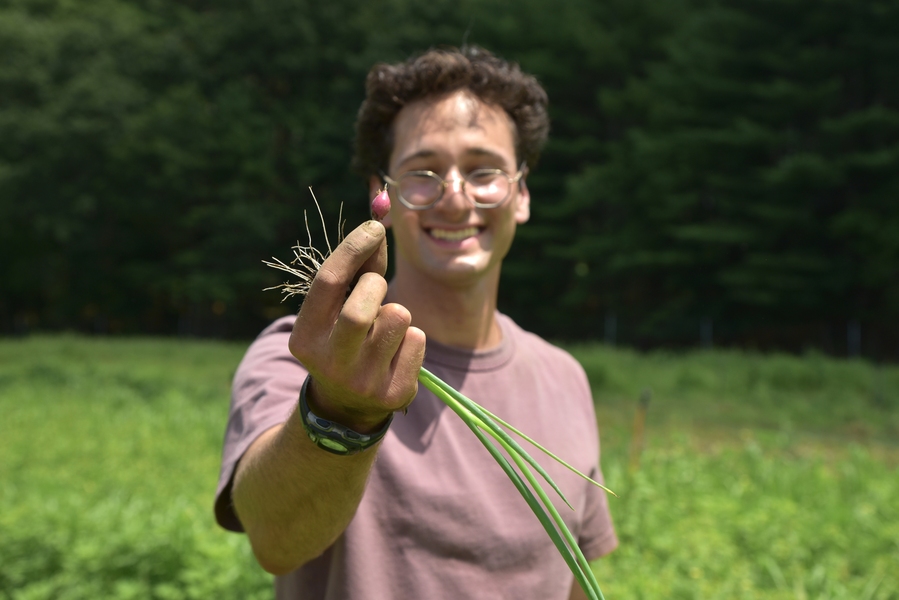
She and several MIT School of Architecture and Planning classmates had spent their morning working at Hannan Healthy Foods Farm in Lincoln, Massachusetts, and then harvested the contents of the salad they were sharing at a picnic table: lettuce, kale, cucumbers, green onions, and tomatoes.
“It doesn’t get much fresher unless you’re eating this in the field,” responds Zachary Rapaport, a classmate and co-founder of MIT Farm, a community-driven program at MIT that is radically changing what it means to eat farm-fresh food on campus and gain practical experience in urban farming.
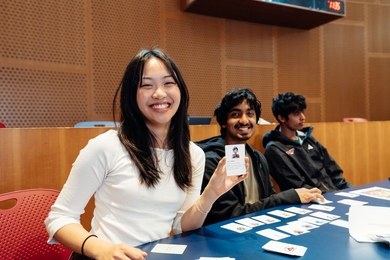
In fact, the program resonated so quickly with so many that it was awarded the Karl Taylor Compton Prize for a group this spring — the highest award presented by the Institute to students in recognition of excellent achievements in citizenship and devotion to the welfare of MIT.
Seated with Hassanin and Rapaport were classmates Aisha Cheema and MIT Farm co-founder Aleks Banaś, undergraduate architecture major Amy Kim, Sanne Wright MCP ’24, and Mohammed Hannan, the owner of Hannan Healthy Foods Farm. The story of how they came to enjoy this meal on a brilliant summer Sunday is equal parts vision, hard work, and serendipity.
Community in Cambridge
In their first year at MIT, Rapaport and Banaś were classmates in a design workshop 4.184 (ClimateCorps@MIT) that focused on climate action within communities. Bonding over their interest in food systems, the two shared a desire to continue the community service work that took them outside of the classroom.
“We started ideating on what it would mean to create relationships with students, faculty, and staff on campus with partners who were already growing food in the community,” says Banaś. “We saw many organizations in the community already doing inspiring work, so instead of starting from scratch we wanted to plug into this system.”
Their concept for MIT Farm explored a holistic view of community, food security, and supporting local farming in a time of climate resilience. It also capitalized on the desires of two budding architects to develop practices they see as essential for sustainable communities.
“After working in an architecture practice, I came to grad school to find a way to create an architecture practice grounded within real communities,” says Banaś. “For me, architecture is not just about creating a building, but creating an environment for other interactions. I think we have a certain level of responsibility to the people around us; we need to learn how to work together with them.”
“What I’ve learned through developing MIT Farm is that farming requires you to being accountable to seasonal change, to people, and to the environment in which we’re working,” adds Rapaport. “There are things you only begin to notice when you spend time with a place and really engage with it. In many ways, architecture is the same. We need to be very attentive to the world around us if we’re going to make good design.”
In 2025, Rapaport and Banaś actively sought out like-minded organizations on campus — including MIT Professor Miho Mazereeuw’s Urban Risk Lab, the MIT Office of Sustainability, and the Open Space Committee — to build relationships and germinate ideas. They found enthusiastic supporters for their ideas which kept them both engaged and excited. That spring, they entered their concept for MIT Farm into the iCampus competition, which recognizes innovative and creative applications of technology that improve living and learning at MIT; they were awarded one of the three cash prizes.
Between supporters on campus and burgeoning relationships with like-minded organizations off campus, Rapaport and Banaś began to execute their vision.
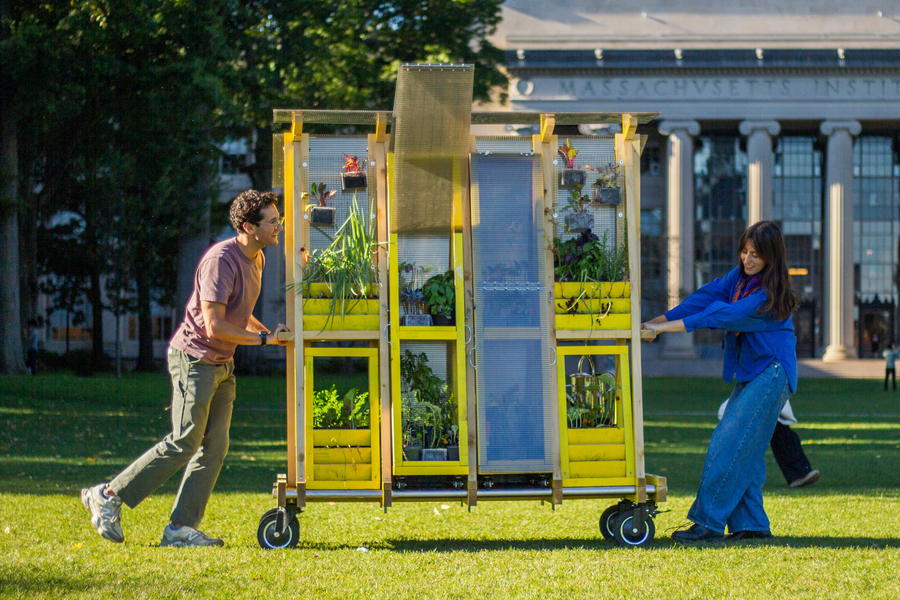
One idea — a farm cart — kick-started what Rapaport terms “the growing side” of MIT Farm. He, Banaś, and classmate Courage Dzidula Kpodo MArch ’25 designed and built the two-tiered cart. It is constructed of pine with polycarbonate panels and divided into sections that support active vegetable gardens. Repurposed pipette tip containers sourced from campus labs serve as seedling planters. Supported on four wheels, the cart can be pushed or pulled anywhere.
“By introducing mobility, we began growing food without having it tethered to a specific plot of land,” says Rapaport.
They discovered it was more than just a “moveable farm.” The cart became a DJ booth at school happy hours; was wheeled to nearby public schools as a learning tool; showcased at the “Day of Climate” event at the MIT Museum; and transformed into a tiny winter greenhouse at the East Campus dorms.
Field work
Rapaport and Banaś also located farm communities in Boston and beyond to develop volunteering and mentoring opportunities. Now, through MIT Farm, students can volunteer to work the two rooftop gardens at Boston Medical Center (BMC), a compact farm that generates 6,000 pounds of produce to serve patients and the BMC community.
A second option for students to work at a city farm is with Eastie Farm in East Boston. A nonprofit with a focus on food security and climate justice, the organization supports local farms that struggle to compete with industrial agriculture.
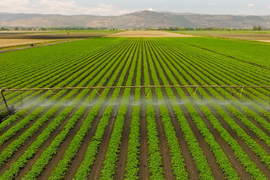
Last summer, Rapaport and Banaś connected with Mohammed Hannan, the Lincoln farm owner and a laboratory manager at MIT. MIT students had already found their way to his farm, about 15 miles from Cambridge. Four years earlier, Heather Paxson, an anthropology professor and associate dean for faculty at MIT School of Humanities and Social Sciences, brought her anthropology class to visit Hannan Farm to learn about small-scale certified organic operations.
Hannan was open to the idea of the MIT community working on the farm. He says it is “increasingly challenging” to find people who want to farm. He stresses the broader importance of community support for local agriculture, noting that food security and sustainable farming require collective effort from society — not just from farmers.
“Many farmers around me are leaving farming to make their living elsewhere,” says Hannan. “It is a silent pandemic.”
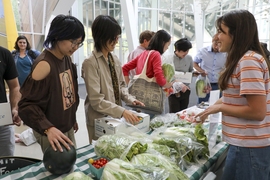
When classes resumed last fall, Rapaport, Banaś, and classmates began volunteering on weekends at the farm. Working with the MIT Office of Sustainability and the Anthropology Section, the group started a pilot program selling Hannan Farm’s produce for a reduced price to students on campus on Mondays. The Fresh Food Bag program offered curated bags of produce that had been harvested a day earlier. The program was met with delight among the MIT community, with nary a vegetable left behind each week. Rapaport and Banaś say they will expand the program this fall to include offering bags of fresh produce in MIT dorms.
The work on the farm changes constantly, based on the season and business needs. One day students may be in the field replanting plants that didn’t establish properly; on another, they may be maintaining tools or working on infrastructure projects.
“There isn't really an ‘off season’ since the farm operates year-round, and we've worked to bring MIT students out in every season and semester,” says Rapaport. “During the winter, we repaired greenhouses, prepared seedling trays, and started getting ready for the next growing season.”
Hannan describes his collaboration with MIT students as “game changing,” highlighting how students gain practical, problem-solving experience while advising him on how to improve the farm’s infrastructure.
“It’s hard to visualize real-world problems when you are working in a lab [on campus],” says Hannan. “But the students are seeing the day-to-day challenges farmers are facing here. They are coming up with solutions that can alleviate these problems — and not just on my farm. We need more people from different backgrounds to see how we can locally grow more efficiently using the tools and technologies that we have. Sometimes we farmers don’t know where the technologies are — such as using solar irrigation. We’re not always tech-savvy, or we don’t have the expertise. Farming needs all of it.”
To everything, there is a season
In January, during MIT’s Independent Activities Period, Rapaport and Banaś conducted a weeklong workshop to design a root cellar to support food storage and preservation for the farm. The group also developed a curriculum for K-12 students to teach how to design a community garden with the support of a Day of Climate Grant they were awarded.
Kahlen Wheaton, a Department of Urban Studies and Planning (DUSP) undergrad, was among the students who worked on the curriculum and helped organize volunteers at the farm last spring.
“I really love the club,” says Wheaton. “It’s a great opportunity for MIT students to get out of their bubble and do some service work. It’s also great just to bring fresh produce to campus because, as an undergrad, I’m not always eating the most healthy or local foods.”
Wheaton had originally planned to study environmental engineering at MIT, but found urban planning and the opportunity to impact policy — especially as it influences designing cities for healthy lifestyles — exciting. She has planned her thesis on urban farming and will use the connections she is making in local farming to inform her work.
Pastures of plenty
This past spring saw dozens of volunteers spending weekends at Hannan Farm. Among them was Rania Ghosn, an MIT associate professor of architecture and urbanism, who brought her family. She says she enjoyed working shoulder-to-shoulder with colleagues in the field, and that MIT Farm provides a “tangible public good while strengthening a sense of belonging and joy.
“Working in the fields with my husband and our 10-year-old son became a kind of Sunday ritual: purposeful, physical, joyful, and full of meaning. For my son, the farm was a lesson no classroom could quite reproduce.”
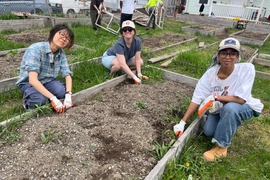
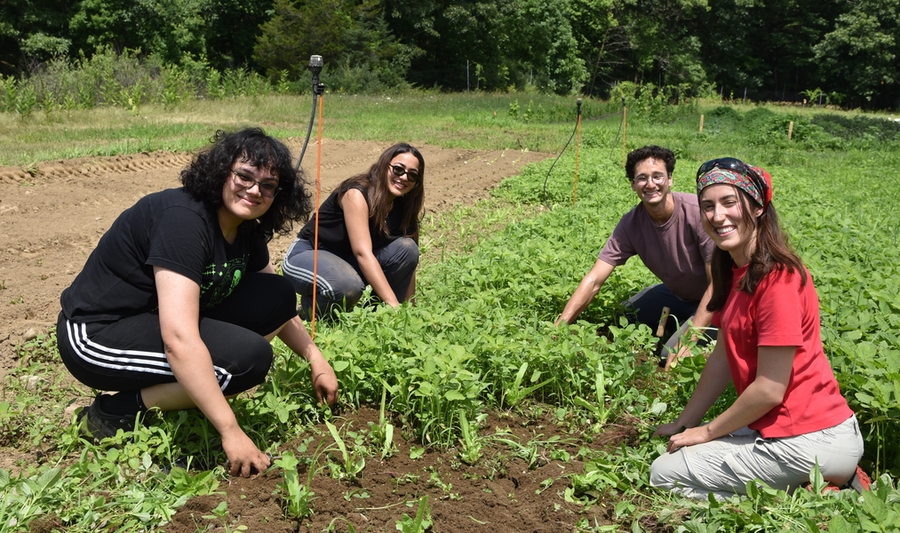
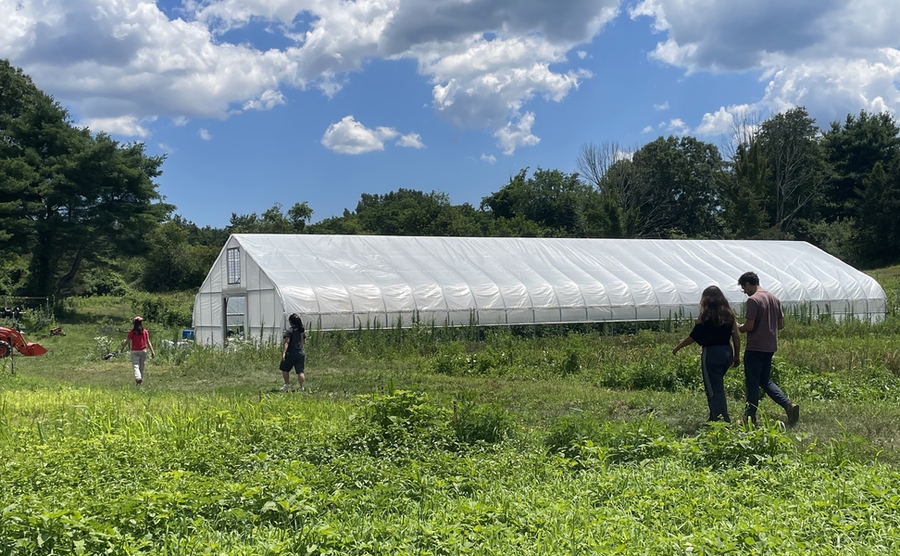
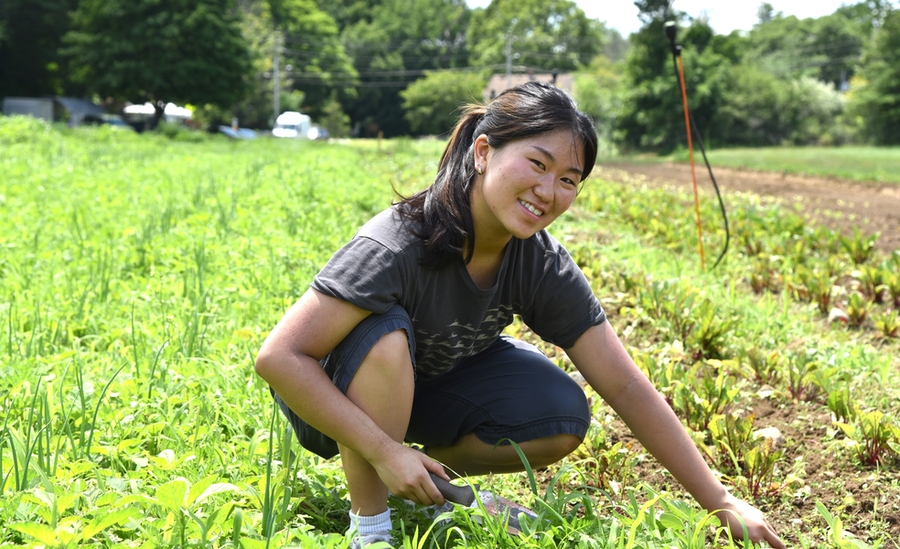
On a recent Sunday, five architecture students tended to rows and rows of vegetables. Weeds had grown high with the recent rain, but after some tugging and digging, they released their hold in the dirt and lay in piles. The hot sun, the smell of fresh herbs, and the sounds of birds and insects made Cambridge and MIT feel very far away.
Nermine Hassanin has spent several Sundays here. She says she enjoys meeting new people on the farm each time.
“It’s a good sense of community here,” she says. “And being out of the city is very therapeutic.”
Growing up, Aisha Cheema worked with her dad on their family garden. She says working on the farm is “a nice way to stay connected” to those experiences.
“I’m interested in how this environment can be pulled into architecture,” says Cheema. “So many spaces seem siloed from the outdoors. I’d like to connect the outdoors to indoor spaces. I think some of the structures here — like the greenhouse — are great inspiration for me.”
Rapaport and Banaś spent their summer designing additional interventions for the Lincoln farm: an improved washing station and an upgraded farm stand that allows for cold storage to keep produce fresh longer. The design has been approved by the Lincoln Conservation Commission and permits are pending.
Also, this summer, Amy Kim oversaw the design of a dormant garden plot on campus near Tang Hall. The undergraduate performed the work as part of MIT’s Undergraduate Research Opportunity Program. Kim says she designed the project because it allowed her “to get hands-on experience building a space that would foster community and collaboration, with the added environmental benefit of repurposing material such as scrap brick and scrap wood.
“The garden's primary goal is to be a pleasant space to sit and relax with friends while surrounded by aromatic herbs and flowers,” Kim adds.
With their theses underway in preparation for Commencement next year, Rapaport and Banaś will hand off their oversight of MIT Farm to Wheaton and others this fall. They could not have guessed how the popularity of MIT Farm would have connected with so many students, or how many friends they cultivated off campus — and they are overjoyed with the results. They believe the community they have developed and fostered will keep MIT Farm vibrant into the future.
Ghosn agrees.
“MIT Farm feels deeply MIT: mind and hand, ethics and experimentation, systems thinking and dirt under the fingernails,” she says. “Aleks and Zach have created a student-led project with moral clarity, organizational intelligence, and genuine public purpose. It is modest in its means and expansive in its imagination and impact."