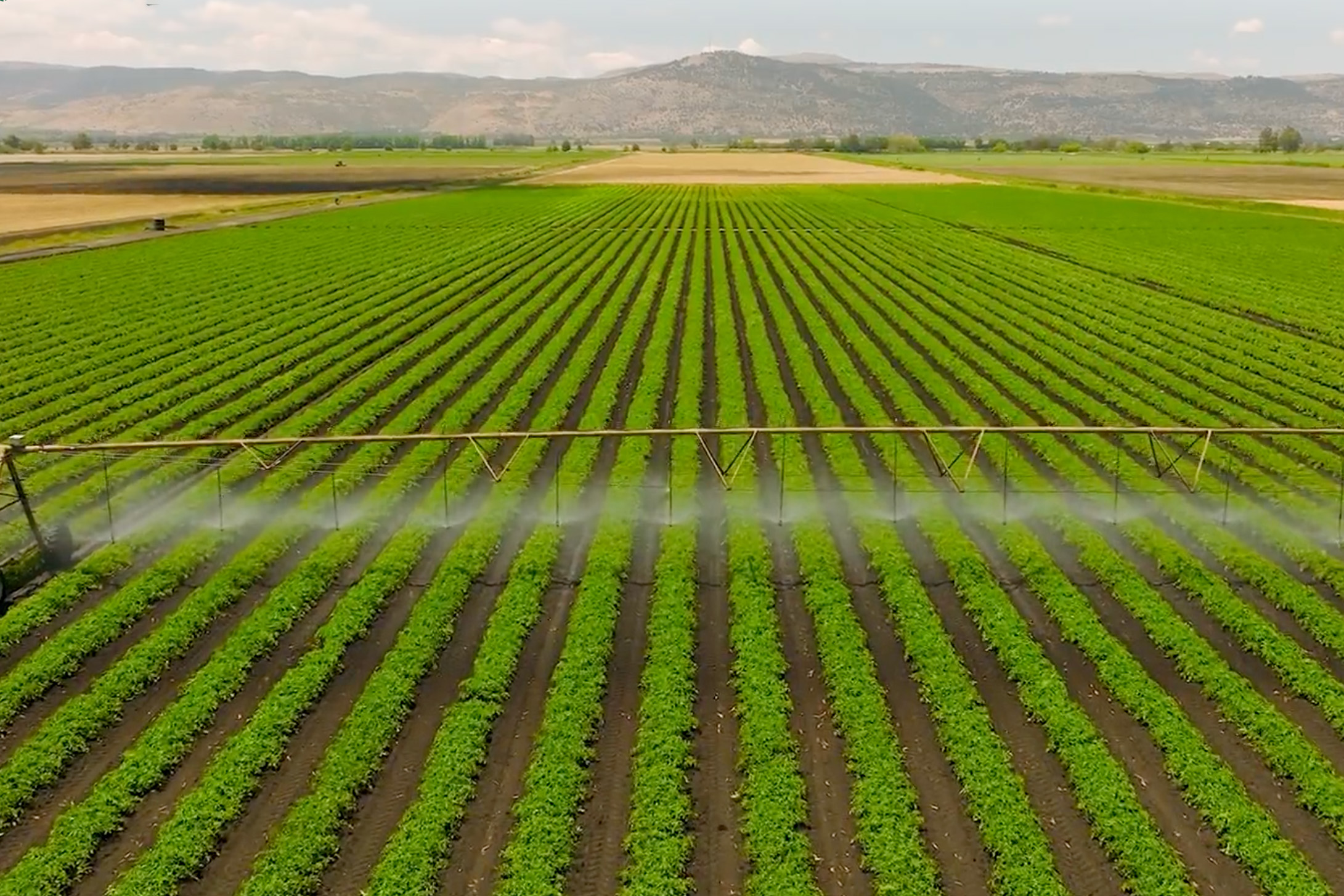
Each year, farmers around the world spend $80 billion on pesticides for their crops. Those pesticides impact not only harmful insects but also bees and beneficial bacteria in the soil. They can also run off into waterways and harm the environment. And, they are increasingly being linked to human diseases like Parkinson’s and cancer.
Amid growing awareness of those problems, pesticides made from living microbes are gaining popularity. Unfortunately, such microbial pesticides are often less effective, forcing farmers to choose between potential environmental damage and higher crop yields.
Now, Robigo is equipping naturally occurring microbes with more potent pest-fighting capabilities. The company, which was co-founded by Andee Wallace PhD ’20, uses technologies more commonly associated with medical applications, like RNA interference and CRISPR, to engineer self-replicating microbes that target plant pathogens more precisely than chemical pesticides and more effectively than other biologically based solutions.
“Chemical pesticides have been a cornerstone of agricultural production for the past 70 years, to the point that it’s nearly impossible to envision an agricultural system without them,” Wallace says. “But that’s the long-term vision we have: providing growers new tools to enable a food system that is in balance with the environment, and that is productive, resilient, and safe.”
In field trials across five states, the company has already shown its microbes offer comparable results to chemical pesticides. In one trial comparing Robigo’s product with another commercial microbial product last summer, Robigo’s system led to a 250 percent increase in crop yield.
“Many crops, like lettuce, are harvested by hand, and the grower told me if a disease reduces yield even by just 25 percent, it’s not economical for them to pay workers to harvest the field at all,” Wallace says. “Growers are just trying to produce enough food to feed everyone. That’s why they use pesticides in the first place. We’re trying to give them a better choice.”
Engineered biology for agriculture
Wallace did her PhD in the lab of Chris Voigt, MIT’s Daniel I.C. Wang Professor and the head of the Department of Biological Engineering. She joined the lab after working at Bolt Threads, a startup spun out of the Voigt lab that was designing a material for the fashion industry inspired by spider silk.
“I came into MIT knowing that I wanted to join Voigt’s lab,” Wallace says. “I was really enamored with biomaterials in general. There are so many examples of animals and organisms that make incredible materials that we humans can’t replicate.”
Wallace’s PhD focused on engineering microbes in an attempt to replicate intricate glass nanostructures produced by single-cell algae called diatoms.
Wallace enjoyed her startup experience and explored entrepreneurship throughout her time at MIT. But it wasn’t until after graduation that she reconnected with two MIT students, Jai Padmakumar PhD ’23 and Connor Sweeney ’21, and decided to start her own company.
The founders’ initial idea was to engineer microbes to deliver CRISPR to target and kill bacteria that are harmful to crops. They used a number of MIT resources to get the company off the ground, including the Venture Mentoring Service, MIT Sandbox, delta v, and the MIT $100K Entrepreneurship Competition. Sweeney was involved in the venture for about a year. Padmakumar left Robigo in 2022.
Today Robigo is addressing a problem of growing importance to the agriculture industry.
“Chemical pesticides are under incredible pressures: increasing scrutiny from consumers and regulators, and increasing pesticide resistance among pests, diseases, and weeds,” Wallace explains. “Over the past 40 years, only two new herbicide chemistry modes of action have been commercialized, so people are understandably worried. If we can’t develop new solutions, resistance is only going to grow and will leave growers without effective tools to protect their crops. I think biotechnology has the potential to solve that problem.”
Farmers hope so, too: In an attempt to address environmental and health concerns, they have increasingly turned to so-called biological pesticide solutions, which are mostly made from natural sources like plant extracts, microbe-derived natural products, and increasingly biotechnology solutions like peptides and RNA.
“They are safer and better for the environment, but currently they just don’t perform as well or as reliably as synthetic chemistry pesticides, so there’s a big distrust among growers,” Wallace says. “Growers are being asked to choose between high performance or safety and sustainability. Robigo is trying to solve that problem by giving them products that do both.”
Robigo’s ARGO biotechnology platform combines synthetic biology and proprietary computational design processes to engineer microbes that perform at a similar level to chemical pesticides, but with improved safety profiles for people and the planet. A key part of that approach is leveraging microbes’ self-replicating abilities to continuously produce and deliver bioactive molecules in the field over the course of the growing season.
The company has moved in recent years from delivering CRISPR to RNA-interference, or RNAi, which inhibits key functions in the pathogens they want to target.
Robigo also differs from other microbial pesticide companies in its approach. Wallace says other companies screen to discover new microbes with the properties they want, then cultivate those for sprays and other modes of applications. But these specialized microbes may not be able to thrive in, say, the microbiome of California farm soil where they’re needed. That means they may die off soon after being deployed. Robigo, conversely, focuses on equipping robust, industry-proven microbes with the ability to target specific pests and diseases.
“Our starting point is ‘What crops will this be used for? and ‘What diseases do we want to control?’” Wallace says. “To design safer products, we need to be direct in how we’re designing RNAi to target different diseases. Another layer of our technology is what we call RNAi stacking, where we combine multiple RNAi into a single microbe to broaden the spectrum of pathogens we can control with a single product.”
Lab to farm to table
Last year, Robigo ran field trials for its two lead products, with soybeans and lettuce across the U.S. Midwest and West. Working with third-party testing companies, they showed a single application of their microbes offered protection for crops over the entire growing season and matched the performance of the leading chemical pesticide at a fraction of the cost.
“That’s very unusual for biological products, and even many chemical products, so we’re really optimistic about engineered microbes being a new solution that disrupts the conventional chemical pesticide paradigm,” Wallace says.
Wallace says Robigo is expanding fourfold this year and plans to expand even faster next year with the help of major agrochemical companies interested in more sustainable solutions. The company is also partnering to expand to other crops as it helps farmers around the world.
“There are a lot of opportunities we’re excited about, and we’re working with a number of partners as we scale,” Wallace says. “Over the past nine months, we’ve systematically used our ARGO platform to tackle new opportunities, and we have a number of products in the pipeline we’re working to bring to growers around the world.”