

It’s an essential insight about our world: Innovation drives economic growth. For the U.S. to thrive, it must keep innovating. But how, and in what areas?
A new book co-authored by MIT faculty members focuses on six key areas where technology advances can drive the economy and support national security.
Those sectors — semiconductors, biotechnology, critical minerals, drones, quantum computing, and advanced manufacturing — are all built on U.S. know-how but are also areas where the country has either yielded a lead in production or innovation, or could yet fall behind.
As the book explains, a roadmap for U.S. prosperity and security involves sustaining notable areas of innovation and the national research ecosystem behind them, while rebuilding domestic manufacturing.
“In each of these areas, there are breakthroughs to be had, where the U.S. can leapfrog competitors and gain an advantage,” says Elisabeth Reynolds, an MIT expert on industrial innovation and editor of the new volume. “That’s a very exciting part of this.” She adds: “These areas are front and center for U.S. national economic and security policy.”
The book, “Priority Technologies: Ensuring U.S. Security and Shared Prosperity,” is published this week by the MIT Press. It features chapters by MIT faculty with expertise on the industrial sectors in question. Reynolds, a professor of the practice in MIT’s Department of Urban Studies and Planning, is a leading expert on industrial innovation and has long advocated for innovation-based growth that helps the U.S. workforce.
“All of this can be good for everyone,” says MIT economist Simon Johnson, who wrote the foreword to the book. “Out of that flow of innovations and ideas, we can create more good jobs for all Americans. Pushing the technological frontier and turning that into jobs is definitely going to help.”
Making more chips
“Priority Technologies” grew out of an ongoing MIT seminar by the same name, which Reynolds and Johnson began holding in 2023, often with appearances by other MIT faculty.
Both Reynolds and Johnson bring vast experience to the subject of innovation and production. Among other things, Reynolds headed MIT’s Industrial Performance Center for over a decade and was executive director of the MIT Task Force on the Work of the Future. She served in the White House National Economic Council as special assistant to the president for manufacturing and development.
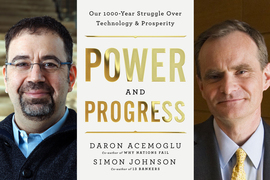
Johnson, the Ronald A. Kurtz (1954) Professor of Entrepreneurship at the MIT Sloan School of Management, shared the 2024 Nobel Prize in economics, with MIT’s Daron Acemoglu and the University of Chicago’s James Robinson, for work about the historical relationship between institutions and economic growth. He has co-authored numerous books, including, with Acemoglu, the 2023 book “Power and Progress,” about the trajectory and implications of artificial intelligence.
As it happens, “Priority Technologies” does not focus on AI, instead opting to examine other vital, and often related, areas of innovation.
“We do not think this is the entire list of priority technologies,” Johnson says. “This is a partial list, and there are lots of other ideas.”
In the chapter on semiconductors, Jesús A. del Alamo, the Donner Professor of Science in MIT’s Department of Electrical Engineering and Computer Science, calls them “the oxygen of modern society.” This U.S.-born industry has seen a large manufacturing shift away from the country, however, leaving it vulnerable in terms of security and the economy; about one-third of inflation experienced in 2021 stemmed from a chip shortage. As he notes, the U.S. is now in the process of rebuilding its capacity to make leading-edge logic chips, for one thing.
“With semiconductors, people thought the U.S. could lose the manufacturing, stay on top of the innovation and design side, and would be fine,” Reynolds says. “But it’s turned out to make the country quite vulnerable. So we’ve had a massive shift to rebuild semiconductor manufacturing capabilities here in the U.S., and I would argue that’s been a successful strategy in recent years.”
Bringing biotech back home
In biotechnology, relocating manufacturing in the U.S. is also key, using new technologies in the process. As J. Christopher Love, the Laurent Professor of Chemical Engineering, puts it in his chapter, while the U.S. is the leader in biotech research, it “lacks the manufacturing infrastructure and expertise necessary to bring these ideas to the market at the same pace as it generates innovative new products.” Among other remedies, he suggests that smaller, more flexible production facilities can help the U.S. “leapfrog” other countries on the manufacturing side. Love is also co-director of MIT’s Initiative for New Manufacturing, which aims to drive advances in U.S. production across industries.
“We have tremendous biotech innovation, we’re the leaders, but we have a bottleneck when it comes manufacturing,” Reynolds observes. “If we can break through that with new technologies, new production processes, we’re in a position to make us less vulnerable, from a supply chain point of view, and capture more of what is going to be a $4 trillion market over the next 15 years.”
A similar story holds in other areas. Many drone innovations were developed in the U.S., while much manufacturing has shifted to China. Fiona Murray, the William Porter (1967) Professor of Entrepreneurship, writes that the U.S. has an “opportunity to rebuild its production at scale,” although that will also require significant strengthening of its supply chains, too.
Elsa Olivetti, the Jerry McAfee (1940) Professor of Engineering and a professor of materials science and engineering, recommends a multifaceted approach to help the U.S. regain traction in the production of critical minerals, including better forms of extraction, manufacturing, and recycling, to reduce potential scarcities.
And in the quantum computing chapter, two MIT co-authors — William D. Oliver, the Henry Ellis Warren (1894) Professor of Electrical Engineering and Computer Science and a professor of physics; and Jonathan Ruane, a senior lecturer at MIT Sloan — note that the sector could help accelerate drug discovery, materials science, and energy applications. Noting that the U.S. still leads in private-sector investment in the field but tails China in public-sector investment, they urge more research support and stronger supply chains for quantum computing components, among other recommendations.
“The country that achieves quantum leadership will gain decisive advantages in these strategically important industries,” they write.
The university engine
From industry to industry, the book makes clear that certain key issues are broadly important to U.S. competitiveness and growth. The partnership between the federal government and the world-leading research capacities of U.S. universities, for one thing, has given the country an initial lead in many economic sectors and promises to continue driving innovation.
At the same time, the U.S. would benefit from expanding and strengthening its domestic supply chains, in the process of building up more domestic manufacturing, and needs capital investment that will help hardware-side, physically substantial industrial growth.
“These common themes include supply chain resilience and manufacturing capability,” Reynolds says. “Can we help drive the country’s innovation ecosystem through expansion of our industrial system and manufacturing? That’s a big question.”
On the research front, she reflects, over the years, “It’s been amazing how much MIT-led research has aligned with national priorities — or maybe that’s not so surprising.”
The partnership between the U.S. federal government and universities as research engines was formalized in the 1940s, thanks in part to then-MIT president Vannevar Bush. According to some estimates, government investment in non-defense research and development alone has accounted for up to 25 percent of U.S. economic growth since World War II.
“Vannevar Bush realized it wasn’t about a stock of technology, it was about a flow of innovation,” Johnson says. “And that brilliant insight is still relevant today. I think that is the insight of the last century. And that’s what we’re trying to capture and reiterate and repeat.”
“This is not even the future. This is current.”
Scholars and industry leaders have praised “Priority Technologies.” Erica Fuchs, a professor of engineering and public policy at Carnegie Mellon University, has stated that when it comes to “ensuring American national security, economic competitiveness, and societal well-being,” the book underscores “the positive role technology can play in those outcomes.” Hemant Taneja, CEO of the venture capital firm General Catalyst, calls the volume “required reading for anyone interested in building the abundant, resilient future America deserves.”
For their part, Reynolds and Johnson hope the book will draw many kinds of readers interested in the economy, innovation, prosperity, and national security.
“We tried to make the volume accessible,” Reynolds says, noting that the book directly lays out “challenges for the country, and what we see as recommendations for next steps in how we position the country to succeed, and lead globally. Each of these chapters has something important to say.”
Johnson also notes the MIT scholars participating in the project want to enhance the ongoing policy conversation, in Washington and across the country, about supporting innovation and using it to drive U.S. economic and technological leadership.
“One reason to write a book is, you can’t pound the table with a podcast,” quips Johnson, who co-hosts a podcast, “Power and Consequences,” on major policy issues. In conversations with political leaders and their staffs, he adds, there is a core message to be transmitted about America and technology-driven growth: We have the knowledge and resources, but need to focus on supporting innovation while trying to increase domestic production.
“Here are the technologies we currently need,” Johnson says. “This is not imagination, this is not fanciful, this is not science fiction. This is not even the future. This is current. These are the technologies needed to defend the country and its interests. And we need to invest in these, and in everything we need to drive them forward.”