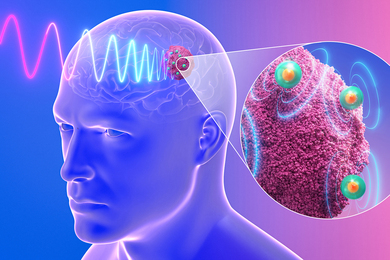
Injectable nanodevices could provide effective treatment for drug-resistant glioblastoma
MIT researchers show implanted nanoantennas can be activated wirelessly to kill brain cancer cells without damage to healthy tissue.
MIT researchers show implanted nanoantennas can be activated wirelessly to kill brain cancer cells without damage to healthy tissue.
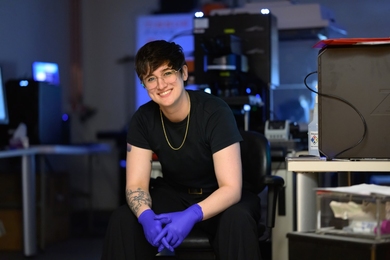
Shannon Knight, a brain and cognitive sciences PhD candidate and McGovern Institute researcher, focuses on developing a novel gene therapy.
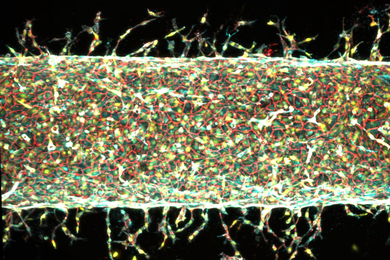
Gently stretching and pulling a “blood vessel on a chip” encourages controlled sprouting of new vessels, for possible use in artificial tissues or organs.

“Scientific American” showcases the history and future of America’s scientific engine, highlighting promising young scientists and icons at MIT and beyond.

The new design could offer a surgery-free alternative to traditional cardiac implants.
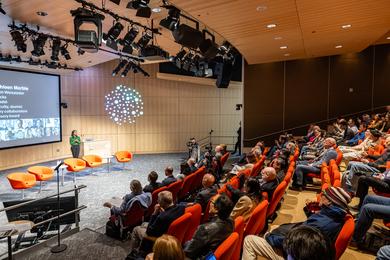
The MIT Marble Center for Cancer Nanomedicine looks back at 10 years of turning big ideas about nanotechnology into transformative advances for cancer patients.
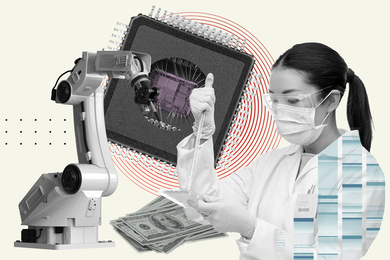
In “Priority Technologies,” MIT faculty examine key areas of innovation that can drive American prosperity and security — now and in the decades ahead.
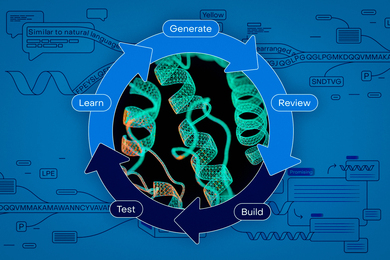
Founded by Tristan Bepler PhD ’20 and former MIT professor Tim Lu PhD ’07, OpenProtein.AI offers researchers open-source models and other tools for protein engineering.
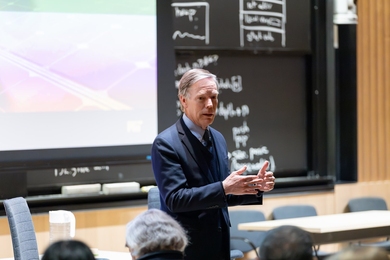
At MIT, former U.S. ambassador to China Nicholas Burns highlights climate change as an area for diplomatic engagement, while exploring areas including China's emphasis on STEM education.

Offering substantial prize funding alongside workshops, classes, and mentorship, the initiative helps translate early-stage biotech research into venture-ready innovation.

In STS.059 (The Bioeconomy and Society), students explore the social and political factors at work in the biology, biotech, and biological engineering sectors.
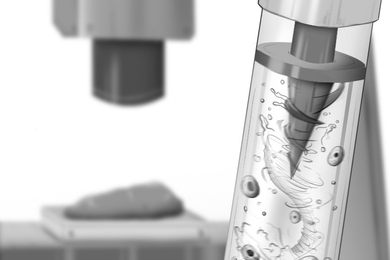
MagMix, an onboard mixing device, enables scalable manufacturing of 3D-printed tissues.
In the 2025 Dresselhaus Lecture, the materials scientist describes her work 3D printing soft materials ranging from robots to human tissues.
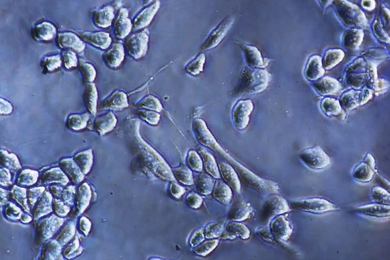
The approach could transform large-scale biomanufacturing by enabling automated and contamination-conscious workflows for cell therapies, tissue engineering, and regenerative medicine.
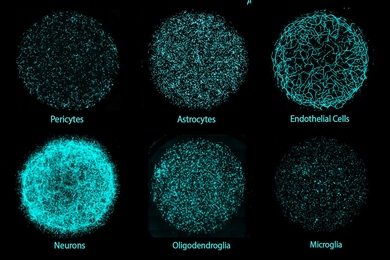
Cultured from induced pluripotent stem cells, “miBrains” integrate all major brain cell types and model brain structures, cellular interactions, activity, and pathological features.