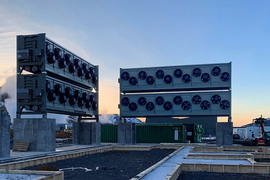
Carbon capture is an important climate change mitigation strategy, but it faces technological barriers and can be energy-intensive and expensive. To help make necessary advances in this area, a team of MIT researchers, with support from the MIT Climate and Sustainability Consortium (MCSC), are exploring energy-efficient and scalable alternatives to conventional carbon dioxide (CO2) capture methods.
Conventional amine scrubbing, which is the current standard for CO2 capture, is energy-intensive and difficult to scale, limiting its impact despite the urgent need to reduce carbon emissions and upgrade CO2 into valuable products. In a new article published in Nature Energy, MIT researchers — graduate students Fang-Yu Kuo of the Department of Chemical Engineering, and Gi Hyun Byun of the Department of Mechanical Engineering (MechE); Professor Betar Gallant of MechE; and former MCSC postdoctoral Impact Fellows Glen Junor and Akachukwu Obi — investigate a promising alternative to these conventional CO2 capture methods. Their findings could move the needle on achieving efficient and flexible carbon capture and removal.
In their paper, the team explores an alternative, electrochemically mediated CO2 capture (EMCC). This approach enables electrification of CO2 separation — driven ideally by renewables — but currently faces challenges, such as relying on sorbents that require highly reducing potentials, where oxygen reduction side reactions become significant. This can compromise both efficiency and long-term performance. To tackle this shortcoming of EMCC, the MIT team researched whether N-heterocyclic imines (NHIs) is a useful new class of EMCC sorbent.
“NHIs have shown promise in recent years as CO2 sorbents because of the ease of NHI molecular modifications for tuning basicity,” says Fang-Yu Kuo. “Our work translates these NHIs for the first time into the EMCC application space, and demonstrates that NHI-based sorbents can be modulated electrochemically for CO2 separation by a unique separation mechanism that avoids the need of applying highly reducing potentials.”
The team’s initial research establishes a novel bis(NHI) structure that can enable a theoretical CO2 modulation of two molecules per electron during cell operation. The initial published result also indicates that with further molecular engineering of bis(NHI) structures to strengthen CO2 binding affinity, the bis(NHI) could operate in more diverse electrolyte environments, opening new possibilities to optimize system performance in terms of electron efficiency, energy efficiency, and operational flexibility.
“A critical future direction of our work involves gaining deeper mechanistic insight into the stability and degradation pathways of the bis(NHI) radical cation,” says Kuo. “Understanding these pathways will inform the rational design of next-generation bis(NHI) molecules, enabling longer operational lifetimes and enhanced cycling durability for practical deployment.”
MIT researchers present a promising new approach to efficient, flexible carbon capture and removal.
Publication Date:
Press Contact:
Caption:
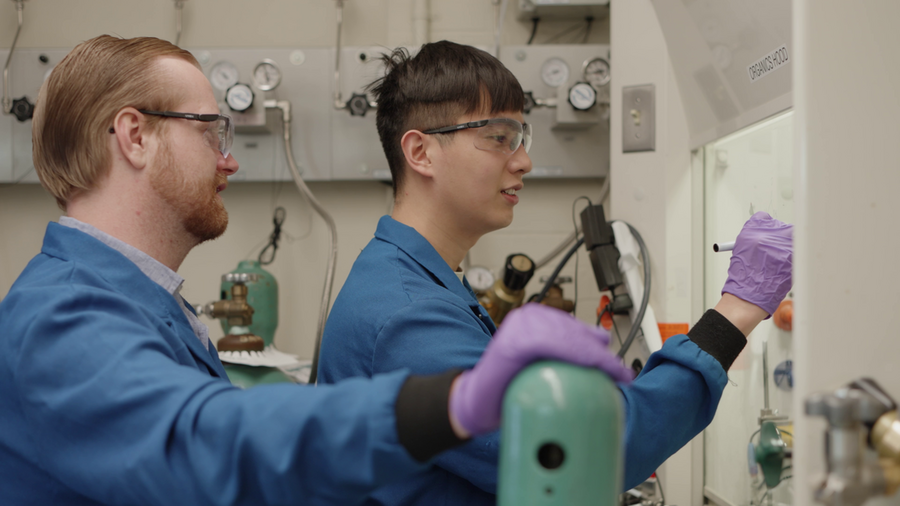
Glen Junor (left) and Fang-Yu Kuo work in the lab.
Credits:
Photo courtesy of the MIT Climate and Sustainability Consortium.
Related Topics
Related Articles