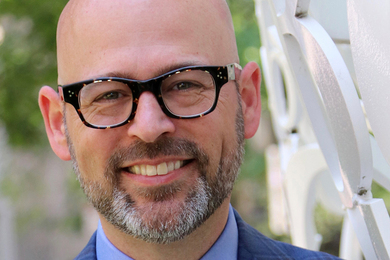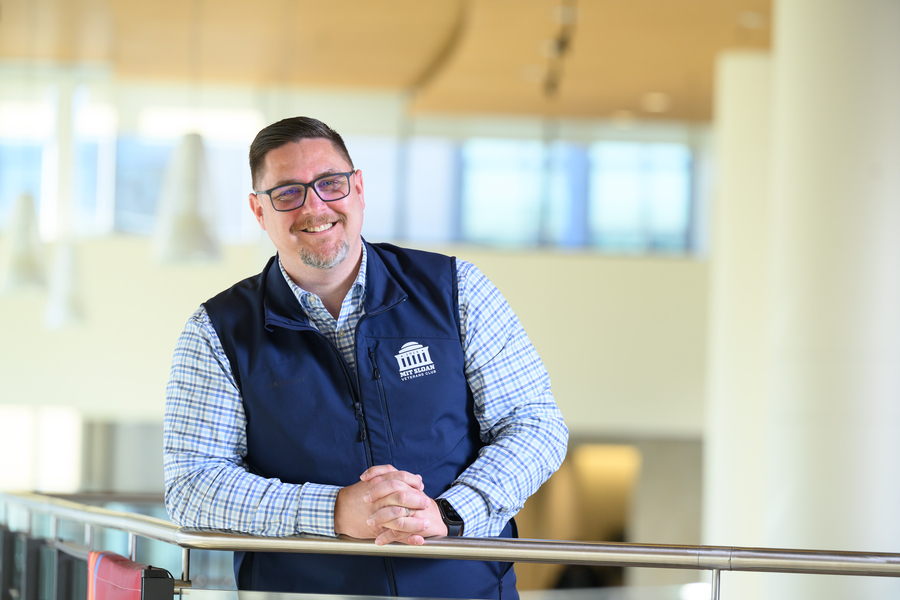
Greg Knutson is a military veteran who recently transitioned from 22 years of flying helicopters for the U.S. Navy to director of business development for Airbus U.S. Space and Defense. Now a second-year student in the MIT Sloan School Executive MBA program and a Pat Tillman Scholar, Knutson works to advance autonomous aircraft technology — while managing frequent travel, coursework and projects at MIT, and time with his wife and children in Houston. He also volunteers as a water polo coach, U.S. Naval Academy recruiter, and holds leadership positions in MIT's Space Industry and Venture Capital clubs.
For Knutson, the juggling act is worth it. "I enjoy being challenged. I enjoy learning new things," he says. "As soon as you stop learning is when you stop progressing."
Military roots and Navy service
Working on, alongside, or in aircraft is familiar territory for Knutson. "I am the son of a son of a sailor," he explains. Third-generation military, he grew up in Houston immersed in a pilot's world: His father flew jets for the U.S. Navy, and his grandfather worked on Navy planes.
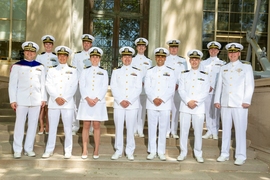
After graduating from the U.S. Naval Academy in 2001 with a degree in oceanography, Knutson completed training and earned his Naval Aviator Wings, which recognizes naval aviation mastery, in 2003. Throughout his career, he crewed three different variants of the H-60 Seahawk (the Navy equivalent to the Army's Black Hawk), as well as the uncrewed MQ-8 Fire Scout.
One experience in particular stands out from his early service. In 2004, Knutson joined his first operational squadron, HS-2 Golden Falcons, meeting the squadron on deployment shortly after the birth of his first son. When the Indian Ocean tsunami struck Indonesia on Dec. 26, Knutson’s carrier strike group was immediately diverted to support humanitarian assistance and disaster relief operations.
"For six weeks, we flew missions from sunrise to sunset, delivering food, water, medical supplies, and critical logistics to displaced populations across the region," Knutson recalls. "This experience left a lasting impression on me and reinforced the impact of military service beyond combat operations."
The high-stakes, high-performance nature of his flight operations satisfied Knutson’s drive for achievement, but the Navy provided him with more than just adrenaline and excitement. "You learn so much about perseverance. You learn about grit," he reflects. "You learn about how to complete a task when there's no set procedures for it."
During his lengthy Navy career, Knutson’s other assignments included three deployments to the United Arab Emirates and serving as commanding officer of the Helicopter Sea Combat Weapons School Atlantic, overseeing training for 6,000 personnel. For his final assignment as head of operations on the USS George Washington, Knutson led the ship's response to a Congressional inquiry following three suicides in a 10-day period. That experience profoundly shaped his views on leadership and human-centered decision-making.
Venturing beyond the comfort zone
Although he left the Navy in 2023, his hard-earned skills serve Knutson well in his current position at Airbus, which he joined in June 2025 to lead the company's Navy, Marine Corps, and Maritime Uncrewed Aerial Systems portfolio.
Knutson's Airbus team works with three main products designed to provide dynamic air support without requiring a human pilot on board. The uncrewed aircraft focus on intelligence collection, ranging from a small 55-pound drone with up to 14 hours of flight time supporting ground troops to high-stratospheric, solar-powered aircraft for sky surveillance. All function remotely, requiring only the press of a button for takeoff.
Prior to joining Airbus, Knutson worked for Venus Aerospace, where his manager, an MIT Leaders for Global Operations alumnus, encouraged him to consider applying to the MIT Sloan Executive MBA program. Initially, he worried it was too far out of reach.
A turning point came in 2024, however, when Venus Aerospace was selected to showcase at the Harvard Business School-MIT Sloan Technology and National Security Conference. Since his manager was unable to attend, Knutson represented the company at the event. While there, he realized MIT was where he wanted to be. "I connected deeply with the campus, the culture, and the students I met, and realized that the EMBA program aligned perfectly with my background and career goals," he says.
Although Knutson's undergraduate degree provides him with a foundation in math and physics, and decades of flying gave him intricate knowledge of aircraft, he has primarily worked on the business end of his Airbus team's projects. MIT is changing that.
"I have intentionally selected courses that expanded my breadth and pushed me outside my comfort zone," Knutson says. He has focused heavily on topics such as artificial intelligence, robotics, analytics, and deep learning. Core courses in the curriculum, like systems dynamics and data-informed decision-making, have given him a deeper understanding of building prototypes for his team's current major focus: converting a piloted helicopter to uncrewed operation. Thanks to the technical knowledge he’s gained at MIT, he says, "I have been able to start talking a lot more with the engineers at Airbus."
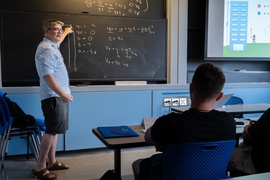
He’s also contributed to the program. During Independent Activities Period this year, Knutson and an Airbus chief engineer were guest lecturers for Confronting Unknowns, a short course in which they discussed how autonomous technology can be leveraged to perform functions that are difficult for pilots to execute.
Beyond coursework, through the MBA entrepreneurship and innovation track Knutson has also discovered a renewed passion for building new ventures. Most recently, he was selected for the National Science Foundation I-Corps Hub Spark program, for which he is developing a software- and AI-enabled solution focused on advanced manufacturing for contested and disrupted supply chains.
The art of juggling
Knutson works constantly to give back to communities that have given him so much. In Houston, he coaches the local children's water polo club, lending his experience from playing the sport in high school and at the Naval Academy. For the Navy, he volunteers as a Blue and Gold Officer, helping recruit and counsel potential candidates.
At MIT, he serves as vice president of both the Space Industry and Venture Capital clubs, is a Graduate Student Council board member, helped host the 2025 and 2026 Harvard Business School and MIT Sloan Technology and National Security Conference and MIT's 2026 Space Innovation Challenge, and is an active member of the Student Veterans Association. He also participated in the Blue Origin Space Industry Challenge as the team lead with MIT undergraduate and graduate students.
Taking on the EMBA program, on top of everything else, hasn't come without sacrifice. Knutson travels roughly 50 percent of the time for Airbus, and every two to three weeks spends Thursday through Saturday at MIT. "I'm definitely getting the miles on United, and Marriott points as well," he chuckles.
Knutson left the military to be home more with his family. Now, to accomplish this, he sometimes forgoes school or work to spend time with his wife and four children. Recently, he skipped a scheduled MIT weekend to attend a father-daughter event at his daughter's high school.
This juggling act hasn't gotten easier, Knutson reports, but while he has dedicated much of his time to his country and communities, it is ultimately his family that gives him the motivation and support to keep going. Looking ahead, he plans to continue bridging his military experience with emerging technologies by exploring opportunities at the intersection of entrepreneurship and advanced aircraft manufacturing — all while keeping his family at the center of his decisions.