GPS navigation, cryptography, quantum computing — while some of humankind’s greatest advancements have been invented by pioneers from various cultures, they were founded upon one common grammar: mathematics.
“Mathematics is the language with which God wrote the universe,” said the famous Italian astronomer, physicist, and philosopher Galileo Galilei, who, among his various scientific contributions, helped provide evidence for the idea that the sun is at the center of the solar system.
Although mostly conveyed through combinations of numbers, letters, and signs that may seem enigmatic to many, math equations hold within them countless stories — playbooks that generations of wonderers and inventors have crafted, refined, and shared in an attempt to make sense of a world full of unknown variables.
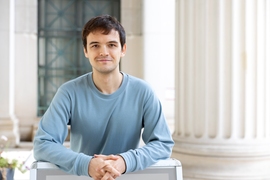
“I have faith in mathematics that, when there seems to be something special happening, when there’s some coincidence, that it’s not just a coincidence,” says mathematician Amanda Burcroff, “but that there’s actually some really deep, interesting, and involved reason for why that should be true.”
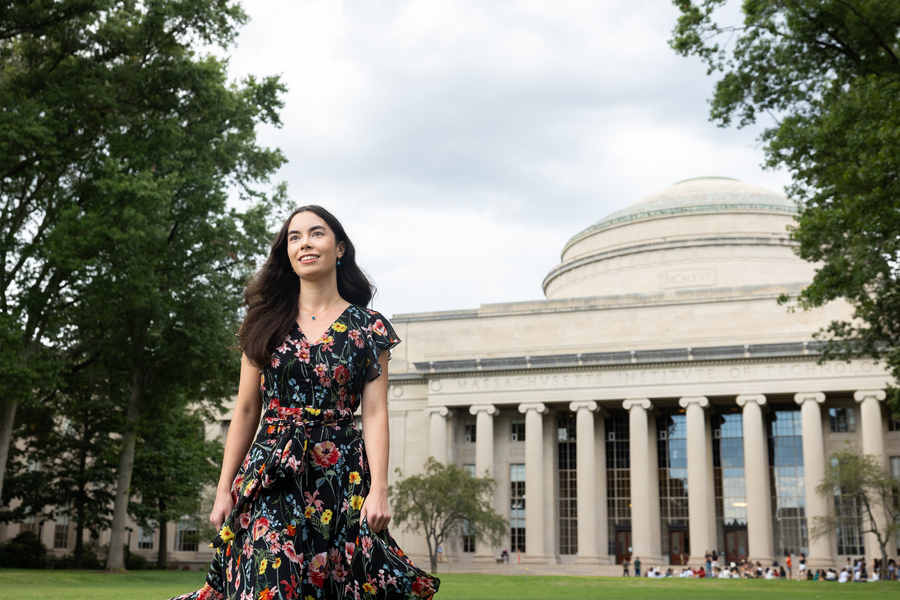
Burcroff’s research is focused on algebraic combinatorics, an area that provides discrete frameworks for understanding algebraic and geometric spaces that ubiquitously arise across science. This year, she joins MIT’s Department of Mathematics as a postdoc as part of the School of Science Dean’s Fellowship. Working with Professor Alexander Postnikov, Burcroff is building upon her techniques with the goal of applying them to other areas such as theoretical physics — a field that seeks to uncover the fundamental laws governing everything from subatomic particles to the cosmos itself.
“I have trust that if you keep following the path, eventually you’ll find the treasure — that is, whatever theorem or proof — that you’re looking for,” she says.
Exploring possibilities and redefining rules
Like many children, Burcroff once saw math as a subject that entailed lots of memorizing. Although she felt that it came naturally to her, she didn’t always find math very interesting.
In high school, as she came to learn about areas like calculus and geometry, Burcroff started to see the discipline in a different light — a creative approach to exploring what’s possible.
“[In] most other fields, the rules are imposed on you by the world,” she says, “but in math, you get full freedom to lay down those rules and then figure out what the implications of those rules are by using logical consequence.”
In 2015, Burcroff began her bachelor’s degree at the University of Michigan with a major in math and a minor in computer science. There, she entered the world of combinatorics — a branch of math dealing with counting, arranging, and combining objects that forms a crucial basis for understanding the complexity of problems, as well as the limits of computer algorithms.
“When I was starting out, I was just happy to have any mystery that anyone gave me,” she says.
Math was, to Burcroff, like a fun game with levels to complete. But during a study abroad program in Budapest, Hungary — the hometown of Paul Erdős, who is considered to be one of the most prolific mathematicians of the 20th century — it became more exciting to play when she was handed puzzles no one has yet solved.
“It turns out that if you put down the right set of rules, there’s an infinite number of beautiful things that you can do with it,” she says.
A journey of endless mysteries to unlock
In 2019, Burcroff embarked on a journey to pursue further research in England, later completing a master’s degree in pure mathematics at the University of Cambridge, then a research master’s degree at Durham University. In 2021, she returned to the United States and began her PhD at Harvard University, with the guidance of Professor Lauren Williams.
Among several riddles she has unraveled over the years, Burcroff helped unify different mathematical approaches to understand why systems work so reliably. Think of it as finding out that two seemingly different set of instructions actually lead the same way. By demonstrating their connections, her work has revealed an underlying, overarching mathematical architecture — a finding that later helped Burcroff and her collaborators tackle one of the many enduring riddles in her field.
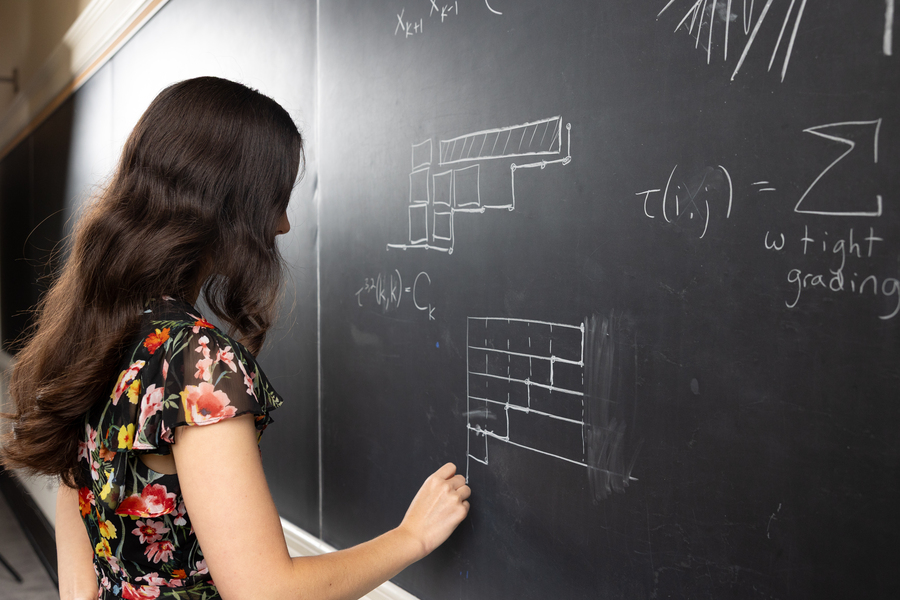
Generalized cluster algebras form the basis for describing geometries that appear throughout physics. For more than a decade, mathematicians suspected these building blocks were created only by adding up ingredients and never subtracting, although no one was able to prove it. In 2024, Burcroff and her collaborators published a paper demonstrating that these spaces have nice positivity properties by developing a new way to count and organize patterns — helping untangle a long-standing conjecture, whose potential implications span from predicting particle collision outcomes to describing the spaces appearing in string theory.
These findings have earned Burcroff numerous prestigious awards including a National Science Foundation Graduate Research Fellowship, a British Marshall Scholarship, and a Jack Kent Cooke Graduate Fellowship.
Despite the tremendous number of problems she has answered, new ones keep arising.
“Every time you unlock one of them, it gives you a bunch of paths to new connected mysteries,” Burcroff says.
At MIT, she is working with Postnikov, whose research on combinatorics and positivity-type problems has presented a radically different way to calculate fundamental quantities in quantum field theory.
“Burcroff is conducting research across disciplinary boundaries,” says Postnikov.
He adds: “I am sure that she will have a lot of fruitful interactions with researchers in other MIT departments.”
Burcroff’s goal is to apply combinatorial techniques to broader physical contexts and direct applications, especially those with implications to topics like mirror symmetry, a principle in string theory suggesting that very different-looking geometric spaces can be mathematically equivalent.
While “doing math is 99 percent trying something and failing,” Burcroff says it is this same challenge that keeps her motivated. To her, it is not about reaching a destination, but rather about the continuous “process of discovery,” one she hopes to share beyond the typical classroom.
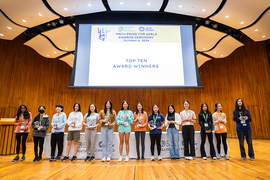
To make math more accessible, especially among underrepresented groups, Burcroff has worked with mentorship programs including Harvard’s Real Representations and Math Includes, Cambridge Girls’ Angle, and MIT PRIMES. During her time as a postdoc, she hopes to continue this outreach and explore ways to get involved with other support groups at MIT’s Department of Mathematics.