
School of Engineering third quarter 2019 awards
Faculty members recognized for excellence via a diverse array of honors, grants, and prizes over the last quarter.
Faculty members recognized for excellence via a diverse array of honors, grants, and prizes over the last quarter.
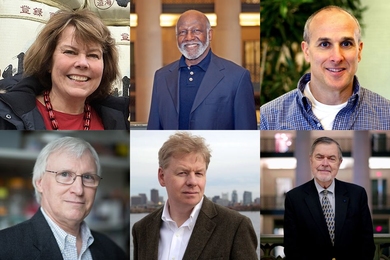
Baggeroer, Flynn, Harris, Klopfer, Lauffenburger, and Leonard are recognized for their efforts to advance science.
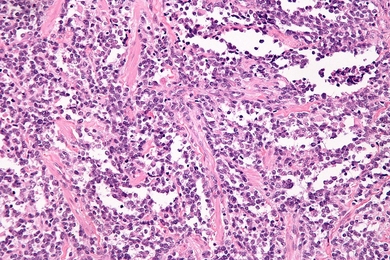
Team of researchers including MIT Professor Angela Koehler obtains $5.8 million grant to study fusion-positive alveolar rhabdomyosarcoma.
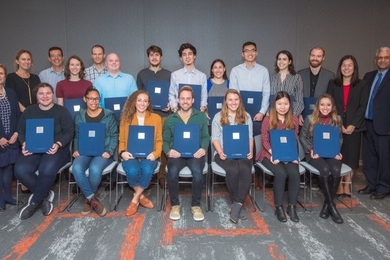
MIT students from the fields of bioengineering, business, computer science, and energy science receive the prestigious awards.
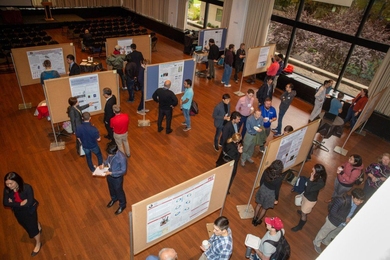
At the sixth annual Mechanical Engineering Research Exhibition, graduate students and postdocs sharpen their communication and presentation skills.
Award will support interdisciplinary research on the role of the human microbiome in health and disease.
James Collins, Pablo Jarillo-Herrero, and Richard Milner have won top prizes for their work.

Engineered signaling pathways could offer a new way to build synthetic biology circuits.

Study shows tumors with softer, larger cells at their periphery are more likely to spread; may suggest new route for cancer therapy.
![“The major research directions and technology platforms that [my] lab is known for today came out of this process where the students or I had a crazy idea, and then the lab executed on it, with all the twists and turns along the way,” says Paul Blainey, associate professor of biological engineering.](/sites/default/files/styles/term_page__news_article/public/images/201910/MIT-Blainey.jpg?itok=sTavLw_j)
His technology platforms have benefited genomics, diagnostics, and drug screening.
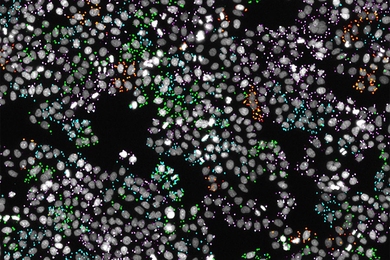
New image-based genetic screening method helps researchers identify key regulators of inflammation.
Specialized sugar molecules called glycans can disarm opportunistic pathogens and prevent infection.
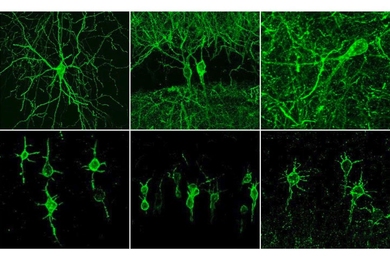
Fluorescent probe could allow scientists to watch circuits within the brain and link their activity to specific behaviors.
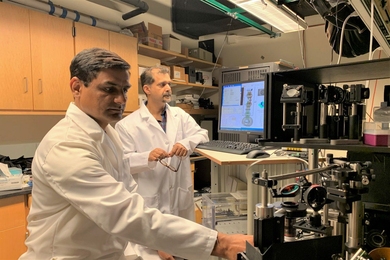
SMART has developed a new way to study cells, paving the way for a better understanding of how cancers spread and become deadly.

By tweaking bacteriophage genomes, MIT team creates a new weapon to combat infection.