Skip to content ↓

📬 Want a dose of MIT in your inbox? Subscribe to the MIT Daily and/or MIT Weekly newsletters.

Top News

Looking for audio? Listen to the MIT News podcast

Recent Highlights

More MIT News articles

In the Media

Fast Company

A new study co-authored by Sloan graduate student Anand Shah explores the growing use of AI across the legal system, reports Chris Stokel-Walker for Fast Company. “The pro se share of all civil cases has been 11% for quite some time,” says Shah. “And then in the post-AI world, we see it jumping all the way up to something like 18%.”

WBUR

Prof. Regina Barzilay speaks with WBUR’s Priyanka Dayal McCluskey about her work developing an AI risk detection tool that can analyze mammogram images and help predict risk of breast cancer before it happens or spreads. Barzilay, who describes the tool as a hi-tech weather forecast for breast health, notes that: “We really need to have tools that can help, rather than just staring at an image and trying to guess.” 

Cambridge Day

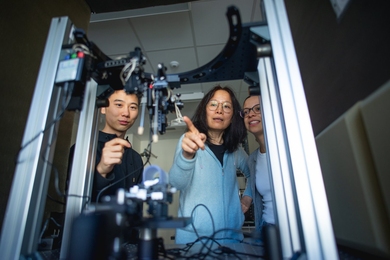
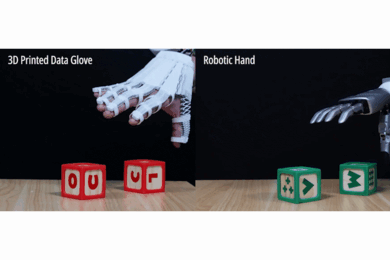
Cambridge Day reporter Zoe Beketova, a student in MIT’s Graduate Program in Science Writing, visits Prof. Xuanhe Zhao’s lab to get a hands-on look at the group’s ultrasound wristband that can map movements of the human body using sound waves, part of the group’s work aimed at changing “how we gather information from inside the body.” Says Zhao: “The mission of my lab is really merging humans with machines and AI. We believe there’s a huge opportunity [with] this interface.”

Fast Company

New research co-authored by Prof. Michiel Bakker examines the impact of using AI tools on an individual’s ability to solve a set of math problems, writes Jude Cramer for Fast Company. The researchers found that participants “who asked the AI for direct solutions saw the largest decline in solve rate and the largest increase in skip rate.” 

New York Times

New York Times reporter Melissa Kirsch spotlights a study by MIT scientists that explores how the “sound of rain causes some seeds to germinate faster.”

Ars Technica

A new tool developed by MIT researchers could help violin designers test how an instrument might sound when certain dimensions or properties are changed without even pulling out a bow, reports Jennifer Ouellette for Ars Technica. The researchers crafted a virtual violin, “a computer simulation tool that can capture the precise physics of the instrument and even reproduce a realistic sound of a plucked string,” Ouellette explains. 

National Public Radio (NPR)

Joseph Coughlin, director of the MIT AgeLab, speaks with NPR’s Allison Aubrey about his team’s work developing the Longevity Preparedness Index, which is aimed at helping people create a comprehensive plan for aging. “We want to look at all those big and little things that we take for granted in life," Coughlin says. "We may expect things won't change, but when a big life transition comes along — whether it's retiring from a profession, a death or unexpected sickness — many people have unintentionally ignored some of the very decisions that could help us thrive.” 

GBH

Prof. Kate Brown speaks with Zoe Matthews of GBH about growing interest in urban gardening. Matthews highlights Brown’s course about cooperative agriculture at MIT, during which “her students produced an accessible how-to guide on starting an urban farm.” 

Fortune

Fortune reporter Preston Fore spotlights Principal Research Scientist Andrew McAfee’s remarks warning against using AI technologies to replace entry level jobs. “How else are people going to learn to do the job except via on-the-job learning and training apprenticeship?” said McAfee. “That’s how you learn to do difficult knowledge work is by helping somebody who’s good at that with the routine stuff. And when we put too much automation in that too quickly, we lose that apprenticeship ladder.”

Forbes

Forbes contributor Michael T. Nietzel spotlights the 120 new members and 25 international members elected by the National Academy of Sciences for 2026. Several MIT faculty members – including Professors Michale Fee, Gareth McKinley, Keith Nelson, Bengt Holmstrom and Catherine Wolfram – were selected. 

CNN

Reporting for CNN, Caleb Hellerman spotlights how MIT computer scientists developed an AI program called Sybil that can “‘look’ at a single CT scan and generate a ‘risk score’ corresponding to the likelihood of the person developing cancer over any period up to six years.”

Community Updates

Featured Multimedia

Video thumbnail

What if time could be measured with near-perfect precision? Atomic clocks do exactly that, using atoms as nature’s most reliable timekeepers. Here’s how they work and why modern life depends on them.

Video thumbnail

MIT researcher Ryan Williams has uncovered a surprising connection between how long a computation takes and how much memory it needs. His new result shows that even very time-consuming problems can sometimes be solved using far less memory than expected, by cleverly reusing space.

Video thumbnail

Engineers have long struggled to replicate the strength, speed, and control of natural muscles. Now, new artificial fibers developed at the MIT Media Lab move closer to matching those qualities.

Video thumbnail

MIT engineers have designed an ultrasound wristband that precisely tracks a wearer’s hand movements in real- time. By moving their hands and fingers, users can direct a robot to perform specific hand gestures and tasks, or they can manipulate objects in a virtual environment with high dexterity control.

Video thumbnail

Dean of the MIT Sloan School of Management, Rick Locke is a scholar of international labor standards and comparative political economy. He discusses the MIT Sloan community and the future of management education.

More News