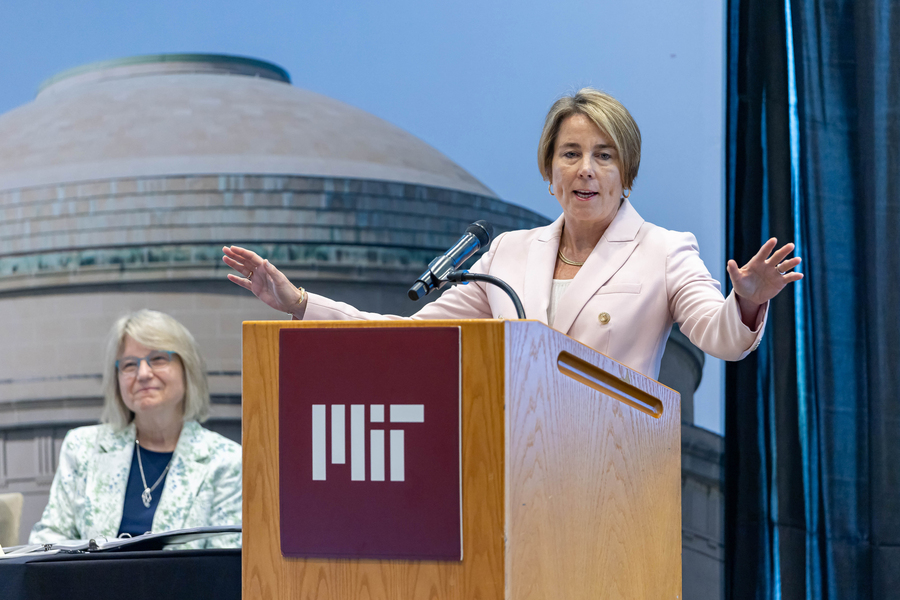
On May 28, MIT President Sally Kornbluth and Massachusetts Governor Maura Healey announced plans for a new laboratory to accelerate the development of next-generation quantum technologies that will enable Massachusetts to remain a national hub for quantum innovation.
Speaking at the Samberg Conference Center on campus, the leaders introduced the Quantum Systems Laboratory (QSL) at MIT, a shared-use facility that will catalyze quantum development in the region and help keep America at the forefront of a technology seen as critical for a range of industries.
“Quantum technologies have the potential to drive transformative change in fields from computing, security, and navigation to health sciences, defense technologies, and space exploration,” Kornbluth said. “Greater Boston has the greatest concentration of quantum talent of anywhere in the world, so it has been clear to us for some time that if we could magnify all of that talent with the right facilities — a shared quantum toolbox — we could establish Massachusetts as a national hub for quantum innovation and help catalyze the next generation of quantum technologies.”
The Quantum Systems Laboratory will join a state-of-the-art quantum computer with the components needed to make it a scalable, practical technology for solving complex, real-world problems. Such components include peripheral hardware such as sensors and quantum interconnects, which are physical channels that transfer quantum information. Located at MIT’s Building 39, the facilities will be open to researchers both from and beyond MIT.
Thanks to a $25 million investment from the state, announced today, which will match a portion of the federal funding for quantum research already underway at MIT, the Institute is now in a position to move forward as early as this summer with construction on the QSL facility. The Commonwealth’s investment adds to MIT’s own financial commitment, as well as generous philanthropic support from Thomas Tull.
“This is good news for MIT, good news for Massachusetts, and frankly, good news for the world that we’re working together to make this happen,” Healey said. “The return on investment is clear: We know the Quantum Systems Laboratory will be a first-of-its-kind center for the shared study and development of quantum science and technology. It’s going to unleash the great power of scientists and innovators from around the state and across the world, and also be a place for collaboration, both for academic and commercial ventures. It will offer incredible opportunities for both scientific progress and economic growth. It’s a testament to MIT’s unrelenting, unyielding belief in the power of openness and collaboration to advance science.”
The new lab will be the physical home for the MIT Quantum Initiative (or QMIT) announced by President Kornbluth in December. It also complements advanced facilities already used for quantum research at MIT, such as MIT.nano and MIT Lincoln Laboratory’s SQUILL foundry, both of which share the mission of democratizing access to world-class facilities. SQUILL and MIT.nano have already made a major impact on the quantum industry through research, startups, and new standards for creating and transmitting quantum information.
“I want to emphasize that just as MIT.nano is a facility for all, there will be many people from beyond MIT that come to use this equipment” at QSL, Kornbluth said. “This is a hub to make Massachusetts the center of the world for quantum. These resources are rare enough that we have to make sure they are available to our colleagues at the University of Massachusetts, Harvard, and beyond. Our plan is to mobilize all the talent in the area through this facility.”
Leading in quantum innovation is important for the prosperity and security of the country, but quantum research requires meticulously controlled environments. The new facilities will give scientists access to the cutting-edge quantum hardware and specialized experimental capabilities needed to achieve the full transformative potential of quantum science and engineering.
The new laboratory’s underlying mission is to return broad scientific, workforce, and economic benefit to the public.
For example, quantum technologies provide significant opportunities in the fields of life sciences and defense technologies, which are $50-billion contributors to the local economy, with dozens of startups working in the area. The new lab is designed to create new job opportunities in the form of academic research, startups, and more. Construction on the QSL facility alone is anticipated to create over 150 full-time, on-site jobs, plus another 75 to 100 jobs across the Commonwealth in supply chain and professional services supporting the project.
Startups from MIT are also a key driver of the region’s entrepreneurial ecosystem; in 2015, Sloan Professors Edward Roberts and Fiona Murray published a report detailing how the Institute’s alumni entrepreneurs have created more than 30,000 active companies, employing 4.6 million people and generating annual global revenues of $1.9 trillion, a figure greater than the gross domestic product (GDP) of the world’s 10th-largest economy, as of 2014. The QSL facility will provide the necessary equipment and facilities for startups working on quantum technologies, thereby strengthening the region’s innovation economy.