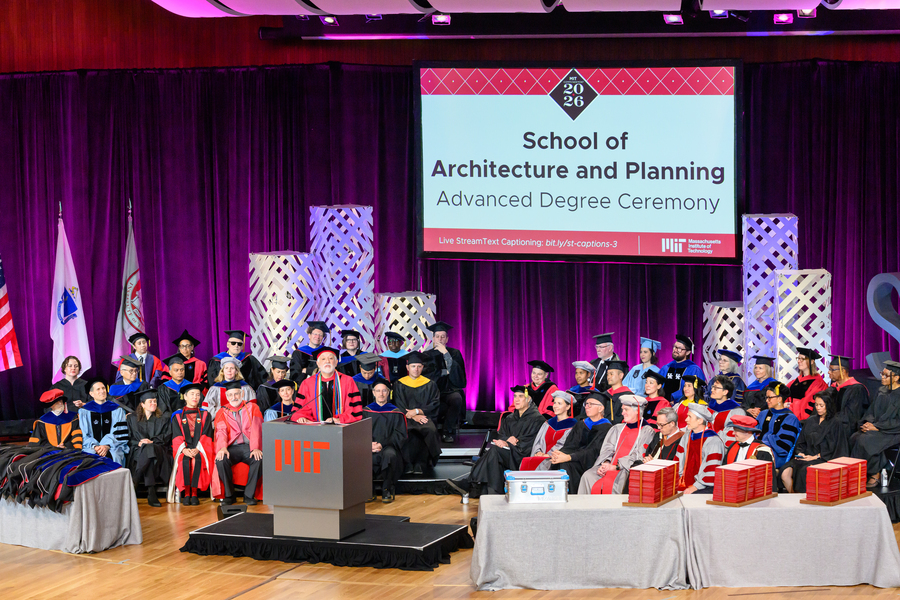
What distinguishes the MIT School of Architecture and Planning’s Class of 2026? According to faculty and staff across the school, it’s their hearts.
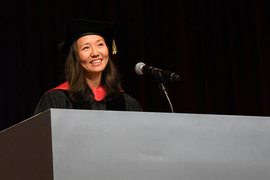
“They’re big-hearted in the way they deal with each other, with their work, and with the world,” said Hashim Sarkis, dean of SA+P, in his opening remarks at the school’s 2026 Advanced Degree Ceremony. As a nod to the class’s generosity, Sarkis announced the creation of the Class of 2026 Scholarship fund to help support incoming students.
“Education is a right, not a privilege, and this fellowship brings us closer to our goal of giving this right to every student and becoming tuition-free as a school,” said Sarkis.
The news was met with joyful and sustained applause.
The SA+P Class of 2026 represents graduates from each of the school’s departments: Architecture; Urban Studies and Planning; Media Arts and Sciences (MIT Media Lab); and the Center for Real Estate. The 206 graduates — including six with dual degrees — represent nearly every corner of the globe. Fifty-seven percent are from the United States, 10 percent are from China, and 5 percent are from India.
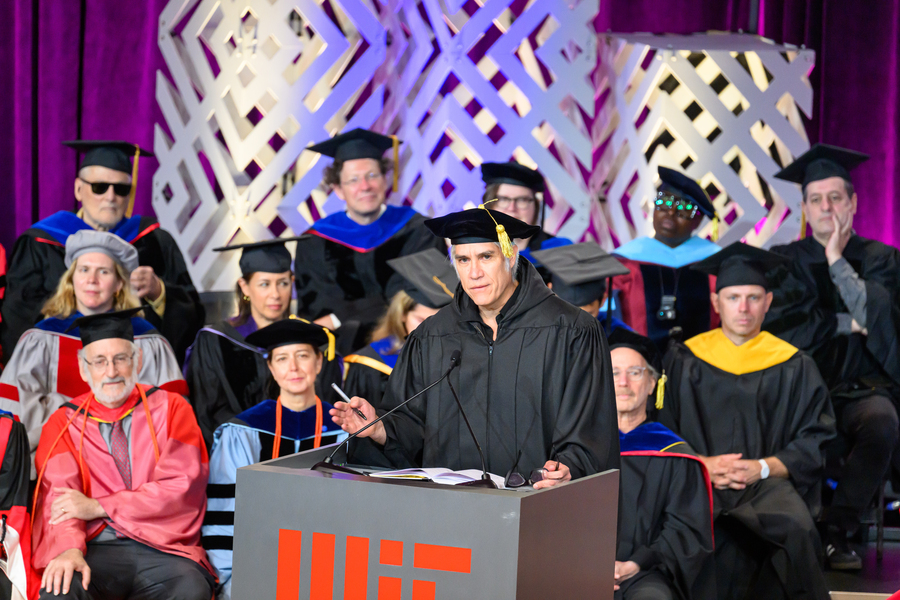
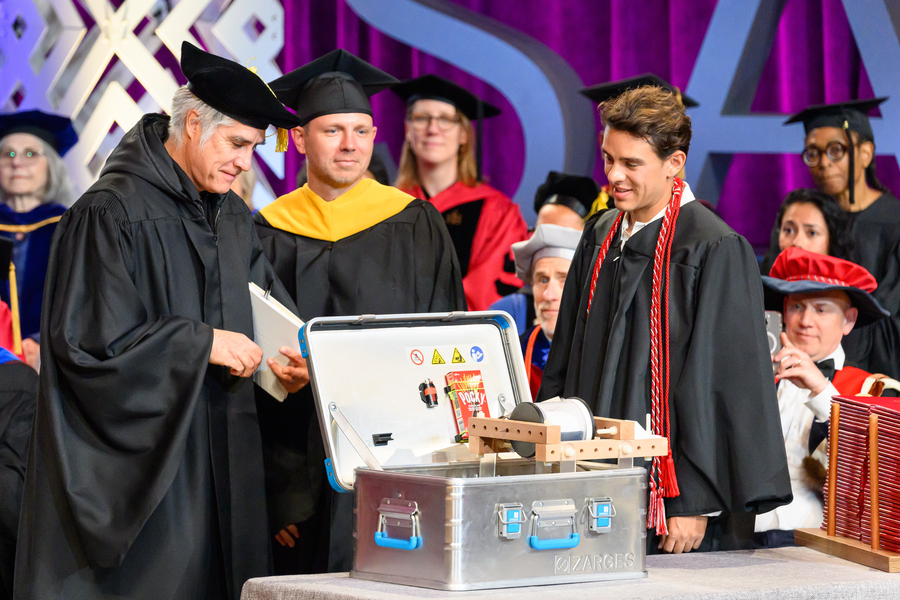
This year’s speaker was Alejandro Aravena, a celebrated Chilean architect whose credits include curating the 2016 Venice Architecture Biennale “Reporting From the Front,” and being awarded the Pritzker Prize (2016), the most prestigious award in architecture — for which he currently serves as jury chair. Aravena leads the architectural firm ELEMENTAL, based in Santiago, Chile, with work that spans a variety of public and private projects developing novel approaches to community engagement shaping how architects and policymakers think about the built environment.
Sarkis said Aravena speaks eloquently to the breadth of fields represented in SA+P, and to the school’s values, “[from] the power of architecture and design to enable society to his innovative models of social housing to creative approaches to community engagement — be it in emergency planning after earthquakes, or in institutional buildings — and to putting architecture front and center in the discussions around the new constitution of Chile.”
Addressing the students and their guests, Aravena shared a series of vignettes that illustrated a world at a “tipping point.” Will it land on the side of civilization, or barbarism?, he asked. One story was of his firm’s work on a project in Chile where his team encountered the “law of the jungle.” During a slum-upgrading project, two social workers from the Ministry of Housing were stalked on their way home by hired killers. With knives at their throats, they were warned never to return if they intended to interfere with the territorial power of organized crime. The message was clear: Come back, and your families will pay the price, he said. A more recent project — building a hospital for victims of sexual violence linked to the armed conflict in Colombia — had the architects questioning the level of violence that people inflict on each other.
If the “law of the jungle” was going to be the new normal, Aravena said, he needed to understand what that meant. Measuring the sizes of a prefrontal cortex — the brain’s command center that controls emotions, complex decision-making, and executive function — within the animal kingdom, humans have the largest capacity for emotions and behaviors.
“The history of humanity and the evolution of the human condition is connected,” he said. “It’s moving in the direction of the prefrontal cortex. Yet, somehow, we’re turning backwards.”
Aravena suggested the students use their newly acquired skills to work on projects that matter to others, and not to just themselves.
“Leveling the playing field, having more people behaving and coexisting in a more even playground, is very bad news for predators,” said Aravena. “Try to use this knowledge and wisdom you have and the training you have received in common interests, and not in just the self. Let’s try to bring back decency. Let’s try to bring back kindness. Let’s try to bring back honoring the truth. And let’s join forces to make the coin fall on the most human possible side.
“Class of 2026, together, let’s make the prefrontal cortex great again,” Aravena concluded.