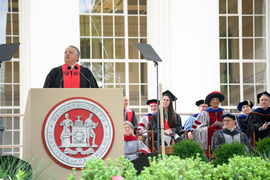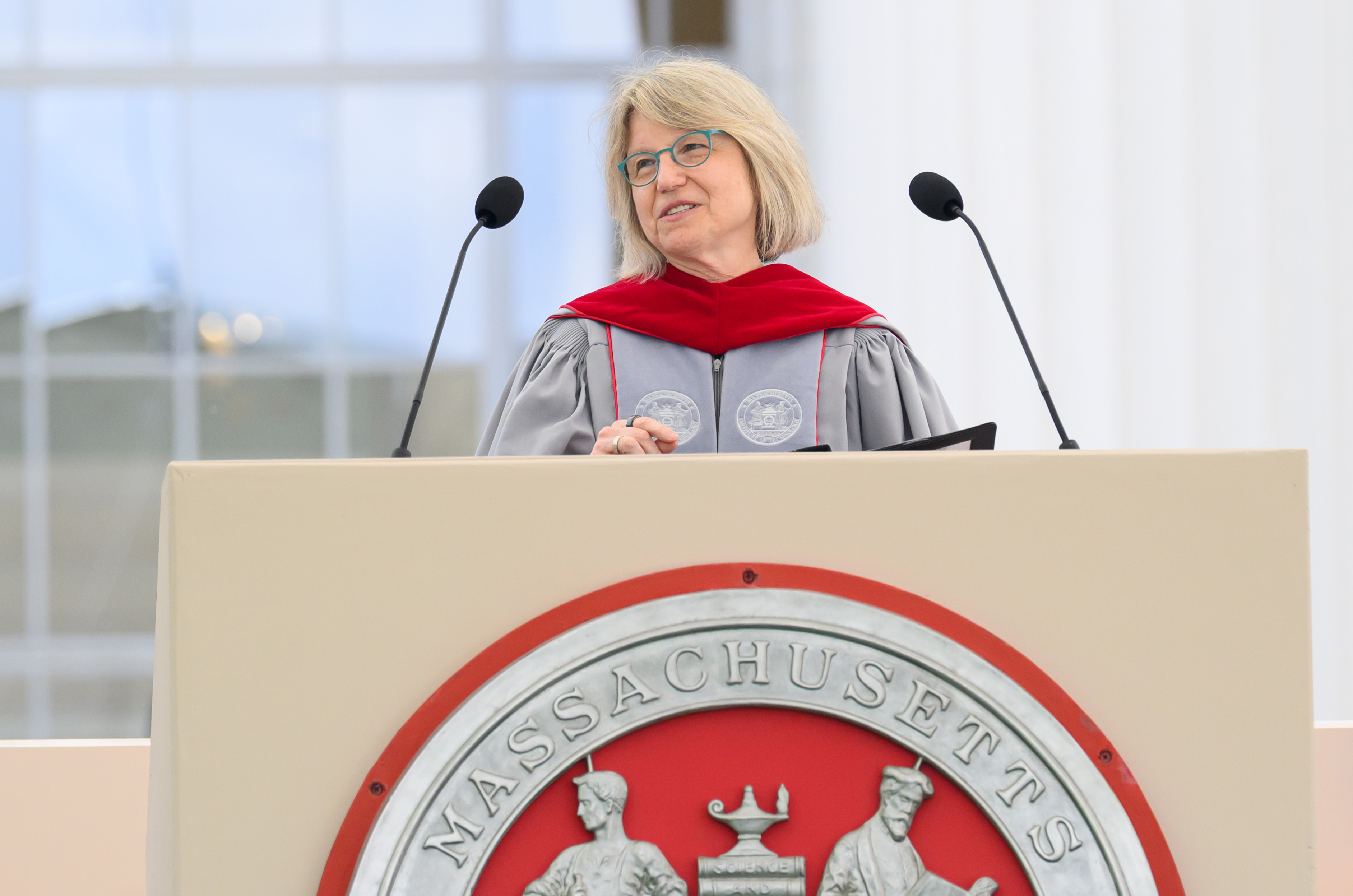
Below is the text of President Sally Kornbluth’s Commencement remarks, as prepared for delivery today.
Technically, as MIT’s president, it’s now my job to deliver a “charge” to the graduates.
But this year, I faced that assignment with a serious case of humility. You’re entering a world that I’m certain you’ll navigate better than I could.
So, for your “charge,” I decided to draw on a special resource: the collective wisdom of our alumni.
I talk with a lot of MIT graduates — around the world, across the country, on our faculty.
They each put it their own way. But nearly all of them talk about how MIT changed their lives. It wasn’t a subject they studied, or a skill they acquired. It was the whole MIT experience! Of living and working here, together, and of belonging to a community with our distinctive passions and values.

So, as you go out into the world, I want to emphasize a few of those values that will serve you wherever you go. The banners in Lobby 7 feature our whole MIT Values Statement. Let’s focus first on the two words at the top: Excellence and Curiosity.
Now, “excellence” is an easy thing to say. Most companies claim it. Probably every university too. But I have never seen a community live its commitment to excellence the way it’s done at MIT.
It’s easy to measure in the outward accomplishments of our faculty and graduates: the prizes, the discoveries, the inventions. The architecture and the industries. The companies and cures.
But you also feel it here, every day — when everyone you meet in the hallway wants to tell you about what they’re working on – and it just blows you away.
As members of this community, we strive to hold ourselves to “the highest standards of intellectual and creative excellence.” Just as important, we inspire each other to reach for those standards too!
(As one timely metaphor: This week 400 of you apparently felt that earning a degree from MIT wasn’t hard enough – so you also had to jump out of a plane!)
As an institution, we support these standards of individual excellence with a systematic focus on merit. For instance: No legacy admissions. No back-door admissions for donors.
Because we value “potential over pedigree.”
A long-ago colleague had a sign in his office. It said, “If you take a lick of the lollipop of mediocrity, you will suck forever.”
Now, let me be clear — I’m talking about self-discipline, not self-regard.
In the work we do, a conscious commitment to excellence is not the same as arrogance.
In fact, it’s kind of the opposite.
The American poet Walt Whitman captured this idea. As he wrote,
“I like the scientific spirit — the holding off, the being sure, but not too sure, the willingness to surrender ideas when the evidence is against them: This … keeps the way beyond open [and] … gives the whole man a chance to try over again.”
So I hope, wherever your life and work lead you, that you’ll strive to sustain our MIT standards of excellence.
And I also hope, in the spirit of Whitman, that you’ll “accept the risk of failing as a rung on the ladder of growth.” Because, in all the fields you’ve studied, the willingness to try, and fail, and try again is the golden path to breakthroughs!
Now, for curiosity.
A few months ago, I was interviewed by a journalist who understands the current challenges for higher education.
He described me as “inexplicably ebullient.”
(He doesn’t see me every day!)
But honestly, if I’m ebullient in leading this community, it’s entirely explicable!
MIT is custom-made for people whose curiosity never sleeps. Which describes our faculty, our staff, our alumni — and every one of you.
Feeding that curiosity is an incredible source of pleasure. You don’t need me to encourage you in this life-long feast!
But I do hope I can count on you to help the world understand that curiosity is also our intellectual rocket fuel — and that this fact is enormously important for our society as a whole.
At MIT, we know that curiosity-driven science is the path to new knowledge – the kind that spawns world-changing innovations.
Curiosity is the force that transforms deadly cancers into treatable conditions, that turns fusion energy from a dream to a reality, that uncovers new ways to grow more food using less of every resource.
We like to say that science is curiosity on a mission.
But we also know that the “curious” path to those deep discoveries can look like a wandering road.
(Years ago, after a long conversation about my PhD work, my own grandmother once asked, “Wait, you’re not trying to cure cancer in humans, you’re trying to give it to chickens?”)
Luckily, over eight decades, the United States had the foresight to see the value of discovery science. It invested public money with steady patience, knowing that the “practical payoff” could be 20, 30, 40 years away.
Today – as many of you know from experience in your own labs — US investment in curiosity-driven science is in sharp decline.
The tragedy here is that shrinking the pipeline of basic discovery research means choking off the flow of future solutions, innovations and cures – and shrinking the supply of future scientists.
So I hope you will join in a great shared effort to sustain the work of scientific curiosity — on a mission to serve.
A final thought: Every one of you here possesses uncommon talent. And with great talent comes great responsibility.
I have no doubt that, like our alumni, you will be top-flight performers in your fields: Innovators. Engineers. Scientists. Doctors and designers. Entrepreneurs, investors and astronauts. Pioneers in whatever realm you chose.
I mentioned Excellence and Curiosity, two of MIT's core values.
But I hope we also hold, together, another core value — the commitment to always act ethically, with integrity, and with consideration for our fellow human beings.
After more than six decades on Earth, I know that living up to this standard requires constant reinforcement and awareness! You will face many temptations, and opportunities to lose focus on that north star.
And you simply have to resist.
I have no doubt that, with your uncommon talent, you can do it!
And if you keep that goal in sight, I know you will do great things for the world.
Congratulations — and warmest best wishes to you for a happy life and fulfilling career!