Skip to content ↓

📬 Want a dose of MIT in your inbox? Subscribe to the MIT Daily and/or MIT Weekly newsletters.

Top News

Looking for audio? Listen to the MIT News podcast

Recent Highlights

More MIT News articles

In the Media

Forbes

Forbes contributor Michael T. Nietzel spotlights the 120 new members and 25 international members elected by the National Academy of Sciences for 2026. Four MIT faculty members – Professors Isaiah Andrews, David Atkin, Pablo Jarillo-Herrero and Benjamin Weiss – were selected along with 13 alumni. 

CNN

Reporting for CNN, Caleb Hellerman spotlights how MIT computer scientists developed an AI program called Sybil that can “‘look’ at a single CT scan and generate a ‘risk score’ corresponding to the likelihood of the person developing cancer over any period up to six years.”

GBH

Prof. Kate Brown speaks with Zoe Matthews of GBH about growing interest in urban gardening. Matthews highlights Brown’s course about cooperative agriculture at MIT, during which “her students produced an accessible how-to guide on starting an urban farm.” 

Fortune

Fortune reporter Preston Fore spotlights Principal Research Scientist Andrew McAfee’s remarks warning against using AI technologies to replace entry level jobs. “How else are people going to learn to do the job except via on-the-job learning and training apprenticeship?” said McAfee. “That’s how you learn to do difficult knowledge work is by helping somebody who’s good at that with the routine stuff. And when we put too much automation in that too quickly, we lose that apprenticeship ladder.”

Slate

President Sally Kornbluth joined Lizzie O’Leary of Slate’s "What Next: TBD" podcast for a live discussion, during which she stressed the importance of curiosity-driven science and emphasized why basic science is critical to our nation’s future. “If you think about long pathways, like immunotherapy for cancer, that began 30-40-years ago in basic immunotherapy research,” said Kornbluth. She added: “As one of the top institutions in the world it’s part of our responsibility to articulate the importance of science.” 

GBH

It may sound fishy, but Prof. Benedetto Marelli and postdoc Giorgio Rizzo have developed a method to up-cycle seafood waste into a coating for seeds that could help plants better withstand drought, while also creating more nutritious and sustainable crops. “It all starts with the idea that we need to find new ways to grow food and, in particular, find new ways to decrease the amount of fertilizers we use,” says Marelli.

Slate

Prof. Daron Acemoglu joins Slate’s “Money Talks” podcast to explain his research into pro-worker technologies and how we can not only avoid the AI job apocalypse but also improve workers’ lives by shifting the goal of AI from automation to collaboration. “Artificial intelligence is quite different than human intelligence,” says Acemoglu. “And when two things are different, a natural way to combine them is in a complimentary way.”

Boston Globe

President Emeritus L. Rafael Reif writes for The Boston Globe that with the advent of transformative AI, there is an urgent need for “a bilateral conversation between Washington and Beijing, focused on the shared dangers these technologies pose to each nation and to global stability. Both governments must work toward agreed guardrails, defining not just how this technology should be used but where it must never be applied. Red lines need to be defined, established, and agreed upon.” 

Scientific American

Scientific American reporter Bob Henderson spotlights how graduate student Jiaruo Li and Prof. Riccardo Comin are developing a new device for storing digital data using “an exotic kind of magnetism discovered in the same lab the previous year to make the device faster and more energy-efficient than any competing technology.” 

Tech Briefs

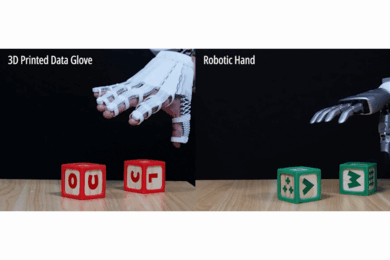
Prof. Xuanhe Zhao speaks with Tech Briefs reporter Andrew Corselli about his team’s work developing an ultrasound wristband that precisely tracks a wearer’s hand movements in real time and can communicate device these motions to a robot or a virtual environment. “For the future of human society, humanized robots will do lots of different work for us. For that work, we need a dexterous robotic hand,” explains Zhao. “We believe this ultrasound wristband, based on variable imaging, could be the future of really knowing the human hand motions.”

Slate

Prof. Daron Acemoglu joins Slate’s “Money Talks” podcast to explain his research into pro-worker technologies and how we can not only avoid the AI job apocalypse but also improve workers’ lives by shifting the goal of AI from automation to collaboration. “Artificial intelligence is quite different than human intelligence,” says Acemoglu. “And when two things are different, a natural way to combine them is in a complimentary way.”

Community Updates

Featured Multimedia

Video thumbnail

What if time could be measured with near-perfect precision? Atomic clocks do exactly that, using atoms as nature’s most reliable timekeepers. Here’s how they work and why modern life depends on them.

Video thumbnail

MIT researcher Ryan Williams has uncovered a surprising connection between how long a computation takes and how much memory it needs. His new result shows that even very time-consuming problems can sometimes be solved using far less memory than expected, by cleverly reusing space.

Video thumbnail

Engineers have long struggled to replicate the strength, speed, and control of natural muscles. Now, new artificial fibers developed at the MIT Media Lab move closer to matching those qualities.

Video thumbnail

MIT engineers have designed an ultrasound wristband that precisely tracks a wearer’s hand movements in real- time. By moving their hands and fingers, users can direct a robot to perform specific hand gestures and tasks, or they can manipulate objects in a virtual environment with high dexterity control.

Video thumbnail

Dean of the MIT Sloan School of Management, Rick Locke is a scholar of international labor standards and comparative political economy. He discusses the MIT Sloan community and the future of management education.

More News