Skip to content ↓

📬 Want a dose of MIT in your inbox? Subscribe to the MIT Daily and/or MIT Weekly newsletters.

Top News

Looking for audio? Listen to the MIT News podcast

Recent Highlights

More MIT News articles

In the Media

The Boston Globe

During his time as a visiting artist at the Media Lab, keyboardist Jordan Rudess worked with researchers from the Responsive Environments Group to develop “jam_bot, a machine learning model designed to emulate his playing style and improvise while performing alongside him,” reports Annie Sarlin for The Boston Globe

Reuters

Prof. Raymond Pierrehumbert and his colleagues have identified a molten planet orbiting a star in the Milky Way galaxy, reports Will Dunham for Reuters. "The era of exoplanet discovery ⁠keeps showing us ​new kinds of worlds, indeed 'strange new worlds,' generally stranger than anything in 'Star Trek,'" says Pierrehumber. “This offers all sorts of exciting opportunities to put together fundamental physics in very novel ways."

New York Times

A new working paper by researchers from MIT and other institutions explores the impact of the North American Free Trade Agreement (NAFTA), reports Ana Swanson for The New York Times. The researchers “found that American workers in communities that were more exposed to competition from Mexican imports saw a significant shortening of their life spans after the trade deal went into effect in 1994,” writes Swanson. 

Financial Times

Writing for the Financial Times, Prof. Danielle Li examines the risks for highly skilled workers whose expertise is used as training data for AI systems. “As workers, people should think about how to use AI to expand their skills: whether by building complementary capabilities or by finding ways to scale their expertise through AI systems,” Li writes. “As citizens, they should press for policies that give workers clearer rights over the data generated by their work and compensation for it.” 

GBH

Prof. Nergis Mavalvala, dean of the MIT School of Science, and Prof. Salvatore Vitale join Edgar B. Herwick III of GBH’s Curiosity Desk to discuss the science behind the Laser Interferometer Gravitational-wave Observatory (LIGO) and how close we are to unraveling the secrets of the early universe. LIGO has provided the ability to “observe the universe in ways that have never been done before,” says Mavalvala. 

CNN

Using the James Webb Space Telescope (JWST), astronomers from MIT and other institutions have determined that asteroid 2024 YR4 will not collide with the moon, reports Ashley Strickland for CNN. “Every time we observe an asteroid, we reduce the range of possible trajectories,” explains Prof. Julien de Wit. “In this case, the JWST observations both provided very precise positional measurements and significantly extended the time span over which the asteroid has been observed.”

MassLive

MIT has launched a new effort aimed at helping high schoolers across the U.S. tackle calculus, reports Juliet Schulman-Hall for MassLive. The new program, called the MIT4America Calculus Project, pairs trained MIT undergraduates and alumni with school districts across the U.S. to tutor high school students from Montana to Texas in calculus. The program “was created last year with an in-person summer calculus camp,” Schulman-Hall notes. “Since then, it has grown to include 14 school districts.” 

NPR

Florencia Pierri, associate curator of Science and Technology at the MIT Museum, speaks with NPR’s All Things Considered host Andrea Shea about the 150th anniversary of the world’s first telephone call. Alexander Graham Bell, the inventor of the telephone, “didn’t set out to create a telephone,” explains Pierri. “He set out to create a better telegraph. But still had this idea of, like, ‘wouldn’t it be cool if I could talk to somebody, even if I wasn’t right there in the room with them?’”

New York Times

Prof. Christopher Knittel speaks with New York Times reporter Emmett Lindner about how the conflict with Iran has influenced gas prices in the United States. “When there’s a supply disruption in the Middle East, that raises prices for every barrel of oil in the world,” explains Knittel. “Those price increases then trickle down to products that use oil, gasoline being the most relevant one.”

NPR

A new essay by Profs. Daron Acemoglu, David Autor and Simon Johnson, has offered “a more hopeful vision for the future of human work,” in a world infused with AI, reports Greg Rosalsky for NPR’s Planet Money. The authors “spend much of the essay providing a thought-provoking analysis of how new technologies can affect human jobs in general,” writes Rosalsky. “In short, it's complicated. Yes, often they do kill jobs. Other times they can make jobs less lucrative by, for example, making those jobs easier to do — or ‘de-skilling’ them — which means the supply of workers who can do these jobs goes up and wages for the occupation can go down.” 

Associated Press

Prof. Simon Johnson speaks with Associated Press reporter Paul Wiseman about how the conflict with Iran has impacted the global economy. “The Strait of Hormuz has to be reopened,” says Johnson. “It’s 20 million barrels of oil a day going through there. There’s no excess capacity anywhere in the world that can fill that gap.” 

Vogue

Vogue editor Lisa Wong Macabasco spotlights “Lighten Up! On Biology and Time,” a new exhibit at the MIT Museum that “traces the rhythms of life itself: circadian patterns, light’s command over the body, and the delicate architecture of alertness and rest.” The exhibit features “18 works that blend science and art, from immersive soundscapes to visualizations of circadian patterns and reflective spaces where you observe your own heartbeat and alertness in new ways,” explains Macabasco. 

Community Updates

Featured Multimedia

Video thumbnail

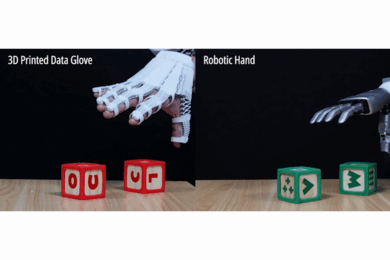
Joseph Paradiso of the MIT Media Lab advances wearable sensing technologies that translate human motion into data and sound, shaping research across dance, medicine, exploration, and human-technology interaction. His work has influenced fields from dance and sports medicine to environmental research and exploration.

Video thumbnail

MIT Lincoln Laboratory’s Communication Networks and Analysis Group develops resilient communication technologies that enable secure, seamless data sharing across space, air, and surface platforms—even in contested or congested environments.

Video thumbnail

MIT President Sally Kornbluth speaks with Associate Professor Emil Verner who examines how finance and the broader economy interact. In this episode they talk about why financial crises happen, how they ripple through economies and politics, and what they mean for individual financial stability.

Video thumbnail

In 16.85 Autonomy Capstone (Design and Testing of Autonomous Vehicles), AeroAstro students build software that allows autonomous flight vehicles to navigate unknown environments. Students develop software and hardware for a quad-rotor drone, navigating a challenging obstacle course. The course emphasizes systems-level thinking and real-world applications.

Video thumbnail

At MIT, our mission is to advance knowledge; to educate students in science, engineering, technology, humanities and social sciences; and to tackle the most pressing problems facing the world today. We are a community of hands-on problem-solvers in love with fundamental science and eager to make the world a better place.

Video thumbnail

Justin Kay's research focuses on making computer vision and machine learning systems more deployable and informative for science and decision-making, particularly for environmental and climate applications. Here he talks about AI and environmental conservation and answers some specific questions about his work.

More News