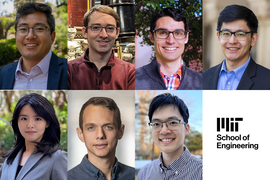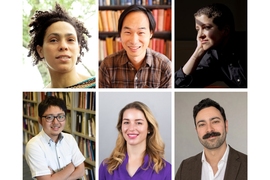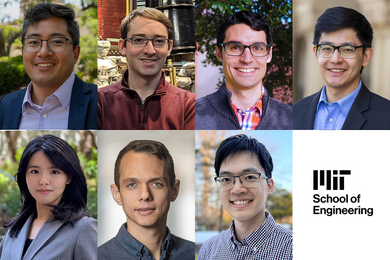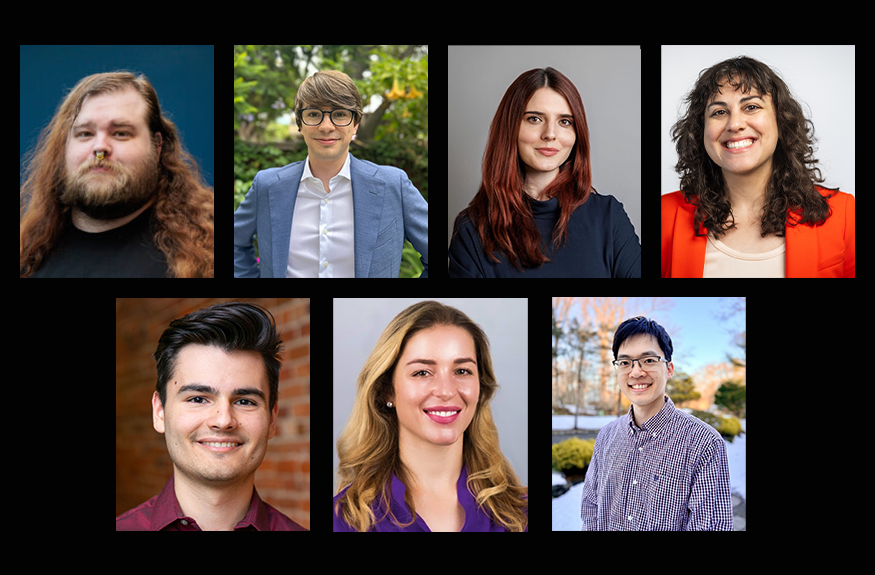
The MIT Schwarzman College of Computing welcomes seven new faculty members in core computing and shared positions to the MIT community in 2026. They’re inventing and using artificial intelligence and computing technologies in new ways to transform areas such as environmental science, quantum computing, human-AI interaction, and macroeconomics and finance.
“It’s a pleasure to welcome these outstanding faculty members to MIT, whose innovative research is leading advances in AI and computing and its impact on society,” says Dan Huttenlocher, dean of the MIT Schwarzman College of Computing and the Panasonic Professor of Electrical Engineering and Computer Science.
These hires include core faculty with appointments in the Department of Electrical Engineering and Computer Science (EECS), which reports jointly to the MIT Schwarzman College of Computing and School of Engineering, as well as shared faculty positions between the college and other departments, including Urban Studies and Planning, Mathematics, Economics; and, at MIT Sloan School of Management, the Finance Group and the Work and Organization Studies Group.
The new shared faculty include:
David Bruns-Smith, an assistant professor at the MIT Sloan School of Management, who holds an MIT Schwarzman College of Computing shared position with EECS, joined MIT in September. He is also a member of the Laboratory for Information and Decision Systems. His recent research has focused on debiased machine learning with applications in macroeconomics and household finance. Previously, he was a postdoc at Stanford Data Science, and he completed his PhD in computer science at the University of California at Berkeley.
Zana Buçinca, an assistant professor at the MIT Sloan School of Management, who holds an MIT Schwarzman College of Computing shared position with EECS, joined MIT in September. She is also a member of the Laboratory for Information and Decision Systems. Her research interests lie at the intersection of human-AI interaction and the future of work, and involve designing human-AI interaction techniques that complement people and amplify their values in AI-assisted work. She was a postdoc at Microsoft in the Office of Applied Research, and received her PhD in computer science from Harvard University.
Alexandra Cabral, an assistant professor in the Department of Urban Studies and Planning, who holds an MIT Schwarzman College of Computing shared position with the Institute for Data, Systems, and Society (IDSS), joined MIT in September. Her research focus includes low-cost sensor networks, smart cities, environmental informatics, and low-resource computing. Previously, she was a postdoc in the Ka Moamoa Lab at Georgia Tech and served as a 2025-26 NSF ICICLE Educational Fellow. She earned her PhD in computer science from Harvard University.
Alexandru Damian, an assistant professor in the Department of Mathematics, who holds an MIT Schwarzman College of Computing shared position with EECS, joined MIT in September. He is also a member of the Laboratory for Information and Decision Systems. His work is focused on developing a predictive, and ultimately prescriptive, theory of deep learning. He holds a BS in mathematics from Duke University and a PhD in applied and computational mathematics from Princeton University.
Lindsey Raymond PhD ’24, an assistant professor in the Department of Economics, who holds an MIT Schwarzman College of Computing shared position with EECS, joined MIT in July. She is also a member of LIDS. Her research involves the effects of digital technologies and artificial intelligence on labor markets, firms, and market competition. She was a postdoc in economics and computation at Microsoft, and earned her PhD from MIT Sloan.
The new core faculty are:
Jas Brooks, the KDD Career Development Professor in Communications and Technology, joined EECS as an assistant professor in September. They are also a member of the Computer Science and Artificial Intelligence Laboratory. Their work focuses on perceptual engineering: the design of computational interfaces that sense and modulate human sensory perception. Previously, they were a Rising Star in EECS, a Siebel Scholar, and a National Science Foundation Graduate Research Fellow. They hold a BS and PhD in computer science from the University of Chicago.
Hengyun (Harry) Zhou ’16 joined EECS as an assistant professor in March. He is also a member of the Research Laboratory of Electronics. His research focuses on accelerating the development of large-scale, fault-tolerant quantum computers through full-stack architectural innovation. Before coming to MIT, he previously served as the Quantum Error Correction Architecture Lead at QuEra Computing. He earned his PhD in physics from Harvard University.