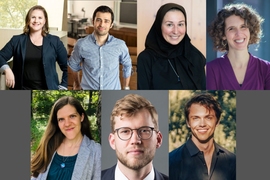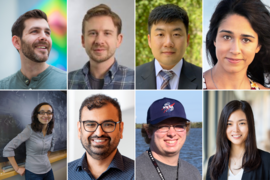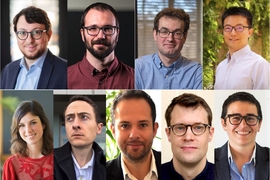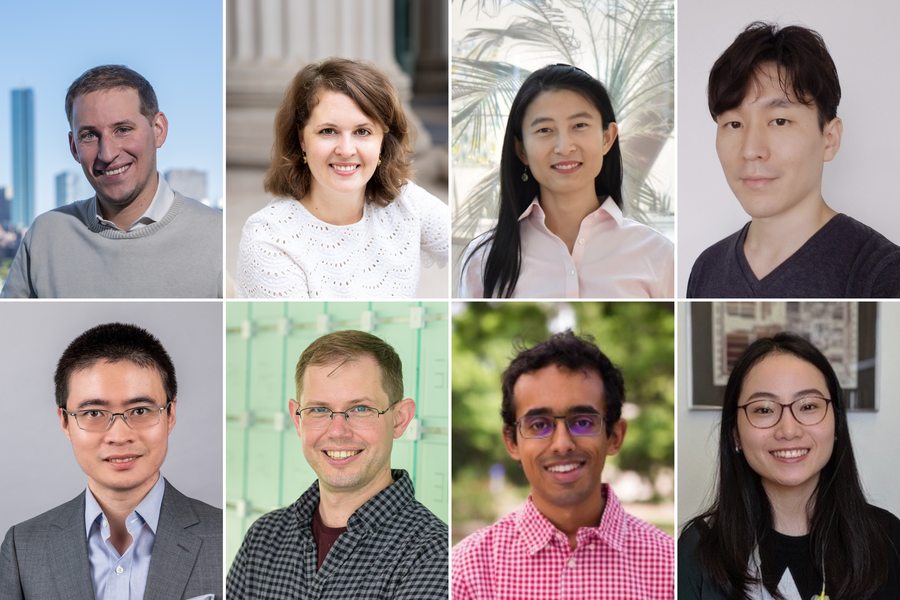
Eight MIT faculty and 22 additional MIT alumni are among 126 early-career researchers honored with 2026 Sloan Research Fellowships by the Alfred P. Sloan Foundation.
The fellowships honor exceptional researchers at U.S. and Canadian educational institutions, whose creativity, innovation, and research accomplishments make them stand out as the next generation of leaders. Winners receive a two-year, $75,000 fellowship that can be used flexibly to advance the fellow’s research.
"The Sloan Research Fellows are among the most promising early-career researchers in the U.S. and Canada, already driving meaningful progress in their respective disciplines," says Stacie Bloom, president and chief executive officer of the Alfred P. Sloan Foundation. "We look forward to seeing how these exceptional scholars continue to unlock new scientific advancements, redefine their fields, and foster the well-being and knowledge of all."
Including this year’s recipients, a total of 341 MIT faculty have received Sloan Research Fellowships since the program’s inception in 1955. The MIT recipients are:
Jacopo Borga is interested in probability theory and its connections to combinatorics, and in mathematical physics. He studies various random combinatorial structures — mathematical objects such as graphs or permutations — and their patterns and behavior at a large scale. This research includes random permutons, meanders, multidimensional constrained Brownian motions, Schramm-Loewner evolutions, and Liouville quantum gravity. Borga earned bachelor’s and master’s degrees in mathematics from the Università degli Studi di Padova in Italy, and a master’s degree in mathematics from Université Sorbonne Paris Cité in France, then proceeded to complete a PhD in mathematics at Unstitut für Mathematik at the Universität Zürich in Switzerland. Borga was an assistant professor at Stanford University before joining MIT as an assistant professor of mathematics in 2024.
Anna-Christina Eilers is an astrophysicist and assistant professor at MIT’s Department of Physics as well as a member of the MIT Kavli Institute for Astrophysics and Space Research. Her work explores how black holes form and evolve across cosmic time, studying their origins and the role they play in shaping our universe. She leverages multi-wavelength data from telescopes all around the world and in space to study how the first galaxies, black holes, and quasars emerged during an epoch known as the Cosmic Dawn of our universe. She grew up in Germany and completed her PhD at the Max Planck Institute for Astronomy in Heidelberg. Subsequently, she was awarded a NASA Hubble Fellowship and a Pappalardo Fellowship to continue her research at MIT, where she joined the faculty in 2023. Her work has been recognized with several honors, including the PhD Prize of the International Astronomical Union, the Otto Hahn Medal of the Max Planck Society, and the Ludwig Biermann Prize of the German Astronomical Society.
Linlin Fan is the Samuel A. Goldblith Career Development Assistant Professor of Applied Biology in the Department of Brain and Cognitive Sciences and the Picower Institute for Learning and Memory at MIT. Her lab focuses on the development and application of advanced all-optical physiological techniques to understand the plasticity mechanisms underlying learning and memory. She has developed and applied high-speed, cellular-precision all-optical physiological techniques for simultaneously mapping and controlling membrane potential in specific neurons in behaving mammals. Prior to joining MIT, Fan was a Helen Hay Whitney Postdoctoral Fellow in Karl Deisseroth’s laboratory at Stanford University. She obtained her PhD in chemical biology from Harvard University in 2019 with Adam Cohen. Her work has been recognized by several awards, including the Larry Katz Memorial Lecture Award from the Cold Spring Harbor Laboratory, Helen Hay Whitney Fellowship, Career Award at the Scientific Interface from the Burroughs Wellcome Fund, Klingenstein-Simons Fellowship Award, Searle Scholar Award, and NARSAD Young Investigator Award.
Yoon Kim is an associate professor in the Department of EECS and a principal investigator in the MIT Computer Science and Artificial Intelligence Laboratory (CSAIL) and the MIT-IBM Watson AI Lab, where he works on natural language processing and machine learning. Kim earned a PhD in computer science at Harvard University, an MS in data science from New York University, an MA in statistics from Columbia University, and BA in both math and economics from Cornell University. He joined EECS in 2021, after spending a year as a postdoc at MIT-IBM Watson AI Lab.
Haihao Lu PhD ’19 is the Cecil and Ida Green Career Development Assistant Professor, and an assistant professor of operations research/statistics at the MIT Sloan School of Management. Lu’s research lies at the intersection of optimization, computation, and data science, with a focus on pushing the computational and mathematical frontiers of large-scale optimization. Much of his work is inspired by real-world challenges faced by leading technology companies and optimization software companies, such as first-order methods and scalable solvers and data-driven optimization for resource allocation. His research has had real-world impact, generating substantial revenue and advancing the state of practice in large-scale optimization, and has been recognized by several research awards. Before joining MIT Sloan, he was an assistant professor at the University of Chicago Booth School of Business and a faculty researcher at Google Research’s large-scale optimization team. He obtained his PhD in mathematics and operations research at MIT in 2019.
Brett McGuire is the Class of 1943 Career Development Associate Professor of Chemistry at MIT. He completed his undergraduate studies at the University of Illinois at Urbana-Champaign before earning an MS from Emory University and a PhD from the Caltech, both in physical chemistry. After Jansky and Hubble postdoctoral fellowships at the National Radio Astronomy Observatory, he joined the MIT faculty in 2020 and was promoted to associate professor in 2025. The McGuire Group integrates physical chemistry, molecular spectroscopy, and observational astrophysics to explore how the chemical building blocks of life evolve alongside the formation of stars and planets.
Anand Natarajan PhD ’18 is an associate professor in EECS and a principal investigator in CSAIL and the MIT-IBM Watson AI Lab. His research is mainly in quantum complexity theory, with a focus on the power of interactive proofs and arguments in a quantum world. Essentially, his work attempts to assess the complexity of computational problems in a quantum setting, determining both the limits of quantum computers’ capability and the trustworthiness of their output. Natarajan earned his PhD in physics from MIT, and an MS in computer science and BS in physics from Stanford University. Prior to joining MIT in 2020, he spent time as a postdoc at the Institute for Quantum Information and Matter at Caltech.
Mengjia Yan is an associate professor in the Department of EECS and a principal investigator in CSAIL. She is a security computer architect whose research advances secure processor design by bridging computer architecture, systems security, and formal methods. Her work identifies critical blind spots in hardware threat models and improves the resilience of real-world systems against information leakage and exploitation. Several of her discoveries have influenced commercial processor designs and contributed to changes in how hardware security risks are evaluated in practice. In parallel, Yan develops architecture-driven techniques to improve the scalability of formal verification and introduces new design principles toward formally verifiable processors. She also designed the Secure Hardware Design (SHD) course, now widely adopted by universities worldwide to teach computer architecture security from both offensive and defensive perspectives.
The following MIT alumni also received fellowships:
Ashok Ajoy PhD ’16
Chibueze Amanchukwu PhD ’17
Annie M. Bauer PhD ’17
Kimberly K. Boddy ’07
danah boyd SM ’02
Yuan Cao SM ’16, PhD ’20
Aloni Cohen SM ’15, PhD ’19
Fei Dai PhD ’19
Madison M. Douglas ’16
Philip Engel ’10
Benjamin Eysenbach ’17
Tatsunori B. Hashimoto SM ’14, PhD ’16
Xin Jin ’10
Isaac Kim ’07
Christina Patterson PhD ’19
Katelin Schutz ’14
Karthik Shekhar PhD ’15
Shriya S. Srinivasan PhD ’20
Jerzy O. Szablowski ’09
Anna Wuttig PhD ’18
Zoe Yan PhD ’20
Lingfu Zhang ’18