Biology-based brain model matches animals in learning, enables new discovery
New “biomimetic” model of brain circuits and function at multiple scales produced naturalistic dynamics and learning, and even identified curious behavior by some neurons.
MIT researchers tested their theory of spatial computing, which holds that the brain recruits and controls ad hoc groups of neurons for cognitive tasks by applying brain waves to patches of the cortex.
Time and again, an unassuming roundworm has illuminated aspects of biology with major consequences for human health.
Research illustrates how areas within the brain’s executive control center tailor messages in specific circuits with other brain regions to influence them with information about behavior and feelings.
Tracking how fruit fly motor neurons edit their RNA, neurobiologists cataloged hundreds of target sites and varying editing rates, finding many edits altered communication- and function-related proteins.
Eleven new professors join the departments of Biology; Brain and Cognitive Sciences; Earth, Atmospheric and Planetary Sciences; Mathematics; and Physics.
Temporarily anesthetizing the retina briefly reverts the activity of the visual system to that observed in early development and enables growth of responses to the amblyopic (“lazy”) eye.
MIT researchers discover how an immune system molecule triggers neurons to shut down social behavior in mice modeling infection.
Seven speakers from around the country convened at MIT to describe some of the latest research on the neural mechanisms that we need to survive.
Five volunteers received 40Hz stimulation for around two years after an early-stage clinical study. Those with late-onset Alzheimer’s performed better on assessments than Alzheimer’s patients outside the trial.
Cultured from induced pluripotent stem cells, “miBrains” integrate all major brain cell types and model brain structures, cellular interactions, activity, and pathological features.
New research shows attention lapses due to sleep deprivation coincide with a flushing of fluid from the brain — a process that normally occurs during sleep.
Scientists identified how circuit connections in fruit flies tune to the right size and degree of signal transmission capability. Understanding this could lead to a way to tweak abnormal signal transmission in certain disorders.
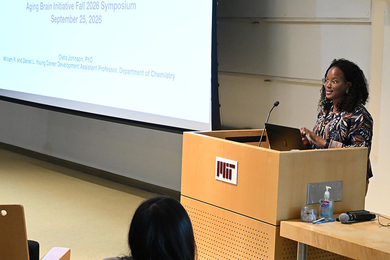
Speakers at MIT’s Aging Brain Initiative symposium described how immune system factors during aging contribute to Alzheimer’s, Parkinson’s and other conditions. The field is leveraging that knowledge to develop new therapies.
MIT researchers employed a novel application of tools and analysis to show that astrocytes ensure neural information processing by maintaining ambient levels of the neurotransmitter chemical GABA.