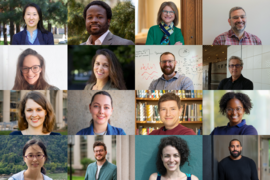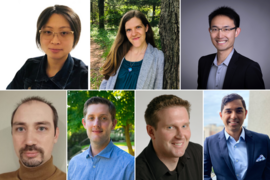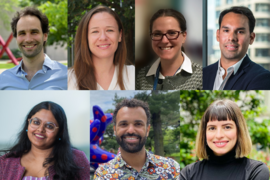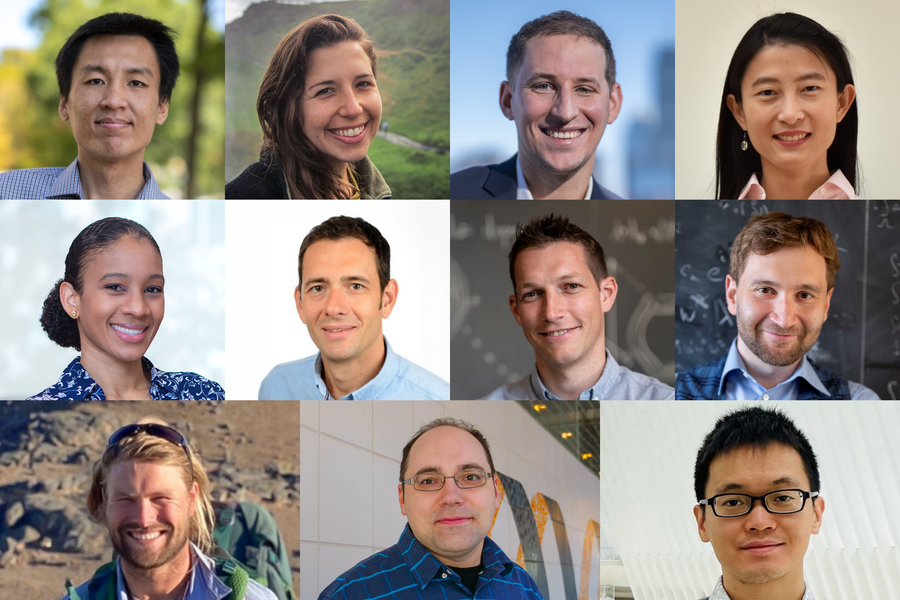
The School of Science welcomed 11 new faculty members in 2024.
Shaoyun Bai researches symplectic topology, the study of even-dimensional spaces whose properties are reflected by two-dimensional surfaces inside them. He is interested in this area’s interaction with other fields, including algebraic geometry, algebraic topology, geometric topology, and dynamics. He has been developing new tool kits for counting problems from moduli spaces, which have been applied to classical questions, including the Arnold conjecture, periodic points of Hamiltonian maps, higher-rank Casson invariants, enumeration of embedded curves, and topology of symplectic fibrations.
Bai completed his undergraduate studies at Tsinghua University in 2017 and earned his PhD in mathematics from Princeton University in 2022, advised by John Pardon. Bai then held visiting positions at MSRI (now known as Simons Laufer Mathematical Sciences Institute) as a McDuff Postdoctoral Fellow and at the Simons Center for Geometry and Physics, and he was a Ritt Assistant Professor at Columbia University. He joined the MIT Department of Mathematics as an assistant professor in 2024.
Abigail Bodner investigates turbulence in the upper ocean using remote sensing measurements, in-situ ocean observations numerical simulations, climate models, and machine learning. Her research explores how the small-scale physics of turbulence near the ocean surface impacts the large-scale climate.
Bodner earned a BS and MS from Tel Aviv University studying mathematics and geophysics, atmospheric and planetary sciences. She then went on to Brown University, earning an MS in applied mathematics before completing her PhD studies in 2021 in Earth, environmental, and planetary science. Prior to coming to MIT, Bodner was a Simons Society Junior Fellow at New York University. Abigail Bodner is an assistant professor in the Department of Earth, Atmospheric, and Planetary Sciences, holding an MIT Schwarzman College of Computing shared position with the Department of Electrical Engineering and Computer Science.
Jacopo Borga is interested in probability theory and its connections to combinatorics, and in mathematical physics. He studies various random combinatorial structures — mathematical objects such as graphs or permutations — and their patterns and behavior at a large scale. This research includes random permutons, meanders, multidimensional constrained Brownian motions, Schramm-Loewner evolutions, and Liouville quantum gravity.
Borga earned bachelor’s and master’s degrees in mathematics from the Università degli Studi di Padova, and a master’s degree in mathematics from Université Sorbonne Paris Cité (USPC), then proceeded to complete a PhD in mathematics at Unstitut für Mathematik at the Universität Zürich. Borga was an assistant professor at Stanford University before joining MIT as an assistant professor of mathematics in 2024.
Linlin Fan aims to decipher the neural codes underlying learning and memory and to identify the physical basis of learning and memory. Her research focus is on the learning rules of brain circuits — what kinds of activity trigger the encoding and storing of information — how these learning rulers are implemented, and how memories can be inferred from mapping neural functional connectivity patterns. To answer these questions, Fan’s group leverages high-precision, all-optical technologies to map and control the electrical charges of neurons within the brain.
Fan earned her PhD at Harvard University after undergraduate studies at Peking University in China. She joined the MIT Department of Brain and Cognitive Sciences as the Samuel A. Goldblith Career Development Professor of Applied Biology, and the Picower Institute for Learning and Memory as an investigator in January 2024. Previously, Fan worked as a postdoc at Stanford University.
Whitney Henry investigates ferroptosis, a type of cell death dependent on iron, to uncover how oxidative stress, metabolism, and immune signaling intersect to shape cell fate decisions. Her research has defined key lipid metabolic and iron homeostatic programs that regulate ferroptosis susceptibility. By uncovering the molecular factors influencing ferroptosis susceptibility, investigating its effects on the tumor microenvironment, and developing innovative methods to manipulate ferroptosis resistance in living organisms, Henry’s lab aims to gain a comprehensive understanding of the therapeutic potential of ferroptosis, especially to target highly metastatic, therapy-resistant cancer cells.
Henry received her bachelor's degree in biology with a minor in chemistry from Grambling State University and her PhD from Harvard University. Following her doctoral studies, she worked at the Whitehead Institute for Biomedical Research and was supported by fellowships from the Jane Coffin Childs Memorial Fund for Medical Research and the Ludwig Center at MIT. Henry joined the MIT faculty in 2024 as an assistant professor in the Department of Biology and a member of the Koch Institute for Integrative Cancer Research, and was recently named the Robert A. Swanson (1969) Career Development Professor of Life Sciences and a HHMI Freeman Hrabowski Scholar.
Gian Michele Innocenti is an experimental physicist who probes new regimes of quantum chromodynamics (QCD) through collisions of ultra relativistic heavy ions at the Large Hadron Collider. He has developed advanced analysis techniques and data-acquisition strategies that enable novel measurements of open heavy-flavor and jet production in hadronic and ultraperipheral heavy-ion collisions, shedding light on the properties of high-temperature QCD matter and parton dynamics in Lorentz-contracted nuclei. He leads the MIT Pixel𝜑 program, which exploits CMOS MAPS technology to build a high-precision tracking detector for the ePIC experiment at the Electron–Ion Collider.
Innocenti received his PhD in particle and nuclear physics at the University of Turin in Italy in early 2014. He then joined the MIT heavy-ion group in the Laboratory of Nuclear Science in 2014 as a postdoc, followed by a staff research physicist position at CERN in 2018. Innocenti joined the MIT Department of Physics as an assistant professor in January 2024.
Mathematician Christoph Kehle's research interests lie at the intersection of analysis, geometry, and partial differential equations. In particular, he focuses on the Einstein field equations of general relativity and our current understanding of gravitation, which describe how matter and energy shape spacetime. His work addresses the Strong Cosmic Censorship conjecture, singularities in black hole interiors, and the dynamics of extremal black holes.
Prior to joining MIT, Kehle was a junior fellow at ETH Zürich and a member at the Institute for Advanced Study in Princeton. He earned his bachelor’s and master’s degrees at Ludwig Maximilian University and Technical University of Munich, and his PhD in 2020 from the University of Cambridge. Kehle joined the Department of Mathematics as an assistant professor in July 2024.
Aleksandr Logunov is a mathematician specializing in harmonic analysis and geometric analysis. He has developed novel techniques for studying the zeros of solutions to partial differential equations and has resolved several long-standing problems, including Yau’s conjecture, Nadirashvili’s conjecture, and Landis’ conjectures.
Logunov earned his PhD in 2015 from St. Petersburg State University. He then spent two years as a postdoc at Tel Aviv University, followed by a year as a member of the Institute for Advanced Study in Princeton. In 2018, he joined Princeton University as an assistant professor. In 2020, he spent a semester at Tel Aviv University as an IAS Outstanding Fellow, and in 2021, he was appointed full professor at the University of Geneva. Logunov joined MIT as a full professor in the Department of Mathematics in January 2024.
Lyle Nelson is a sedimentary geologist studying the co-evolution of life and surface environments across pivotal transitions in Earth history, especially during significant ecological change — such as extinction events and the emergence of new clades — and during major shifts in ocean chemistry and climate. Studying sedimentary rocks that were tectonically uplifted and are now exposed in mountain belts around the world, Nelson’s group aims to answer questions such as how the reorganization of continents influenced the carbon cycle and climate, the causes and effects of ancient ice ages, and what factors drove the evolution of early life forms and the rapid diversification of animals during the Cambrian period.
Nelson earned a bachelor’s degree in earth and planetary sciences from Harvard University in 2015 and then worked as an exploration geologist before completing his PhD at Johns Hopkins University in 2022. Prior to coming to MIT, he was an assistant professor in the Department of Earth Sciences at Carleton University in Ontario, Canada. Nelson joined the EAPS faculty in 2024.
Protein evolution is the process by which proteins change over time through mechanisms such as mutation or natural selection. Biologist Sergey Ovchinnikov uses phylogenetic inference, protein structure prediction/determination, protein design, deep learning, energy-based models, and differentiable programming to tackle evolutionary questions at environmental, organismal, genomic, structural, and molecular scales, with the aim of developing a unified model of protein evolution.
Ovchinnikov received his BS in micro/molecular biology from Portland State University in 2010 and his PhD in molecular and cellular biology from the University of Washington in 2017. He was next a John Harvard Distinguished Science Fellow at Harvard University until 2023. Ovchinnikov joined MIT as an assistant professor of biology in January 2024.
Shu-Heng Shao explores the structural aspects of quantum field theories and lattice systems. Recently, his research has centered on generalized symmetries and anomalies, with a particular focus on a novel type of symmetry without an inverse, referred to as non-invertible symmetries. These new symmetries have been identified in various quantum systems, including the Ising model, Yang-Mills theories, lattice gauge theories, and the Standard Model. They lead to new constraints on renormalization group flows, new conservation laws, and new organizing principles in classifying phases of quantum matter.
Shao obtained his BS in physics from National Taiwan University in 2010, and his PhD in physics from Harvard University in 2016. He was then a five-year long-term member at the Institute for Advanced Study in Princeton before he moved to the Yang Institute for Theoretical Physics at Stony Brook University as an assistant professor in 2021. In 2024, he joined the MIT faculty as an assistant professor of physics.