That there is tremendous potential for nanotechnology to transform cancer detection and treatment is a vision that has guided faculty at the Marble Center for Cancer Nanomedicine through its first 10 years.
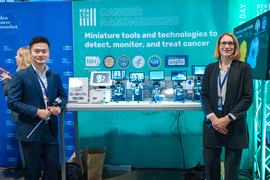
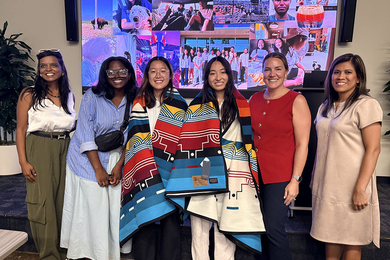
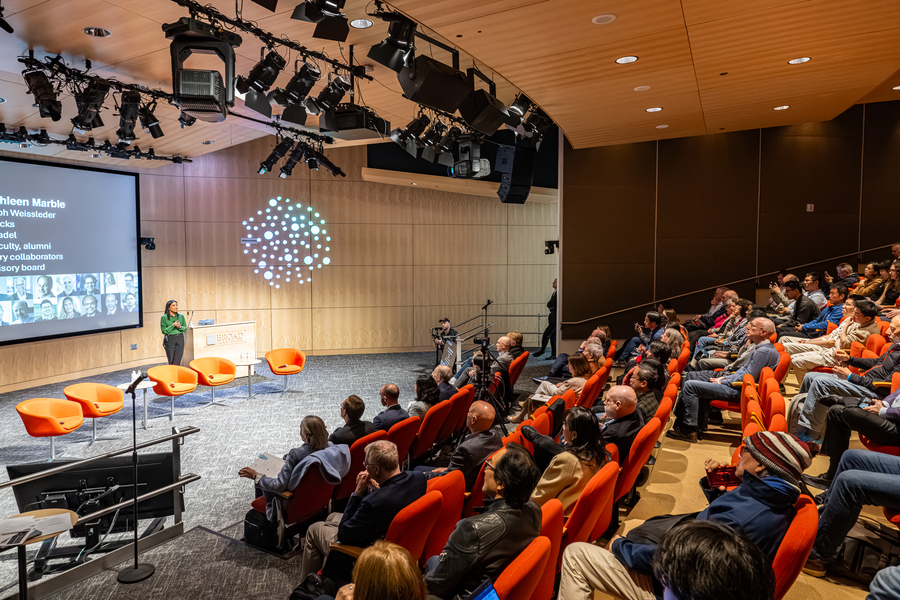
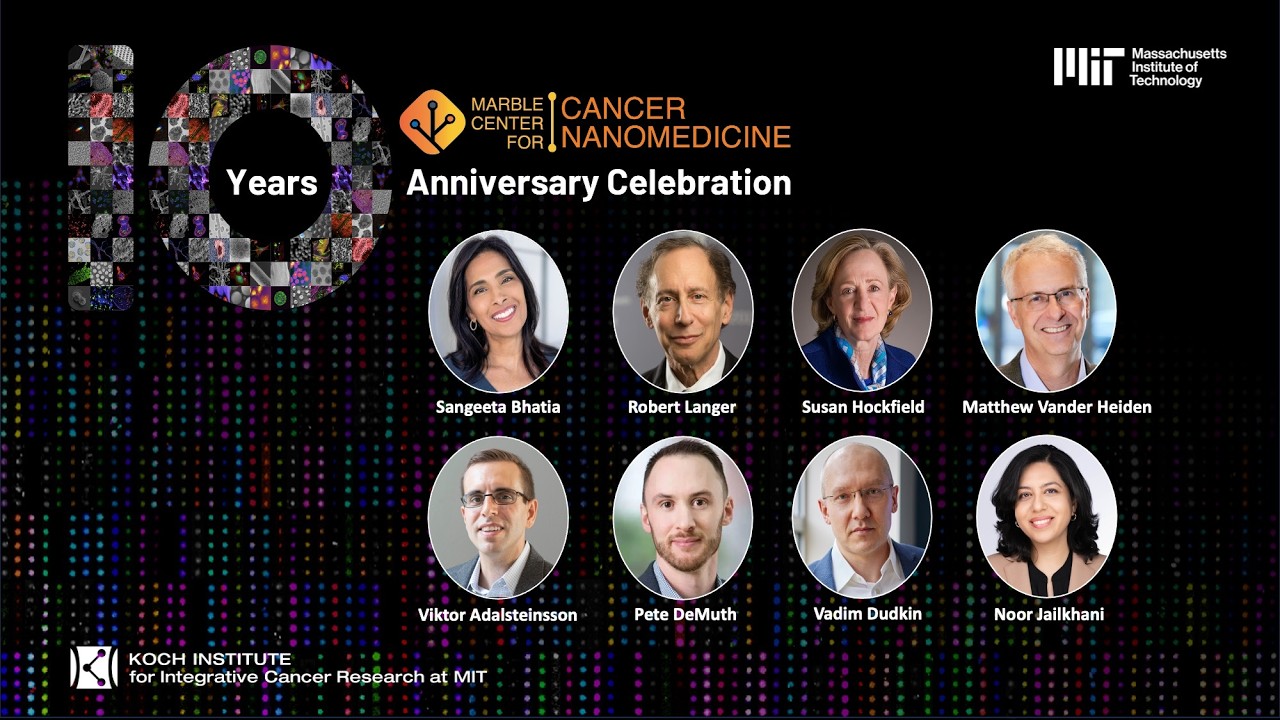
On April 9, the center gathered researchers, entrepreneurs, clinicians, industry collaborators, and members of the public at the Broad Institute of MIT and Harvard and the Koch Institute for Integrative Cancer Research galleries to celebrate a milestone anniversary and reflect on its journey.
“Our purpose has always been clear: to empower discovery and community in nanomedicine at MIT,” said Sangeeta Bhatia, faculty director at the Marble Center for Cancer Nanomedicine and the John J. and Dorothy Wilson Professor of Health Sciences and Technology and Electrical Engineering and Computer Science at MIT.
“A decade in, we are seeing that vision materialize not just in publications, but in our community, our startups, and ultimately, in patients whose lives are being changed,” Bhatia told an audience of about 150 gathered in person for the celebration.
The event featured an overview of the Marble Center by Bhatia and a perspective on nanomedicine by Robert S. Langer, the David H. Koch (1962) Institute Professor and faculty member at the Marble Center.
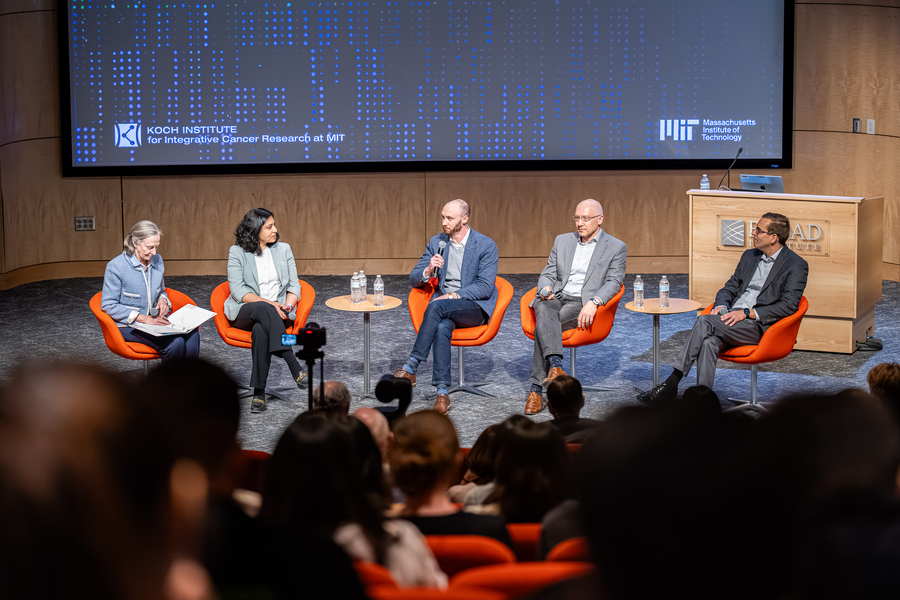
A panel on translational nanomedicine followed the talks. It was moderated by Susan Hockfield, president emerita and professor of neuroscience at MIT, and included Noor Jailkhani, former MIT postdoc in the laboratory of the late MIT professor of biology Richard Hynes and CEO, co-founder and president of Matrisome Bio; Peter DeMuth ’13, chief scientific officer at Elicio Therapeutics; Vadim Dudkin, founding chief technology officer at Soufflé Therapeutics; and Viktor Adalsteinsson ’15, co-founder of Amplifyer Bio and director of the Gerstner Center for Cancer Diagnostics at the Broad Institute.
A decade of impact in nanomedicine
Established in 2016 through a generous gift from Kathy and Curt Marble ’63, the Marble Center brings together leading Koch Institute faculty members and their teams to focus on grand challenges in cancer detection, treatment, and monitoring through miniaturization and convergence — the blending of the life and physical sciences with engineering, a core concept fueling multidisciplinary research at the Koch Institute.
At the center’s founding, Bhatia and Langer were joined by five additional faculty members: Daniel G. Anderson, professor of chemical engineering and member of the Institute for Medical Engineering and Science; Angela M. Belcher, the James Mason Crafts Professor in the departments of Biological Engineering and Materials Science and Engineering; Michael Birnbaum, professor of biological engineering; Paula T. Hammond, Institute professor and dean of the School of Engineering; and Darrell J. Irvine, who is now professor and vice-chair at the Department of Immunology and Microbiology at the Scripps Research Institute in La Jolla, California.
“Over the past decade, the center and its member laboratories have trained close to 500 researchers. Among them, 109 have become faculty in 79 clinical and research universities. We also have worked in close collaboration with clinical and industry partners to produce the results you are seeing today,” said Tarek Fadel, associate director of the Marble Center and director of strategic alliance at the Koch Institute.
“Twenty-three startup companies have emerged from Marble Center laboratories during that time with companies such as Cision Vision, Soufflé Therapeutics, Orna Therapeutics, Matrisome Bio, Amplifyer Bio, Gensaic, among several others that hold so much promise for the early detection of disease and drug delivery,” Fadel added.
The Marble Center has launched several topical programs aimed at trainee development and industry engagement. At monthly seminars, trainees at the Marble Center lead an open forum on emerging issues in their fields. The Convergence Scholars Program, which was originally launched in 2017 to further the development of postdocs beyond the laboratory bench, is now a competitive award program offered to postdocs at the Koch Institute. Through an industry affiliate program, the center worked closely with several key players in the field of nanoscience. Industry collaborators mentor trainees and participate as judges in an annual poster symposium.
More recently, MIT-wide grants have catalyzed new collaborations: In 2023, the Global Oncology in Nanomedicine grant supported a project on leveraging AI-based approaches to speed the development of RNA vaccines and other RNA therapies. The project was led by Giovanni Traverso, the Karl Van Tassel (1925) Career Development Professor and a professor of mechanical engineering.
From lab to clinic: Lessons in nanomedicine translation
Panelists at the anniversary event shared candid reflections on the often messy, but exhilarating process of turning their ideas into commercial technologies.
DeMuth described how Elicio Therapeutics, whose core technologies originated from his graduate research in Irvine’s group, harnesses the natural power of the lymph nodes to generate enhanced immune responses against tumors. The amphiphile platform uses the body’s natural albumin transport system to “shuttle” medicines into the lymph nodes, boosting immune cell activation. Elicio is now advancing their platform through a Phase 2 trial in pancreatic ductal adenocarcinoma and colorectal cancer.
Jailkhani co-founded Matrisome Bio with Bhatia and Hynes. Matrisome Bio is pioneering a new class of therapies, small protein binders called nanobodies that deliver potent payloads directly to the extracellular matrix of tumors and metastases while sparing normal tissues. Matrisome Bio is currently testing radioligand modalities with their targeting platform for the treatment of cancer.
Adalsteinsson co-founded Amplifyer Bio with Bhatia and J. Christopher Love, the Raymond A. (1921) and Helen E. St. Laurent Professor of Chemical Engineering and associate director of the Koch Institute, with the goal of developing priming agents for liquid biopsy. Priming agents injected before a blood draw transiently slow the clearance of cell-free DNA from the bloodstream, thus allowing up to 100-fold more tumor DNA to be recovered for liquid biopsy applications. While injection for medical diagnostics has been done for decades in the context of imaging scans, Amplifyer Bio’s approach would be the first of its kind in the field of liquid biopsy.
Dudkin described Soufflé Therapeutics’ vision to enable targeted delivery with receptor-mediated uptake to any type of cell in the human body. Soufflé Therapeutics is working to engineer cell-specific ligands to deliver siRNA-based medicines that are precise and transferred across the cell membrane to their target, by combining proprietary technologies for identification of cell-specific receptors, ligand optimization, and potent siRNA engineering.
Panelists stressed that successful translation requires complex choices. While platform technologies can theoretically address many cancer problems, startups must focus on specific indications and clinical modalities to succeed in resource-limited, commercial settings. While the academic lab offers freedom to explore multiple applications, commercialization demands strategic narrowing of scope.
Reproducibility during scale-up emerged as another critical consideration: Founders building platform companies must demonstrate not only that their technology works, but that their underlying discovery is reproducible and robust enough to support a business. All panelists agreed that thinking about manufacturability early in research, rather than as an afterthought, significantly improves a startup’s path to the clinic. Highlighting tension between selecting cutting-edge approaches and managing their inherent regulatory risks, they recommended minimizing risk by leveraging established processes and chemistries that have already been validated in approved drugs.
Finally, panelists highlighted the importance of institutional collaborations, particularly with centers like the Marble Center for Cancer Nanomedicine. These partnerships offer access to collaborative, mission-driven researchers who can push technological boundaries, while startups maintain focus on narrow clinical applications. Panelists emphasized that faculty collaborators, such as at the Marble Center, often provide “big sky thinking” that explores new directions and applications that complement the company’s core mission.
The next chapter in nanomedicine at MIT
As the Marble Center enters its second decade, the community is focused on expanding collaborations, leveraging advances in computation and other intersecting disciplines, and exploring new disease indications.
“The next 10 years will be defined by our ability to leverage insights gained at the nanoscale to push the boundaries of precision medicine. The Marble Center is in a unique position to do just that, as we evolve this incredible community at MIT to be a global hub for nanomedicine research,” said Bhatia.
Bhatia also announced that in June, the Marble Center will launch a new grant, Integrated Nanoscale Sensing, Imaging, and Health Technologies (INSIHT), aimed at advancing new imaging and sensing technologies for precision medicine.
Similarly, panelists expressed optimism about nanomedicine’s transformative potential, centered on precision medicine. The field, they argued, will focus on minimizing side effects while opening previously unavailable therapeutic windows — enabling treatments that are fundamentally more targeted and effective. This precision could render many currently untreatable diseases manageable, or even curable, while also enabling in some cases the repurposing of drugs that failed in earlier clinical contexts.
“Ten years ago, Sangeeta, Tyler Jacks, and the Marble Center community had a vision” said Matthew Vander Heiden, director of the Koch Institute and Lester Wolfe (1919) Professor of Molecular Biology.
“Today, that vision is creating a place where bold ideas turn into transformative advances that can help cancer patients and non-cancer patients as well. It is exciting to see this momentum in nanomedicine at MIT and what will happen in the coming decade.”