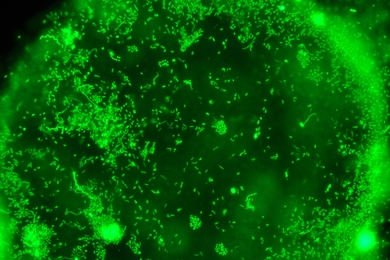
Microscale marine interactions may shape critical carbon cycles
New research finds interactions between microorganisms and marine particles may have significant effects on oceanic carbon cycling.
New research finds interactions between microorganisms and marine particles may have significant effects on oceanic carbon cycling.
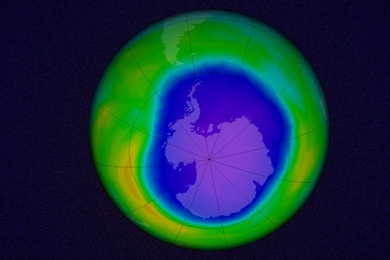
September ozone hole has shrunk by 4 million square kilometers since 2000.
Inexpensive sensors could be worn by soldiers to detect hazardous chemical agents.
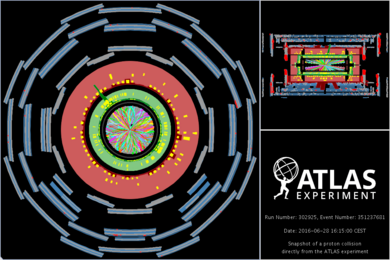
A new MIT project taps into particle collisions to generate music and forge harmony between science and art.
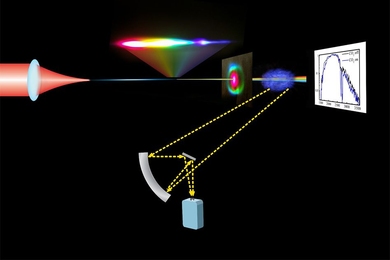
Laser pulses produce glowing plasma filaments in open air, could enable long-distance monitoring.

Computer model finds slits in the spleen impose a “physical fitness test” on red blood cells.
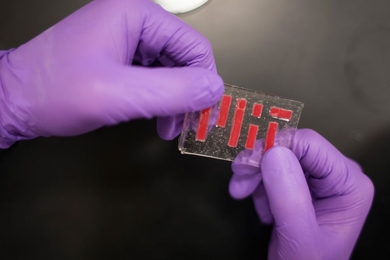
Water-based material could be used to make artificial skin, longer-lasting contact lenses.
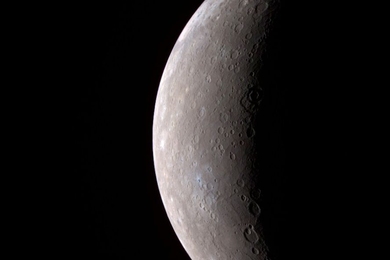
Experiments show planet cooled dramatically in half a billion years.

Research suggests Antarctica and the Southern Ocean may be experiencing a period of cooling before warming takes over, thanks to the ozone hole.
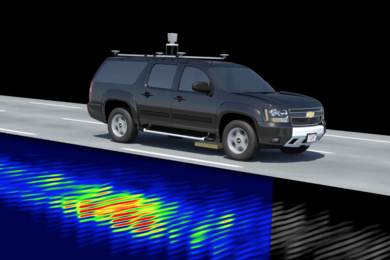
MIT Lincoln Laboratory radar system achieves centimeter-level localization; could help driverless cars stay in lane when road markings are obscured.

Report calls for more integration of physical, life sciences for needed advances in biomedical research.
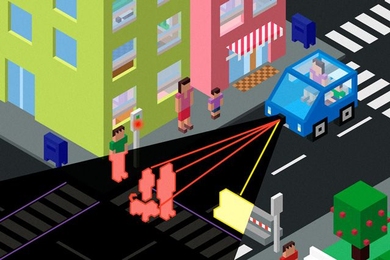
Study shows inconsistent public opinion on safety of driverless cars.
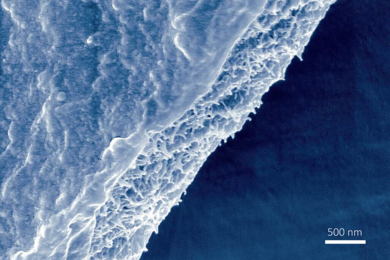
Engineers find nanosized building blocks of silk hold the secrets to improved filtration membranes.
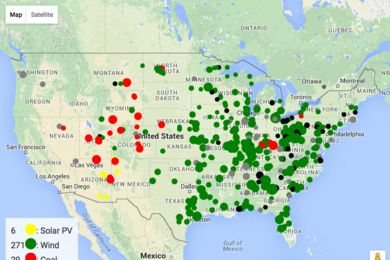
CoalMap online tool shows what policy regulations and technological advancements can do for the cost-competitiveness of solar and wind energy.
![“In about 30 seconds, we can scan a container and provide a three-dimensional map of [the materials inside the cargo]. This information clears the container or alerts you to a region that needs to be examined more carefully,” says William Bertozzi, MIT physics professor emeritus and co-founder of Passport Systems.](/sites/default/files/styles/term_page__news_article/public/images/201606/MIT-Passport-System.jpg?itok=M43U9LUQ)
Scanners more rapidly and accurately identify radioactive materials at U.S. borders, events.