Magnetic mixer improves 3D bioprinting
MagMix, an onboard mixing device, enables scalable manufacturing of 3D-printed tissues.
Architecture students bring new forms of human-machine interaction into the kitchen.
WITEC is working to develop the first wearable ultrasound imaging system to monitor chronic conditions in real-time, with the goal of enabling earlier detection and timely intervention.
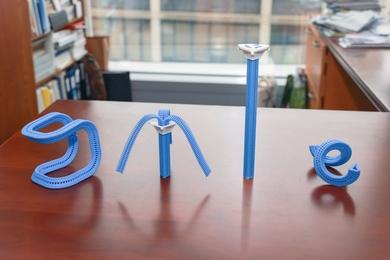
“MechStyle” allows users to personalize 3D models, while ensuring they’re physically viable after fabrication, producing unique personal items and assistive technology.
Six MIT student teams pitched products during the annual capstone course prototype launch event.
Nineteen-year-old Freesia Gaul built a VR prototype thanks to MIT OpenCourseWare classes that provided “a solid foundation of knowledge and problem-solving abilities.”
Professors Ahmad Bahai and Kripa Varanasi, plus seven additional MIT alumni, are honored for highly impactful inventions.
Placing first in the MADMEC innovation contest, the MITten team aims to curb costly power outages during winter storms.
Macro, a modeling tool developed by the MIT Energy Initiative, enables energy-system planners to explore options for developing infrastructure to support decarbonized, reliable, and low-cost power grids.
Inspired by traditional acupuncture, the approach has potential to impact all implantable bioelectronic devices, enabling applications such as hypertension mitigation.
The approach could transform large-scale biomanufacturing by enabling automated and contamination-conscious workflows for cell therapies, tissue engineering, and regenerative medicine.
MIT Lincoln Laboratory researchers designed the hydrophone using common MEMS parts for defense, industrial, and undersea research applications.
Jacqueline Prawira’s innovation, featured on CBS’s “The Visioneers,” tackles one of the world’s most pressing environmental challenges.
Cultured from induced pluripotent stem cells, “miBrains” integrate all major brain cell types and model brain structures, cellular interactions, activity, and pathological features.
The technology would allow battery-free, minimally invasive, scalable bioelectronic implants such as pacemakers, neuromodulators, and body process monitors.