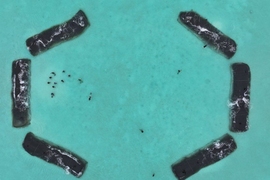
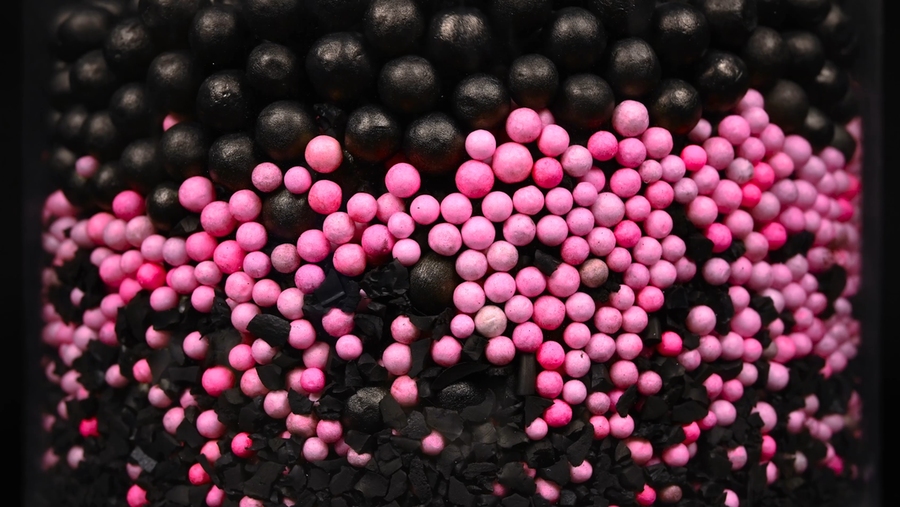
Granular convection takes place everywhere: candy in a box, sand on the beach, foam in a cushion. Often referred to as the “Brazil nut effect,” granular convection occurs when solid, independent, irregularly shaped particles reorder themselves following agitation. One might think, intuitively, that the larger pieces fall to the bottom, but it is their size, and not their density, that alters their location, and the larger pieces end up on the top.
In the world of competitive running, elite athletes have their footwear individually designed for needs such as foot shape and pressure points. Comfortable and supportive footwear can assist optimal performance. However, most footwear is standardized and doesn’t offer a personalized performance.
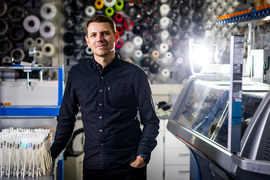
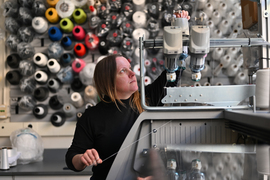
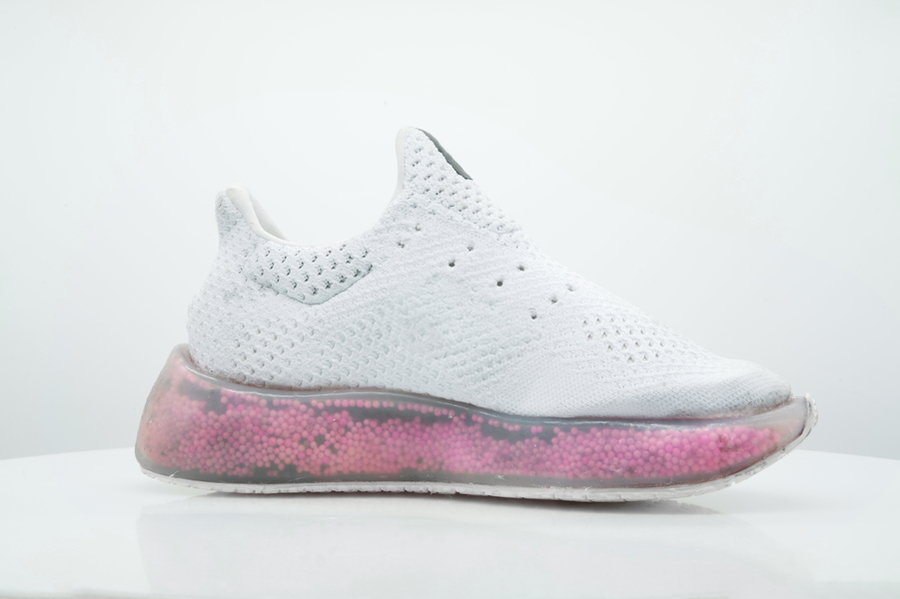
MIT associate professor of architecture Skylar Tibbits, founder and co-director of the Self-Assembly Lab in the MIT School of Architecture and Planning, along with various MIT colleagues, have been developing tests surrounding the phenomenon of granular convection within the midsole — or middle layer, between the outsole (bottom) and insole (top) — of running shoes to create a shoe that evolves over time to provide an individualized product. As we approach the running of the 130th Boston Marathon — one of the world's most prominent displays of footwear supporting athletes — Tibbits answers three questions about bead-based technologies as applied to running shoes.
Q. What are the advantages of an adaptive midsole over the current bead-based midsole technology?
A. Currently, the standard midsoles in running shoes are static. They aren’t customized to the shape of our foot or the force we deliver when running or walking. They also don’t change or improve over time as we run in them. Some products — blue jeans, baseball gloves, and hats, for example — get more comfortable as you wear them. We were exploring how this could be taken even further with a running shoe so that you would have the cushion, support, and stiffness where you need it and have it improve these features as you use it so that, over time, the actual performance of the shoe gets better. It’s not a personalized fit; it’s a performance-driven adaptation.
There are three advantages to this technology. The first is that customization is not only for elite athletes. Most elite athletes are already getting gear personalized for their specific needs by their sponsoring brands. Now, customized gear can be available for everyone. Second, customized gear currently does not adapt to an athlete’s performance. But you need your footwear to evolve because your needs as a runner evolve. You need to get the comfort, cushioning, and protection, to support your performance.
A third advantage is the manufacturability of this type of shoe. Custom shoes are now made in a factory for the specifications of a single athlete. That doesn’t scale. You can’t produce a manufacturing process where every single person’s shoe is going to be custom-made for them. We’ve shown that every shoe can be the same and mass produced, but, over time, the shoe will evolve to your personal needs. That is a way to get customization without having to change the manufacturing process.
Q: Why the interest in granular systems, and granular convection in particular?
A: We’ve worked on reversible construction techniques with granular jamming over the years, which is at the opposite end of the spectrum. Granular convection promotes the movement of particles; the more they are mixed, the more they separate. Our vision was looking at footwear that adapts with you over time. We thought we could use granular convection as a mechanism for the footwear to evolve.
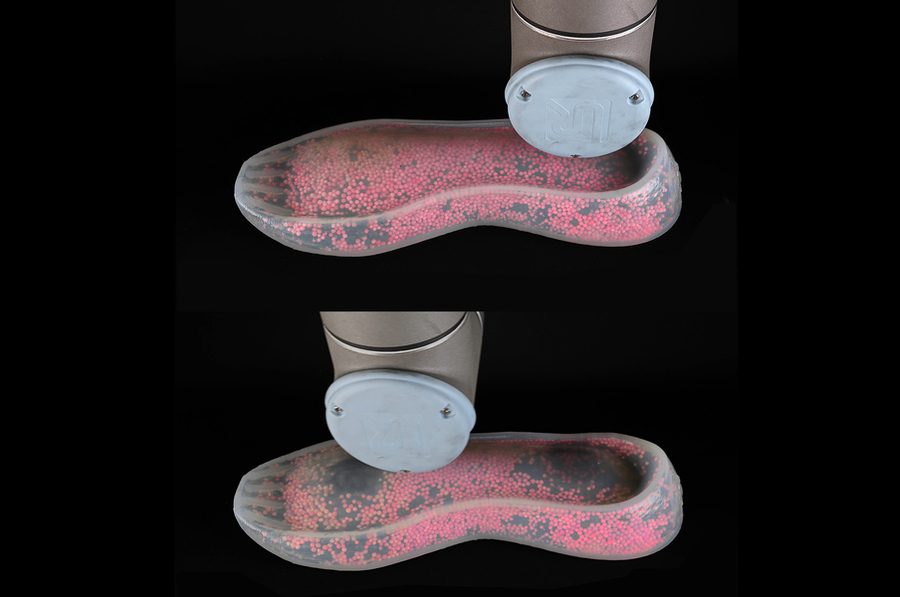
We put particles with different stiffness, different material properties, and unique sizes, so that over time, we know the softer particles, which are the larger particles, will rise to the top, and the stiffer particles that are smaller will sink to the bottom, towards the outsole. We designed how these particles moved based on the vibration and the impact of walking and running.
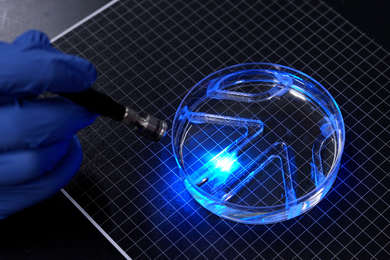
We also designed the container. We had three different particle sizes; we conducted tests to try to dial it into the right number of steps for it to evolve over the course of about 20,000 steps. About the length of a marathon. We could either speed up or slow down that process.
Q. Are there future applications of customization for granular convection? If so, where do you see your research going next?
A: Any products that need cushioning systems that improve over time would benefit from this technology. With custom packaging, you have molded foam that fits around a product — a flat-screen television, for example — that is tossed out after it has been shipped from factory to distributor to customer. I worked with a furniture company that wrapped blankets around chairs for transport, but there were still some chairs that sustained damage. Maybe we could develop a blanket or some kind of material that adapts over the journey so that it creates just the right amount of cushion for the shape and property of that product and, once it’s delivered, its shape could be “released” and then reused. How can we reset this product in a timely manner so it can be used again?
Wheelchairs are another product where we would want seat cushions that can adapt to how a person sits, the force distribution, and the environment in which they are being used, such as a sidewalk or a gravel path. We considered this as it relates to footwear. You might want to reset your shoes because you’re going to be running road races on a given day and trail races another day. How can we empty and refill the midsole with different particles so it can adapt again? More importantly, how can we upgrade or change our shoes without throwing them away? This is exciting future work for us to explore.