A spray-on coating to keep power lines standing through an ice storm may not be the obvious fix for winter outages — but it’s exactly the kind of innovation that happens when MIT students tackle a sustainability challenge.
“The big threat to the power line network is winter icing that causes huge amounts of downed lines every year,” says Trevor Bormann, a graduate student in MIT’s Department of Materials Science and Engineering (DMSE) and member of MITten, the winning team in the 2025 MADMEC innovation contest. Fixing those outages is hugely carbon-intensive, requiring diesel-powered equipment, replacement materials, and added energy use. And as households switch to electric heat pumps, the stakes of a prolonged outage rise.
To address the challenge, the team developed a specialized polymer coating that repels water and can be sprayed onto aluminum power lines. The coating contains nanofillers — particles hundreds of times smaller than a human hair — that give the surface a texture that makes water bead and drip off.
The effect is known as “superhydrophobicity,” says Shaan Jagani, a graduate student in the Department of Aeronautics and Astronautics. “And what that really means is water does not stay on the surface, and therefore water will not have the opportunity to nucleate down into ice.”
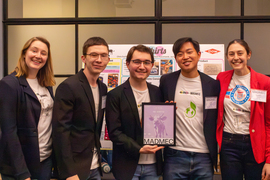
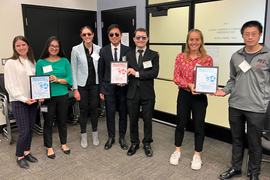
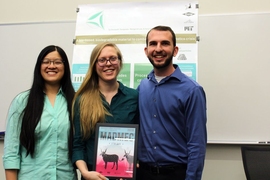
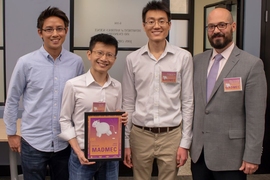
MITten — pronounced “mitten” — won the $10,000 first prize in the contest, hosted by DMSE on Nov. 10 at MIT, where audience presentations and poster sessions capped months of design and experimentation. Since 2007, MADMEC (the Making and Designing Materials Engineering Contest), funded by Dow and Saint-Gobain, has given students a chance to tackle real-world sustainability challenges, with each team receiving $1,000 to build and test their projects. Judges evaluated the teams’ work from conception to prototype.
MADMEC winners have gone on to succeed in major innovation competitions such as MassChallenge, and at least six startups — including personal cooling wristband maker Embr and vehicle-motion-control company ClearMotion — trace their roots to the contest.
Cold inspiration
The idea for the MITten project came in part from Bormann’s experience growing up in South Dakota, where winter outages were common. His home was heated by natural gas, but if grid-reliant heat pumps had warmed it in negative-zero winter months, a days-long outage would have been “really rough.”
“I love the part of sustainability that is focused on developing all these new technologies for electricity generation and usage, but also the distribution side of it shouldn’t be neglected, either,” Bormann says. “It’s important for all those to be growing synergistically, and to be paying attention to all aspects of it.”
And there’s an opportunity to make distribution infrastructure more durable: An estimated 50,000 miles of new power lines are planned over the next decade in the northern United States, where icing is a serious risk.
To test their coating, the team built an icing chamber to simulate rain and freezing conditions, comparing coated versus uncoated aluminum samples at –10 degrees Celsius (14 degrees Fahrenheit). They also dipped samples in liquid nitrogen to evaluate performance in extreme cold and simulated real-world stresses such as lines swaying in windstorms.
“We basically coated aluminum substrates and then bent them to demonstrate that the coating itself could accommodate very long strains,” Jagani says.
The team ran simulations to estimate that a typical outage affecting 20 percent of a region could cost about $7 million to repair. “But if you fully coat, say, 1,000 kilometers of line, you actually can save $1 million in just material costs,” says DMSE grad student Matthew Michalek. The team hopes to further refine the coating with more advanced materials and test them in a professional icing chamber.
Amber Velez, a graduate student in the Department of Mechanical Engineering, stressed the parameters of the contest — working within a $1,000 budget.
“I feel we did quite good work with quite a lot of legitimacy, but I think moving on, there is a lot of space that we could have more play in,” she says. “We’ve definitely not hit the ceiling yet, and I think there’s a lot of room to keep growing.”
Compostable electrodes, microwavable ceramics
The second-place, $6,000 prize went to Electrodiligent, which is designing a biodegradable, compostable alternative to electrodes used for heart monitoring. Their prototype uses a cellulose paper backing and a conductive gel made from gelatin, glycerin, and sodium chloride to carry the electric signal.
Comparing electrocardiogram (ECG) results, the team found their electrodes performed similarly to the 3M Red Dot standard. “We’re very optimistic about this result,” says Ethan Frey, a DMSE graduate student.
The invention aims to cut into the 3.6 tons of medical waste produced each day, but judges noted that adhesive electrodes are almost always incinerated for health and safety reasons, making the intended application a tough fit.
“But there’s a whole host of other directions the team could go in,” says Mike Tarkanian, senior lecturer in DMSE and coordinator of MADMEC.
The $4,000 third prize went to Cerawave, a team made up of mostly undergraduates and a member the team jokingly called a “token grad student,” working to make ceramics in an ordinary kitchen microwave. Traditional ceramic manufacturing requires high-temperature kilns, a major source of energy use and carbon emissions. Cerawave added silicon carbide to their ceramic mix to help it absorb microwave energy and fuse into a durable final product.
“We threw it on the ground a few times, and it didn’t break,” says Merrill Chiang, a junior in DMSE, drawing laughs from the audience. The team now plans to refine their recipe and overall ceramic-making process so that hobbyists — and even users in environments like the International Space Station — could create ceramic parts “without buying really expensive furnaces.”
The power of student innovation
Although it didn’t earn a prize, the contest’s most futuristic project was ReForm Designs, which aims to make reusable children’s furniture — expensive and quickly outgrown — from modular blocks made of mycelium, the root-like, growth-driving part of a mushroom. The team showed they could successfully produce mycelium blocks, but slow growth and sensitivity to moisture and temperature meant they didn’t yet have full furniture pieces to show judges.
The project still impressed DMSE senior David Miller, who calls the blocks “really intriguing,” with potential applications beyond furniture in manufacturing, construction, and consumer products.
“They adapt to the way we consume products, where a lot of us use products for one, two, three years before we throw them out,” Miller says. “Their capacity to be fully biodegradable and molded into any shape fills the need for certain kinds of additive manufacturing that requires certain shapes, while also being extremely sustainable.”
While the contest has produced successful startups, Tarkanian says MADMEC’s original goal — giving students a chance to get their hands dirty and pursue their own ideas — is thriving 18 years on, especially at a time when research budgets are being cut and science is under scrutiny.
“It gives students an opportunity to make things that are real and impactful to society,” he says. “So when you can build a prototype and say, ‘This is going to save X millions of dollars or X million pounds of waste,’ that value is obvious to everyone.”
Attendee Jinsung Kim, a postdoc in mechanical engineering, echoed Tarkanian’s comments, emphasizing the space set aside for innovative thinking.
“MADMEC creates the rare environment where students can experiment boldly, validate ideas quickly, and translate core scientific principles into solutions with real societal impact. To move society forward, we have to keep pushing the boundaries of technology and fundamental science,” he says.