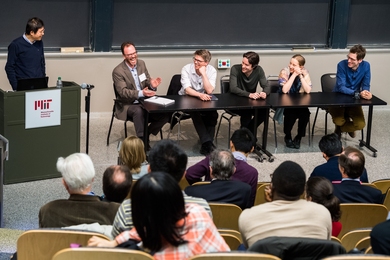
Center for Theoretical Physics celebrates 50 years
Symposium explores how novel ideas and experiments are advancing many areas of theoretical physics in newly interconnected ways.
Symposium explores how novel ideas and experiments are advancing many areas of theoretical physics in newly interconnected ways.
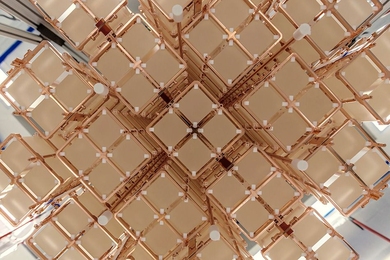
Data could shed light on why the universe has more matter than antimatter.
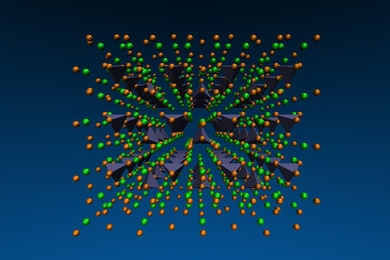
Design principles could point to better electrolytes for next-generation lithium batteries.
Study finds that turbulence competes in fusion plasmas to rapidly respond to temperature perturbations.

New research provides insight into the behavior of microbial communities in the ocean.
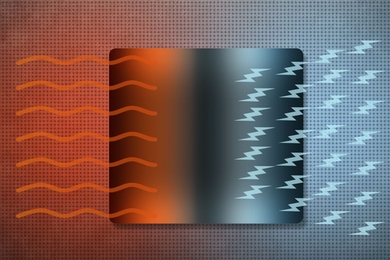
Study finds topological materials could boost the efficiency of thermoelectric devices.
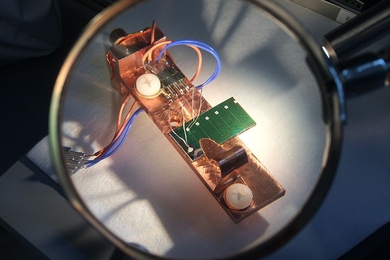
Approach could bypass the time-consuming steps currently needed to test new photovoltaic materials.

Illumination from nanobionic plants might one day replace some electrical lighting.
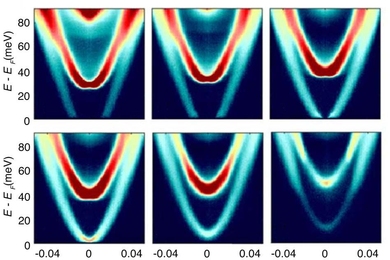
Scientists invent technique to map energy and momentum of electrons beneath a material’s surface.

Electronic circuits reveal when a plant begins to experience drought conditions.
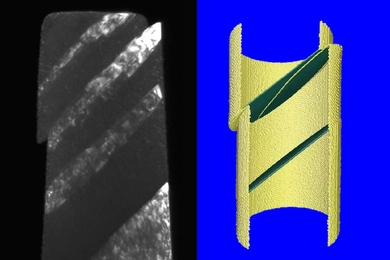
Materials with a special kind of boundary between crystal grains can deform in unexpected ways.

Ahrens, Rathbun, Silmore, and Wei are recognized for tackling complex science and engineering problems of national importance.
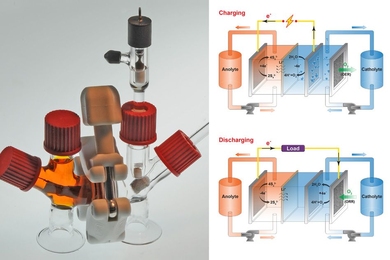
“Air-breathing” battery can store electricity for months, for about a fifth the cost of current technologies.

Recently discovered phenomenon could provide a way to bypass the limits to Moore’s Law.

Nuclear science and engineering graduate student receives Department of Energy Innovation Award for his work on plasma turbulence.