
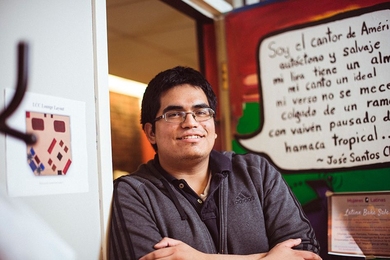
Raul Boquin: Working toward high-quality education for all
MIT senior envisions opportunities for “every person of the world who wants to learn something.”

Celebrating 10 years of Scratch
Scratch Day @ MIT was one of more than 1,100 global events during May to celebrate the kids’ programming language and online community on its 10th anniversary.
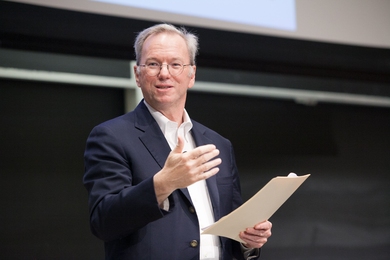
Eric Schmidt visits MIT to discuss computing, artificial intelligence, and the future of technology
Former Google CEO, now chairman of parent company Alphabet, speaks to students as part of fireside chat with CSAIL Director Daniela Rus.

Detecting walking speed with wireless signals
By measuring this emerging vital sign, CSAIL system could help monitor and diagnose health issues like cognitive decline and cardiac disease.


Tommi Jaakkola appointed Thomas Siebel Professor in EECS and IDSS
Leader in machine learning and natural language processing takes on professorship established by veteran software entrepreneur Thomas Siebel.
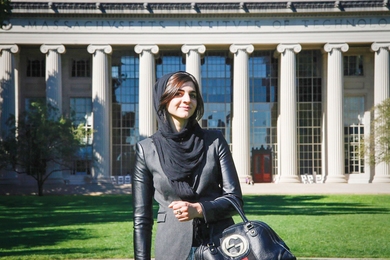
Software developer is a voice for Muslim women
An entrepreneur who co-founded Wise Systems, Layla Shaikley SM ’13 may be better known for her viral video created to combat media stereotypes of Muslim women.
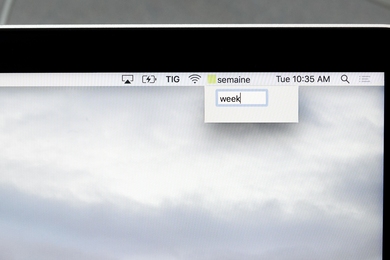
Learn a language while you wait for WiFi
CSAIL tool integrates with email and web browsers to harness micro-moments.
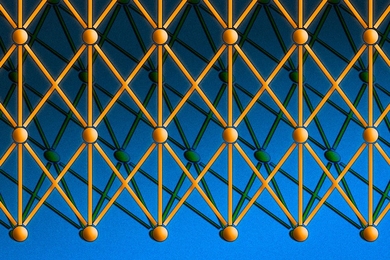
Explained: Neural networks
Ballyhooed artificial-intelligence technique known as “deep learning” revives 70-year-old idea.
![Tim Berners-Lee was honored with the Turing Award for his work inventing the World Wide Web, the first web browser, and "the fundamental protocols and algorithms [that allowed] the web to scale."](/sites/default/files/styles/term_page__news_article/public/images/201704/tim-berners-lee-mit-turing-award-00_1.jpg?itok=1MdPEI1v)
Tim Berners-Lee wins $1 million Turing Award
CSAIL researcher honored for inventing the web and developing the protocols that spurred its global use.
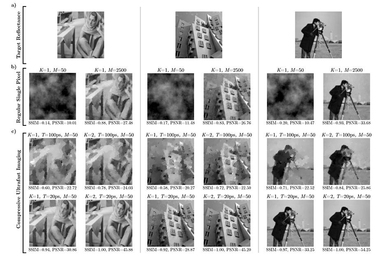
A faster single-pixel camera
New technique greatly reduces the number of exposures necessary for “lensless imaging.”

Faster page loads
System allocates data center bandwidth more fairly, so no part of a webpage lags behind others.

MIT experts urge Trump administration to take immediate action on cybersecurity
Report warns of hacking risk to electric grid, oil pipelines, and other critical infrastructure.

A big leap toward tinier lines
Self-assembly technique could lead to long-awaited, simple method for making smaller microchip patterns.