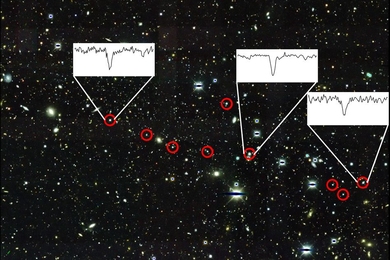
3 Questions: The origin of the cosmos’ heaviest elements
Unique galaxy offers clues to the extreme conditions that yield the heavies of the periodic table.
Unique galaxy offers clues to the extreme conditions that yield the heavies of the periodic table.
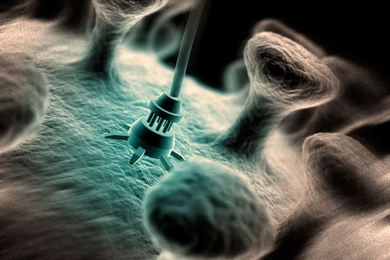
Theoretical proof could lead to more reliable nanomachines.
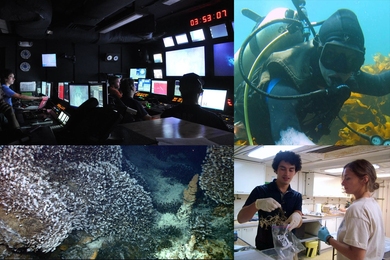
Santiago Herrera studies the genome to establish new connections between species living in the deep sea.
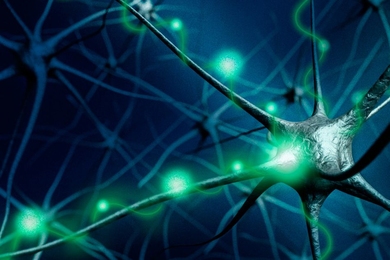
Study finds bursts of neural activity as the brain holds information in mind, overturns a long-held model.
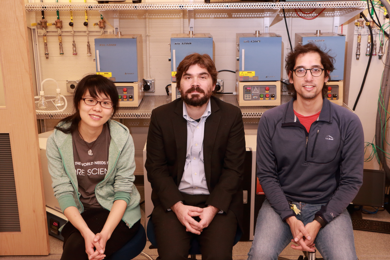
Synthesizing new physics: Assistant professor blends materials science and solid state physics to uncover new properties linked to collective behavior of electrons.
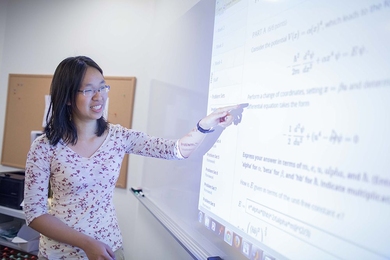
New projects emphasize using digital methods not possible in traditional classes, leveraging research-based teaching practices, and measuring student learning.
Neuroscientists retrieve missing memories in mice with early Alzheimer’s symptoms.
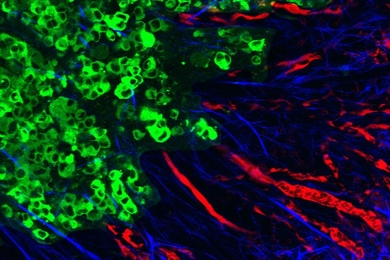
Cancer cells remodel their environment to make it easier to reach nearby blood vessels.
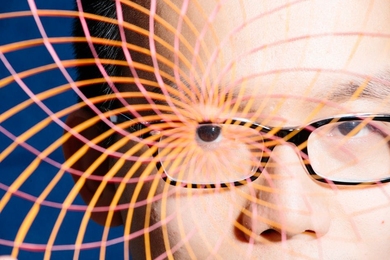
Senior YQ Lu finds new ways to combine math and paper art, shares his passion for both.

Larger set of translations may shed light on an idiosyncratic Amazonian language.
Scientists surprised to find amino acids, not sugar, supply most building blocks for tumor cells.
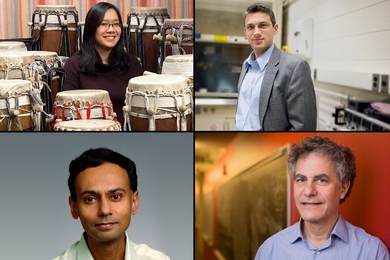
Devadas, Grossman, Sipser, and Tang awarded MIT’s highest undergraduate teaching award.

New quantum computer, based on five atoms, factors numbers in a scalable way.
!["[W]e hope that our studies of vps-50 will provide insights into human neuropsychiatric disorders,” H. Robert Horvitz says.](/sites/default/files/styles/term_page__news_article/public/images/201603/MIT-BehavorialStates.jpg?itok=0Jejll8C)
Gene required for the control of behavioral state is also found in humans, may be linked to autism.
Study ties high-fat diet to changes in intestinal stem cells, may help explain increased cancer risk.