Skip to content ↓

📬 Want a dose of MIT in your inbox? Subscribe to the MIT Daily and/or MIT Weekly newsletters.

Top News

Looking for audio? Listen to the MIT News podcast

Recent Highlights

More MIT News articles

In the Media

New York Times

Prof. David Kaiser and graduate student Alexandra Klipfel speak with New York Times reporter Dennis Overbye about their theory that a neutrino detected zipping through the Mediterranean Sea in February 2023 may have come from an exploding primordial black hole. “Dr. Kaiser and Ms. Klipfel concluded that if primordial black holes were the explanation for long-sought dark matter, scientists should expect about 40 black-hole explosions to occur each year in every cubic light-year near the Milky Way,” Overbye notes. “You’ll never, ever hope to see Hawking radiation if the only black holes ever were ones that formed from dead stars,” says Kaiser. Primordial black holes have different masses and different lifetimes, he noted: “Some go bang right now.”

Associated Press

Prof. Christopher Knittel speaks with Associated Press reporter Paul Wiseman about the economic impact of the U.S. conflict with Iran. “A week ago or certainly two weeks ago, I would have said: If the war stopped that day, the long-term implications would be pretty small,’’ says Knittel. “But what we’re seeing is infrastructure actually being destroyed, which means the ramifications of this war are going to be long-lived.’’

Forbes

Researchers at MIT and elsewhere have found that “one in five couples could boost retirement savings by reallocating contributions,” reports Caroline Castrollon for Forbes. “There are pretty large gains to coordinating your finances,” explains Prof. Taha Choukhmane. “We find that couples leave quite a lot of money on the table every year.”

ABC News

A new study by Prof. Daniel Varon and his colleagues has found that “parts of the U.S. may be emitting much more of one of the most potent greenhouse gases than previously thought,” reports Julia Jacobo for ABC News. “Satellite observations suggest that methane emissions in urban areas may be ‘widely underestimated’ – up to 80% higher than noted in the U.S. Environmental Protection Agency's Greenhouse Gas Inventory,” explains Jacobo. 

USA Today

Prof. Dava Newman speaks with USA Today reporter Sara D. Wire about NASA’s plans to return to the moon and, hopefully, Mars in the 2030s.  The “moon is a three-day trip," Newman explains. "Mars, you need eight months. Those are very different targets.” 

Forbes

Writing for Forbes, Senior Lecturer Guadalupe Hayes-Mota 08, SM '16, MBA '16 explores how businesses can best prepare for the rapid advancements underway in the field of neurotechnology. “I believe that one of the most important steps companies can take regarding this emerging technology is to act now, without waiting for regulatory clarity first,” writes Hayes-Mota. “Treat neural data as categorically sensitive from day one—not because you are forced to, but because you understand that operating this close to the human mind demands a higher threshold of trust than almost any technology before it.” 

Boston Globe

Writing for The Boston Globe, Prof. Christopher Knittel and graduate student Fischer Espiritu Argosino make the case that in Massachusetts the “current compensation structure for the electricity produced by solar panels turns a climate solution into an inequitable cost shift that burdens many residents.” They add: “The state needs to prioritize large-scale wind and solar deployment and fix how residential solar exporters are compensated…. Massachusetts has long been a clean-energy leader. It can remain one by showing that decarbonization and affordability can go hand in hand.”

Forbes

In an article for Forbes, Joseph Coughlin, director of the MIT AgeLab, emphasizes that: “Retirement planning can no longer be framed solely as a question of how much to save or how to invest. It must also account for how to live in a world where stability is less certain, shocks arrive in close succession, and the systems that underpin daily life — energy, supply chains, and healthcare — are more exposed to disruption than the standard retirement playbook assumed.”

The Boston Globe

Senior Research Scientist C. Adam Schlosser, deputy director of the MIT Center for Sustainability Science and Strategy, speaks with Joshua Miller of The Boston Globe’s Camberville & Beyond newsletter about weather, climate and how warming temperatures could impact the Northeastern US. Schlosser explains that: “warmer air can carry more moisture, more vapor. So, imagine again a future for the Northeast where everything is risen by a few degrees. It's not just the daytime temperatures, but the nighttime temperatures. The amount of vapor in the air has a big impact on nighttime temperatures, and on hot, humid nights, your body's ability to cool is diminished.” 

Smithsonian Magazine

While excavating “a small room inside a lavish home in ancient Pompeii,” researchers from MIT found the walls were covered with Egyptian blue paint, a bright blue pigment estimated to “have cost more than half the annual salary of a Roman foot solider,” reports Sonja Anderson for Smithsonian Magazine.  

The New York Times

New York Times reporter Holly Bass spotlights Prof. Joshua Bennett’s newest works, “We (The People of the United States)” and “The People Can Fly.” Bennett’s “texts remind us there is power in the collective body of a people and their culture,” writes Bass. “There is power in pressing on in the face of obstacles and opposition.” 

Community Updates

Featured Multimedia

Video thumbnail

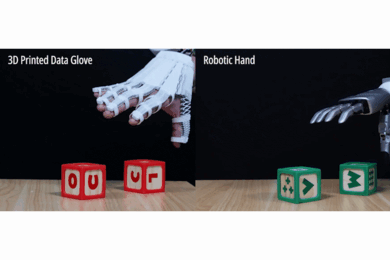
MIT engineers have designed an ultrasound wristband that precisely tracks a wearer’s hand movements in real- time. By moving their hands and fingers, users can direct a robot to perform specific hand gestures and tasks, or they can manipulate objects in a virtual environment with high dexterity control.

Video thumbnail

Song Han is an associate professor in Electrical Engineering and Computer Science whose research focuses on efficient AI computing. In this episode, President Sally Kornbluth speaks with Song about efficient AI, why it’s so energy-hungry in the first place, and the benefits of lighter models.

Video thumbnail

Rosalind Picard reflects on the origins of her work in wearable sensing and affective computing — technology designed to measure and respond to human emotions. Her team created a glove-based electrodermal sensor that glowed in response to users' emotional response. This opened up new possibilities for emotion-sensing wearables, ultimately shaping the direction of her future research and the field as a whole.

Video thumbnail

In 16.85 Autonomy Capstone (Design and Testing of Autonomous Vehicles), AeroAstro students build software that allows autonomous flight vehicles to navigate unknown environments. Students develop software and hardware for a quad-rotor drone, navigating a challenging obstacle course. The course emphasizes systems-level thinking and real-world applications.

Video thumbnail

At MIT, our mission is to advance knowledge; to educate students in science, engineering, technology, humanities and social sciences; and to tackle the most pressing problems facing the world today. We are a community of hands-on problem-solvers in love with fundamental science and eager to make the world a better place.

More News