When an animal’s environment changes faster than the animal can adapt, its chances of survival can flat-line. The same is true for populations, and even entire species.
Now, scientists at MIT and the University of Leicester have found that this connection between evolutionary adaptation and the pace of environmental change holds up at the global scale as well — and can determine life’s susceptibility to mass extinction. The researchers developed a theoretical model of this phenomenon, which they present in a paper appearing today in Physical Review Letters.
The team compared the model with available data from past major mass extinctions, including how fast the global environment changed at the time of each event. The model successfully predicted the severity of most mass extinctions in Earth’s history, or the fraction of life that was unable to adapt, and therefore went extinct.
Interestingly, the researchers found that the range of adaptation rates across animal groups is broadly similar to the range of rates at which the environment can change.
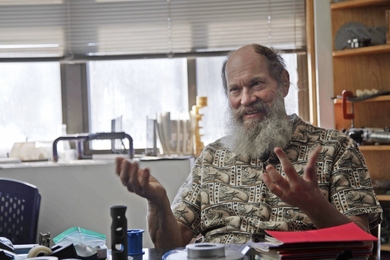
“What we’re beginning to see is a certain level of organization, and ways in which life behaves that are consistent with the ways in which the environment behaves,” says study author Daniel Rothman, professor of geophysics and co-director of the Lorenz Center at MIT. “It may be that life has evolved so that its range of adaptabilities matches the range of stresses that it meets.”
Rothman’s study co-author is Sergei Petrovskii, professor of applied mathematics at the University of Leicester in England.
A catastrophizing connection
The connection between extinction and environmental change is not new. In the late 18th century, the French naturalist Georges Cuvier, who is often referred to as the founding father of paleontology, was the first to propose the concept of “catastrophism.” He had discovered fossil bones near Paris that didn’t match any animal known to exist at the time. Cuvier concluded that the bones were from a group of giant mammals that existed at one time but was no longer around. He proposed, then, that an entire species could disappear, or go extinct, likely due to a widespread catastrophe.
“That itself was a major idea, that a species could go extinct,” Rothman says. “And he had suggested it was an environmental catastrophe that had caused it.”
The concept of catastrophism later gave way to the view that Earth’s history was shaped mainly by slow, gradual processes. But in the mid-20th century the American geologist Norman Newell revisited the problem. In seeking the cause of extinctions, he proposed what Rothman and Petrovskii call the “rate-mismatch” hypothesis, the notion that extinction occurs when the rate of environmental change is higher than the rate at which a species can evolve to adapt.
Biologists have since observed Newell’s hypothesis play out in many cases where changes in the environment have driven the extinction of individual species. Rothman and Petrovskii wondered: Could the hypothesis also apply at the global scale?
“We know that individual species go extinct when environmental change outpaces their ability to adapt,” Rothman notes. “But it hasn’t been clear whether this same idea applies at the scale of global extinction events.”
Finding a mismatch
For their new study, the researchers looked to test the rate mismatch hypothesis at the global scale. They wanted to see whether mass extinction events in history can be explained by a mismatch between the rate of global environmental change and the rate at which life around the world can adapt.
To do so, at least in theory, they would have to compare two sources of data: the rates at which the global environment has changed over time and the rates at which different groups of organisms adapt to environmental change. The first can be found in geological records, which scientists have used extensively to infer how the Earth’s climate changed through history. The second, however, is almost impossible to record.
“We’re talking about the rates at which organisms adapt to major environmental change at effectively geologic timescales, from thousands to millions of years,” Rothman says. “And that doesn’t lend itself to direct observation.”
In place of actual data, the researchers aimed to construct a general mathematical theory to describe the range of adaptation rates across animal groups around the world. In this context, “adaptation” refers to any change within a species, over time periods that are much longer than a generation, that enable the species to persist as its environment changes.
It is generally understood in evolutionary theory that a species can successfully adapt only when multiple conditions are met. For instance, there needs to be variation in the population, these variations must be heritable, some variations enable an organism to adapt better than others, and the organisms that adapt better should leave more offspring. If all these conditions are met, the entire species should be able to adapt to a given environmental change. However, if any one condition fails, the population will go extinct.
Rothman and Petrovskii recognized that in this case, a species’ probability of successfully adapting multiplies with every condition that it meets. And it turns out that this pattern can be described mathematically as a very simple, bell-shaped curve. Such a curve essentially describes what fraction of the world’s animals can adapt at given rates, from the slowest to the fastest adapters, and how this fraction changes nonlinearly with the rate of adaptation. This curve generally shows that most animal groups can adapt at intermediate rates, while fewer animal groups adapt at the slowest and fastest rates.
After they established this general pattern of adaptation rates, the researchers looked to see how this pattern compares to recorded rates of environmental change, and how these two rates match, or don’t match, at times of mass extinction.
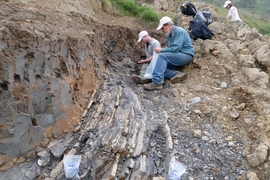
To do so, they considered paleontological and geochemical data from 27 episodes over the last 450 million years where the carbon cycle experienced significant change — a measure that is generally understood to reflect global environmental change. They then compared rates of environmental change with the fraction of animal groups that went extinct during each episode — numbers that were established previously in a well-regarded study by paleobiologist John Alroy.
In the end, Rothman and Petrovskii observed that indeed, for almost every mass extinction event in the last 450 million years, there was a mismatch in the rates at which the environment changed and at which animals could adapt; mass extinctions occurred when a significant fraction of animals could not adapt fast enough to match the changing environment. Their results confirm that the rate mismatch hypothesis applies at the global scale.
What’s more, this mismatch in rates could predict the severity of extinction events, or the fraction of animal life that went extinct given the rate at which the environment changed.
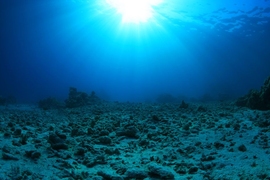
In the case of the end-Permian extinction, it’s likely that the rapid acidification of the ocean outpaced organisms’ ability to evolve adequate protections, leading to the extinction of over 80 percent of the world’s marine species.
The team’s work focuses on applying the new model to past extinction events. But the work could also provide a framework for understanding modern extinction risk.
“Carbon dioxide levels in the ocean are increasing today at a rate which, when appropriately re-scaled, is similar to rates of carbon-cycle change that are just lower than those associated with major extinction events in the past,” Rothman says. “It suggests that modern environmental change may be approaching rates beyond which adaptation becomes increasingly difficult.”
This research is supported, in part, by Schmidt Sciences, LLC; the MIT Climate Grand Challenges; the U.S. National Science Foundation; the European Space Agency; and the London Mathematical Society.