Stroke is one of the leading causes of death and disability worldwide, affecting 15 million people each year and leaving 5 million with long-term impairments. There’s also a growing shortage of physical therapists, making it harder for patients to access consistent, high-quality care.
A new approach developed by MIT mechanical engineers combines cutting edge artificial intelligence with real human care practices.
“Our goal is to teach robots how to assist with physical and occupational therapy, not to replace therapists, but to extend their reach,” explains Johannes Lachner, who completed this work as a MIT-Novo Nordisk Artificial Intelligence Postdoctoral Fellow in the Departments of Mechanical Engineering (MechE) and Brain and Cognitive Sciences at MIT. “A core innovation of our system is that physical therapists can train their own robot using AI, enabling personalized, scalable support tailored to each patient’s needs.”
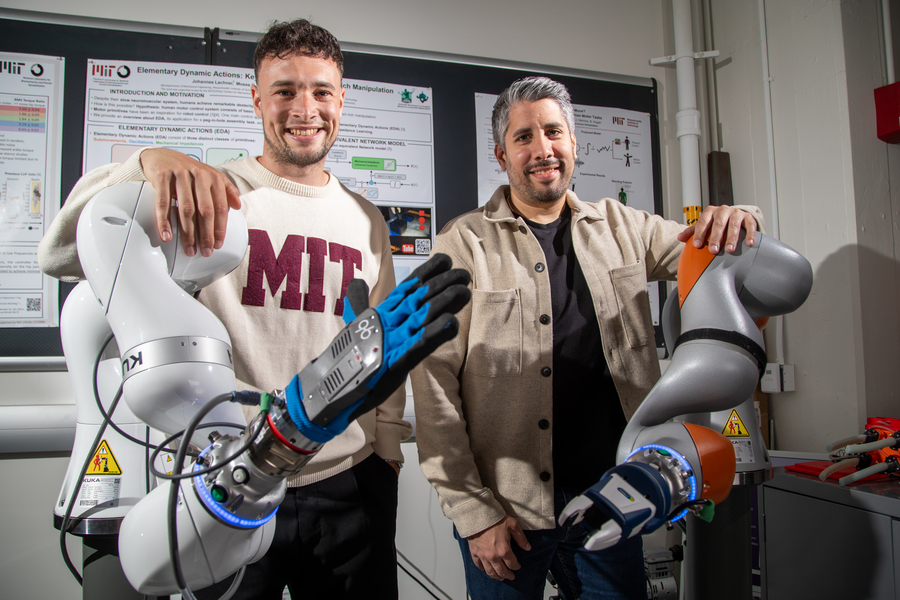
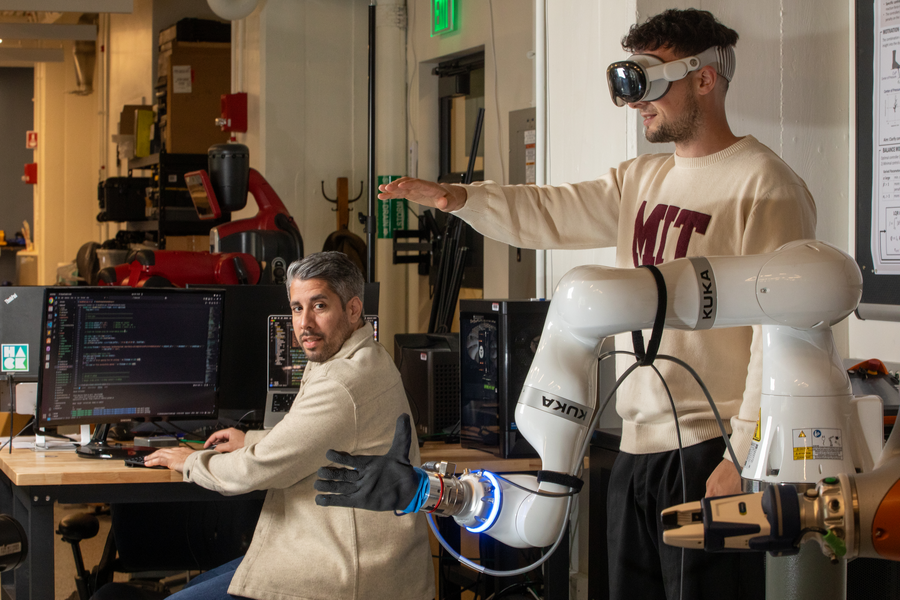
Lachner, now an assistant professor at Purdue University, and Noah Geiger, a Junior Managers Program Trainee (AI/IT Track) at Robert Bosch GmbH and former visiting student at MIT, developed a robotic therapy system that learns from physical therapists to adaptively support stroke patients. Combining transformer-based diffusion models with real-time force feedback, the dual-arm robot safely adjusts assistance based on each patient’s capabilities.
The system uses similar AI technology to that of ChatGPT generating images, but instead, it learns how a robot should behave to best support a patient during physical therapy. The robot then assists the patient based on what it has learned, providing just the right amount of physical assistance to keep the patient challenged and engaged.
“While most generative AI models in robotics focus on motion, ours is among the first to learn physical interaction, i.e., how to respond to touch, force, and resistance,” says Geiger. “The novelty of our generative AI model is its ability to learn dynamic physical interaction beyond motion planning.”
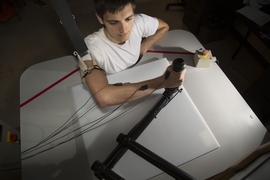
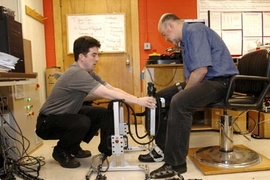
Through an initial prototype tested with healthy participants, the researchers trained a generative AI model using real-world physical telemanipulation experiments. Participants performed common rehabilitation movements, such as arm lifting and out-of-plane reaching, while intentionally varying their level of effort.

“This enabled the model to learn how robotic assistance should adapt to the patient's active participation,” Lachner explains. “In parallel, human operators guided the robot through contact-rich manipulation tasks using telemanipulation, creating a ‘physical parkour of motion.’ Together, these complementary datasets enabled the model to learn and generalize effective physical interaction strategies.”
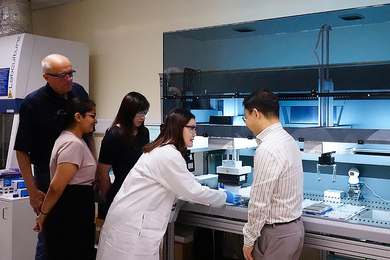
The research has since moved beyond the laboratory. In an ongoing clinical study conducted in collaboration with the lab of Professor Cristina Piazza at the Technical University of Munich (TUM) and Pfennigparade, an outpatient rehabilitation center in Munich, Germany, physical and occupational therapists wearing force-sensing gloves are being recorded with cameras while treating patients. The data collected are being used to train a new generative AI model that captures the unique physical interaction style of individual therapists.
“Initial robotic experiments have already demonstrated the feasibility of this approach,” Lachner reports. “The next phase of the project aims to develop therapist-specific models and evaluate them in a long-term clinical study with the same patients who previously received manual therapy.”

This work builds on previous research from the Newman Laboratory for Biomechanics and Human Rehabilitation, under the direction of Neville Hogan, the Sun Jae Professor of Mechanical Engineering at MIT. “The prior work was confined to reaching on a plane,” explains Hogan. “This new work extends to a much broader and more functional set of actions.”
The system can support a wide range of physical therapy needs. Key examples include stroke patients with upper limb impairments, post-surgical patients working to regain range of motion, and older adults who need to maintain strength and mobility in their arms and shoulders — but, Lachner says, other future applications are possible.
“Looking ahead, our approach could go far beyond physical therapy,” he says. “It has the potential to teach robots how to physically interact with the world, for example, in industrial settings or collaborative workspaces. By combining physics-grounded control with AI, we’re enabling a new generation of physically intelligent, stable, and safe robots.”
The team’s paper, “Diffusion-Based Impedance Learning for Contact-Rich Manipulation Tasks,” is available now from the journal IEEE Transactions on Robotics.
This research was made possible through funding from the MIT-Novo Nordisk Artificial Intelligence Postdoctoral Fellows Program, the TUM Global Program, and support from KUKA Robotics, Germany. More information about the project can be found on the project website.