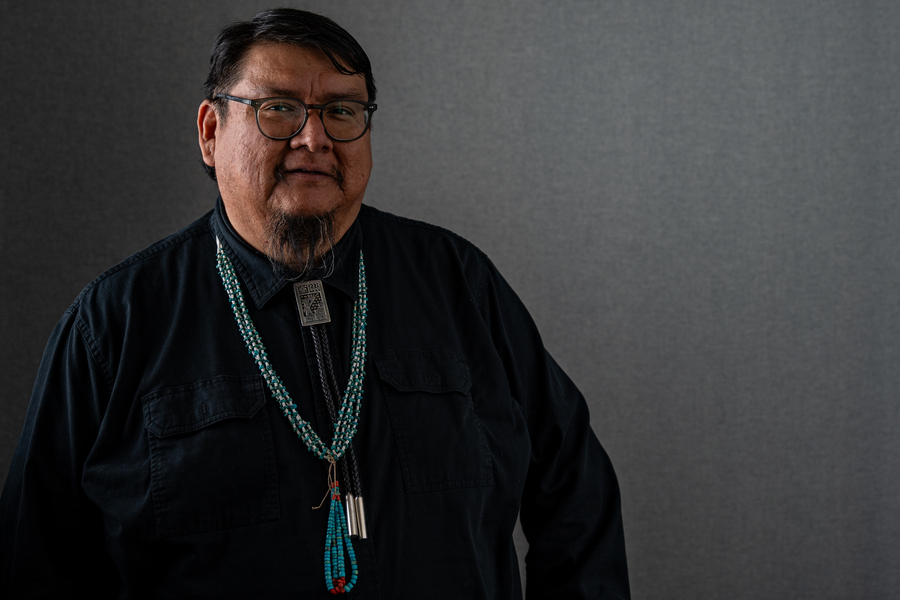
Growing up in the village of Kewa — located between Santa Fe and Albuquerque in New Mexico — William Pacheco, a member of the Santo Domingo Pueblo, learned the value of his language, its history, and the traditions it carries.
“We speak Keres, a language isolate found in seven villages and communities in central New Mexico,” he says. “It’s an endangered language with fewer than 10,000 speakers.” The Pueblos’ conception of ‘language,’ according to Pacheco, evokes the idea that speaking “comes from deep within.”
Pacheco is a graduate student in the MIT Indigenous Languages Initiative, a special master’s program in linguistics for members of communities whose languages are threatened. The two-year program provides its graduates with the linguistic knowledge to help them keep their communities’ languages alive. The initiative also offers expanded opportunities for students and faculty to become involved in Indigenous and endangered languages, working with both native speaker linguists in the master’s program and outside groups, ideas that appealed to him.
“There’s some complexity to our language that defies traditional instruction,” says Pacheco, who will complete his studies this spring. “I want to develop the linguistic tools I need to improve my understanding of its construction and how best to teach and preserve it.” Pacheco is keenly aware of cultural differences in how language transmission occurs. Language, he believes, evolves over time and is best learned experientially; the Western model of language learning prioritizes immediacy and test-taking.
A variety of factors complicate efforts to preserve and potentially teach Keres. Each of the villages where it’s spoken has its own distinct dialect. These dialects are mutually intelligible to various degrees based on where they’re being spoken. Additionally, the last three decades have seen a significant increase in English usage by young Pueblos, which further endangers Keres’ existence.
Furthermore, Keres isn’t a written language. For centuries, the Pueblo have relied on daily use within their homes and communities to maintain its vitality. “The community doesn’t want it written,” Pacheco says.
Contact with the wider world has previously imperiled Indigenous ideas, an outcome Pacheco wants to avoid. “We believe [Keres] is a form of intellectual property, a tradition and artifact that is best served by empowering our people to preserve it,” he says.
From the Southwest to MIT
While he’s now passionate about linguistics, languages weren’t Pacheco’s first choice when considering an educational path. “I always admired [MIT alumnus and Nobel laureate] Richard Feynman,” he recalls. “I wanted to study physics.”
After earning an undergraduate degree from the University of New Mexico, Pacheco, who’d been working as a K-12 educator, began efforts to preserve Keres, increasing the language’s vitality and preserving its usefulness for, and value to, future generations. He sought permission and certification from the tribe to teach the language at the Santa Fe Indian School, an off-reservation boarding school. He soon discovered that a traditional Western approach to language learning wouldn’t suffice.
“Students weren’t taking the course to be scholars of the language; they wanted to learn it to build community and create opportunities to connect with elders,” Pacheco says. It was students’ advocacy, he notes, that led to the Keres learning initiative. While designing the course, however, he found gaps in his knowledge that led him to consider graduate study.
“There are fascinating idiosyncrasies in Keres, including, for example, verb morphology — the ways in which verbs and verb sounds change,” he notes. “I wasn’t sure about how to teach them.” He sought to improve his understanding and ability by earning a master’s degree in learning design, innovation, and technology from Harvard University. While completing his studies there, he had another burst of inspiration.
“I thought a background in linguistics would prove useful,” he says. “An advisor told me about the Indigenous Languages Initiative at MIT and recommended I apply.” Pacheco knew of Professor Emeritus Noam Chomsky’s pioneering work in generative linguistics at the Institute and sought to learn more about the field’s potential to help him become a better, more effective educator and linguist.
Upon arriving at MIT in 2024, Pacheco found himself embraced by faculty and students alike. “[MIT linguists] Adam Albright and Norvin Richards have been wonderfully supportive mentors, offering enthusiasm and expertise” he says. “I’ve benefited from MIT’s approach to linguistics and its use of scientific inquiry as a tool to explore language.” Engaging with other students working to preserve languages at risk of extinction continues to drive his work.
“MIT continually encourages us to use its resources, to collaborate, and to help one another find solutions to our unique challenges,” he says. “Networking, gathering good ideas, and having access to professors and students from a variety of disciplines is incredibly valuable.”
MIT’s scholars, Pacheco says, are experienced with Indigenous language learning, education, and pedagogy.
Developing an organized approach to Keres research and instruction
While gratified that his work created opportunities for him to preserve and teach Keres, Pacheco marvels at his path to the Institute and its impact on his life. “It was my language, not my interest in physics, which led me to Harvard and MIT,” he says. “How did I end up at these places?”
An advantage of language and linguistics education at MIT is the rigor with which it explores language acquisition modeling and allows for alternatives to established systems. Pacheco is after new ideas for Keres language learning and education, working to develop an effective course based on generative linguistics that both preserves the Pueblos’ approach to community and offers an educational model students are likely to embrace. He’s already had opportunities to test novel theories and practices as an educator back home.
“I was teaching students to use Keres as a programming tool,” he says. “We modeled a robot as a member of the community navigating a maze, and students would have to teach it to accept commands in Keres.”
Pacheco also wants to explore community-centered language issues. He wants to standardize the development and education of community linguists, creating a cohort of scholars trained to use the tools he designs that are deeply invested in Keres’ preservation and instruction.
“We want to drive inquiries into Keres and how it’s taught,” he says, “while also centering Indigenous knowledge systems and expanding access to linguistics study for Indigenous scholars.”
Pacheco believes there’s value in exposing scholars and communities to the cultural and ideological exchanges he’s enjoyed between the sciences, humanities, Indigenous ideas, and experiences. “Indigenous scholars exist at MIT,” he says. “We’re here, and the Institute’s support helps preserve languages like Keres as important communal and cultural artifacts.”
Pacheco is grateful for the opportunities his research at MIT have afforded him. While his education as a linguist and scholar continues, Pacheco’s community, culture, and support for Keres language learning remain top priorities.
“I want to amplify the impact in tribal language policy and Indigenous-centered education,” he says. “Language, its study, and its transmission is both science and art.”