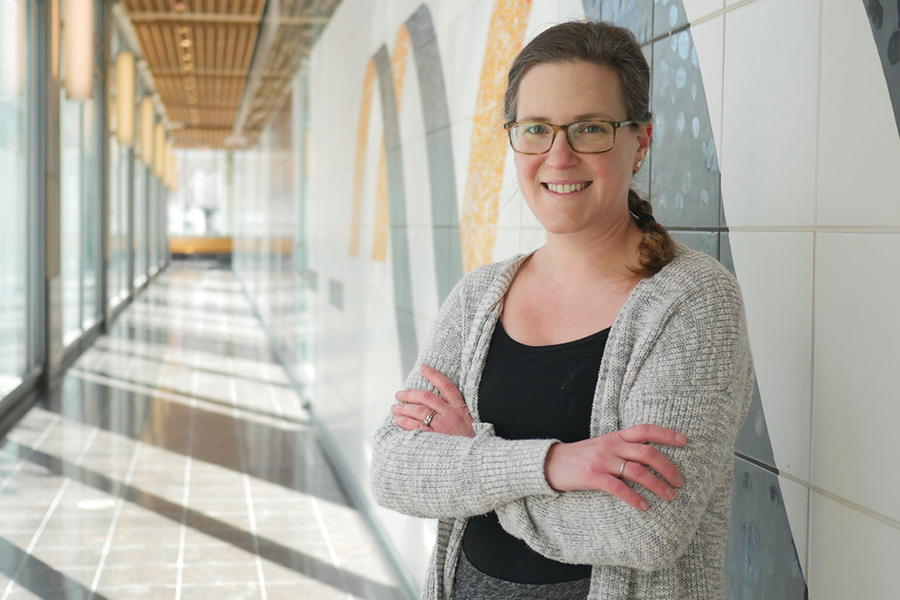
A prestigious grant from the W.M. Keck Foundation to Alison E. Ringel, an MIT assistant professor of biology, will support groundbreaking healthy aging research at the Institute.
Ringel, who is also a core member of the Ragon Institute of Mass General Brigham, MIT, and Harvard, will draw on her background in cancer immunology to create a more comprehensive biomedical understanding of the cause and possible treatments for aging-related decline.
“It is such an honor to receive this grant,” Ringel says. “This support will enable us to draw new connections between immunology and aging biology. As the U.S. population grows older, advancing this research is increasingly important, and this line of inquiry is only possible because of the W.M. Keck Foundation.”
Understanding how to extend healthy years of life is a fundamental question of biomedical research with wide-ranging societal implications. Although modern science and medicine have greatly expanded global life expectancy, it remains unclear why everyone ages differently; some maintain physical and cognitive fitness well into old age, while others become debilitatingly frail later in life.
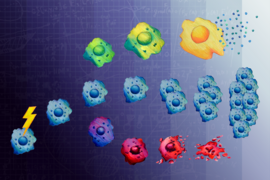
Our immune systems are adaptable, but they do naturally decline as we get older. One critical component of our immune system is CD8+ T cells, which are known to target and destroy cancerous or damaged cells. As we age, our tissues accumulate cells that can no longer divide. These senescent cells are present throughout our lives, but reach seemingly harmful levels as a normal part of aging, causing tissue damage and diminished resilience under stress.
There is now compelling evidence that the immune system plays a more active role in aging than previously thought.
“Decades of research have revealed that T cells can eliminate cancer cells, and studies of how they do so have led directly to the development of cancer immunotherapy,” Ringel says. “Building on these discoveries, we can now ask what roles T cells play in normal aging, where the accumulation of senescent cells, which are remarkably similar to cancer cells in some respects, may cause health problems later in life.”
In animal models, reconstituting elements of a young immune system has been shown to improve age-related decline, potentially due to CD8+ T cells selectively eliminating senescent cells. CD8+ T cells progressively losing the ability to cull senescent cells could explain some age-related pathology.
Ringel aims to build models for the express purpose of tracking and manipulating T cells in the context of aging and to evaluate how T cell behavior changes over a lifespan.
“By defining the protective processes that slow aging when we are young and healthy, and defining how these go awry in older adults, our goal is to generate knowledge that can be applied to extend healthy years of life,” Ringel says. “I’m really excited about where this research can take us.”
The W.M. Keck Foundation was established in 1954 in Los Angeles by William Myron Keck, founder of The Superior Oil Co. One of the nation’s largest philanthropic organizations, the W.M. Keck Foundation supports outstanding science, engineering, and medical research. The foundation also supports undergraduate education and maintains a program within Southern California to support arts and culture, education, health, and community service projects.