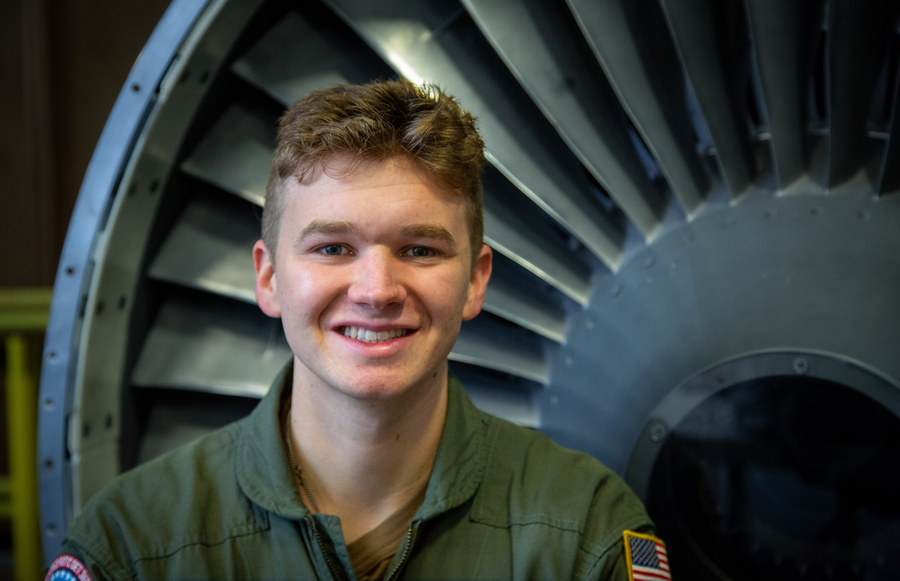
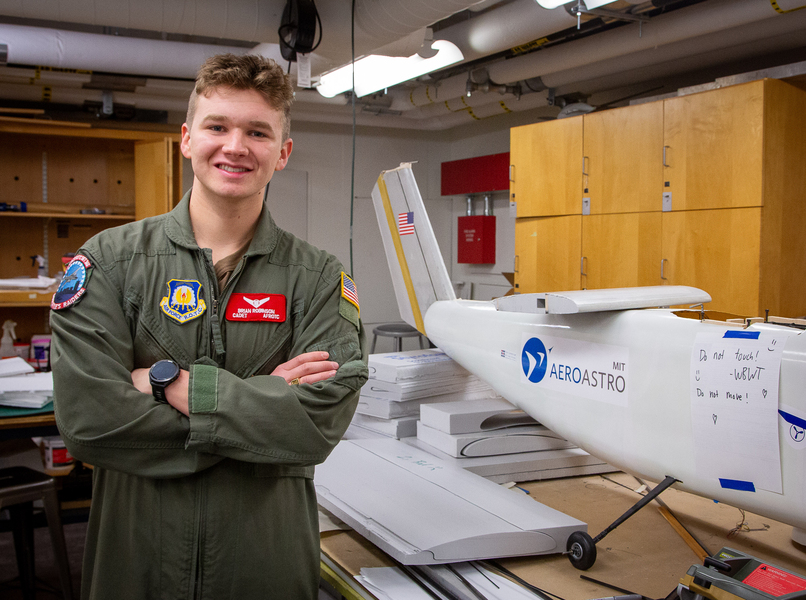
Brian Robinson has always been interested in exploring the sky, and beyond.
“When I was a middle schooler, I would draw pictures about wanting to be an astronaut one day,” he remembers.
Now at MIT, Robinson continues to follow that passion. As a senior double majoring in aerospace engineering and political science, his research focuses on the technical and practical issues related to autonomous systems, including the design and capabilities of unmanned aerial vehicles (UAVs). He says aerospace engineering is an important part of his approach to his current and future plans.
“Aerospace engineering provides a technical base through which I can better understand UAVs and their impacts,” he says, citing military contexts in particular. “You always want to bring something to the table when you’re in a room with others working on projects and related challenges.”
He’s following in the footsteps of, and being inspired by, Erik Lin-Greenberg, an associate professor, U.S. Air Force reservist, and co-director of MIT’s Wargaming Lab, whose research explores how emerging military technologies affect conflict dynamics. Robinson is also working under the tutelage of Caitlin Talmadge, the Raphael Dorman-Helen Starbuck Associate Professor of Political Science and an affiliate of the Security Studies Program.
This spring, Robinson will also complete a master’s degree in political science, with a focus in security studies and international relations. He’s currently a member of the Air Force’s Reserve Officer Training Corps and will be commissioned as a second lieutenant when he reports for Air Force training after graduation, part of a 10-year commitment for pilots. He welcomes the next part of his journey.
“I’m receiving wonderful opportunities and can serve my country, so I’m honored,” he says. “I love the idea of flying.”
Designing a path to the Institute
Robinson’s passion for flying began with his first flight with the Young Eagles program, which exposes young people to flying, and drives him even today. “I fell in love with flying after that,” he says. Robinson’s parents encouraged him to pursue his flying dreams. “They said if I could work to make it happen, I should literally shoot for the stars,” he remembers.
He worked with advisors and others in high school to pursue those academic areas offering the tools he’d need to reach MIT and the skies, seeking and joining clubs and organizations whose offerings and goals aligned with his. His efforts created a path that would let him focus on a career in spaceflight or defense.
While shaping a curriculum that would help him become the professional he wanted to be, he learned that his high school didn’t offer physics courses. He enrolled in a virtual school to complete the physics education requirements he knew he’d need if he wanted to enroll at MIT.
Joining the Air Force ROTC — which offered scholarships and other support — brought his MIT dream closer to reality, a possibility he found both daunting and exhilarating.
“The thought of challenging myself to be uncomfortable at MIT, in furtherance of my dreams, is exactly what I wanted,” he says.
His interest in political science began in high school with a “great history teacher” who helped him better understand the human costs of nation-building throughout recorded history. Continuing his investigations as a political science major once he earned acceptance to MIT seemed like a logical next step.
Growing a network at MIT
Upon his arrival at MIT, Robinson found the challenges he sought while also discovering a vast network of faculty, staff, and students invested in his success.
“Sometimes at other schools you hear about how siloed and competitive things can get,” he reports, “but I’ve learned that the people at MIT are incredibly supportive and willing to help if you ask.”
Robinson decided that studying political science at MIT — an institution that places a premium on a fact-based, data-driven, and collaborative approach to investigation — would pair nicely with his work in aerospace engineering. His experiences have borne that out.
“[Political science] was something different that managed to complement aerospace studies,” he says of his decision to pursue a double major. “It helped me develop skills I may not have acquired otherwise.”
Robinson lauds a cross-disciplinary course he took, 16.811 (Advanced Manufacturing for Aerospace Engineers). The course, taught by Zachary Cordero, the Esther and Harold E. Edgerton Associate Professor, and Zoltán Spakovszky, the T. Wilson (1953) Professor in Aeronautics, asks students to create an additively manufactured turbopump.
“The course condensed what would, in the real world, likely be a months-long design cycle into a single semester,” he marvels. “You had to make decisions and stick with them.”
Robinson learned that MIT encourages collaborative problem-solving, which can produce better outcomes. While completing the course, Robinson also found that the soft skills he learned from his political science studies proved invaluable. “You have to seek input, compromise, and ensure everyone’s voices are being heard,” he says. “You have to rely on your people.”
Engineering a pathway to leadership
Robinson is learning to balance an awareness of war’s realities — dealing with non-state actors, tracking technological advances, and managing shifting regional and global alliances — with human impacts. At MIT, he can work with other engineers and colleagues in the humanities to consider the variety of possibilities their research areas might uncover.
“You’re answering important questions,” he says. “At MIT, both aerospace engineering and political science take a fact-based approach to their work.”
Robinson says pairing the humanities with the sciences has obvious value both inside and outside the classroom, lessons he’ll take with him into the Air Force. “I’ll be equipped with tools that can help sort political challenges related to technology, defense, and leadership,” he notes. “Professor Lin-Greenberg helped me understand how different actors approach conflict, while Professor Talmadge helped me learn how to get at the question I’m trying to ask and separate the noise from what’s important.”
Leadership requires flexibility and big-picture thinking, no more so than when you’re leading a group of airmen. The technical acumen needed to be successful when studying political science and aerospace engineering are important tools for an incoming second lieutenant. He’s learning to be a better leader.
“You’re a technical expert for the first part of your career [in the Air Force] and, as you transition to leadership roles, the combination of the technical and theoretical improves your ability to lead, and be led,” he says. “I can provide value while simultaneously learning from others.”