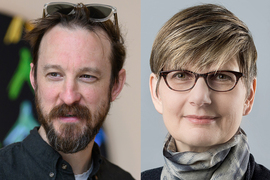
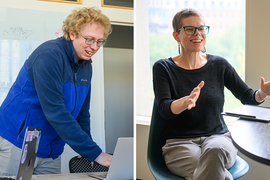
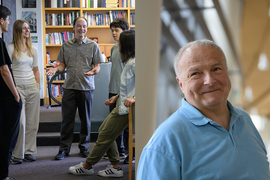
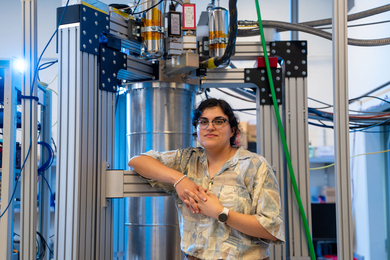
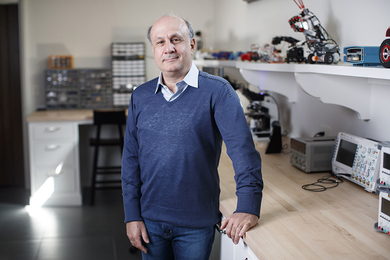
Both Rohit Karnik and Nathan Wilmers personify the type of mentorship that any student would be fortunate to receive — one rooted in intellectual rigor and grounded in humility, empathy, and personal support. They show that transformative academic guidance is not only about solving research problems, but about lifting up the people working on them.
Whether it’s Karnik’s quiet integrity and commitment to scientific ethics, or Wilmers’ steadfast encouragement of his students in the face of challenges, both professors cultivate spaces where students are not only empowered to grow as researchers, but affirmed as individuals. Their mentees describe feeling genuinely seen and supported; mentored not just in theory or technique, but in resilience. It’s this attention to the human element that leaves a lasting impact.
Professors Karnik and Wilmers are two of the 2023–25 Committed to Caring cohort who are cultivating confidence and craft across disciplines. For MIT graduate students, the Committed to Caring program recognizes those who go above and beyond.
Rohit Karnik: Rooted in rigor, guided by care
Rohit Karnik is Abdul Latif Jameel Professor in the Department of Mechanical Engineering at MIT, where he leads the Microfluidics and Nanofluidics Research Group and serves as director of the Abdul Latif Jameel Water and Food Systems Lab (J-WAFS). His research explores the physics of micro- and nanofluidic flows and systems. Applications of his work include the development of water filters, portable diagnostic tools, and sensors for environmental monitoring.
Karnik is genuinely excited about his students’ ideas, and open to their various academic backgrounds. He validates students by respecting their research, encouraging them to pursue their interests, and showing enthusiasm for their exploration within mechanical engineering and beyond.
One student reflected on the manner in which Karnik helped them feel more confident in their academic journey. When a student from a non-engineering field joined the mechanical engineering graduate program, Karnik never viewed their background as a barrier to success. The student wrote, “from the start, he was enthusiastic about my interdisciplinarity and the perspective I could bring to the lab.”
He allowed the student to take remedial undergraduate classes to learn engineering basics, provided guidance on leveraging their previous academic background, and encouraged them to write grants and apply for fellowships that would support their interdisciplinary work. In addition to these concrete supports, Karnik also provided the student with the freedom to develop their own ideas, offering constructive, realistic feedback on what was attainable.
“This transition took time, and Karnik honored that, prioritizing my growth in a completely new field over getting quick results,” the nominator reflected. Ultimately, Karnik’s mentorship, patience, and thoughtful encouragement led the student to excel in the engineering field.
Karnik encourages his advisees to explore their interests in mechanical engineering and beyond. This holistic approach extends beyond academics and into Karnik’s view of his students as whole individuals. One student wrote that he treats them as complete humans, with ambitions, aspirations, and passions worthy of his respect and consideration — and remains truly selfless in his commitment to their growth and success.
Karnik emphasizes that “it’s important to have dreams,” regularly encouraging his mentees to take advantage of opportunities that align with their goals and values. This sentiment is felt deeply by his students, with one nominator sharing that Karnik “encourag[ed] me to think broadly and holistically about my life, which has helped me structure and prioritize my time at MIT.”
Nathan Wilmers: Cultivating confidence, craft, and care
Nathan Wilmers is the Sarofim Family Career Development Associate Professor of Work and Organizations at MIT Sloan School of Management. His research spans wage and earnings inequality, economic sociology, and the sociology of labor. He is also affiliated with the Institute for Work and Employment Research, and the Economic Sociology program at Sloan. Wilmers studies wage and earnings inequality, economic sociology, and the sociology of labor, bringing insights from economic sociology to the study of labor markets and the wage structure.
A remarkable mentor, Wilmers is known for guiding his students through different projects while also teaching them more broadly about the system of academia. As one nominator illustrates, “he … helped me learn the ‘tacit’ knowledge to understand how to write a paper,” while also emphasizing the learning process of the PhD as a whole, and never reprimanding any mistakes along the way.
Students say that Wilmers “reassures us that making mistakes is a natural part of the learning process and encourages us to continuously check, identify, and rectify them.” He welcomes all questions without judgment, and generously invests his time and patience in teaching students.
Wilmers is a strong advocate for his students, both academically and personally. He emphasizes the importance of learning, growth, and practical experience, rather than solely focusing on scholarly achievements and goals. Students feel this care, describing “an environment that maximizes learning opportunities and fosters the development of skills,” allowing them to truly collaborate rather than simply aim for the “right” answers.
In addition to his role in the classroom and lab, Wilmers also provides informal guidance to advisees, imparting valuable knowledge about the academic system, emphasizing the significance of networking, and sharing insider information.
“Nate’s down-to-earth nature is evident in his accessibility to students,” expressed one nominator, who wrote that “sometimes we can freely approach his office without an appointment and receive valuable advice on both work-related and personal matters.” Moreover, Wilmers prioritizes his advisees’ career advancement, dedicating a substantial amount of time to providing feedback on thesis projects, and even encouraging students to take a lead in publishing research.
True mentorship often lies in the patient, careful transmission of craft — the behind-the-scenes work that forms the backbone of rigorous research. “I care about the details,” says Wilmers, reflecting a philosophy shaped by his own graduate advisors. Wilmers’ mentors instilled in him a deep respect for the less-glamorous but essential elements of scholarly work: data cleaning, thoughtful analysis, and careful interpretation. These technical and analytical skills are where real learning happens, he believes.
By modeling this approach with his own students, Wilmers creates a culture where precision and discipline are valued just as much as innovation. His mentorship is grounded in the belief that becoming a good researcher requires not just vision, but also an intimate understanding of process — of how ideas are sharpened through methodical practice, and how impact comes from doing the small things well. His thoughtful, detail-oriented mentorship leaves a lasting impression on his students.
A nominator acclaimed, “Nate’s strong enthusiasm for my research, coupled with his expressed confidence and affirmation of its value, served as a significant source of motivation for me to persistently pursue my ideas.”