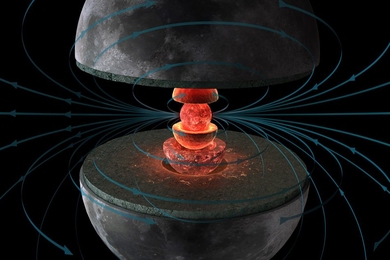
Lunar dynamo’s lifetime extended by at least 1 billion years
Findings suggest two mechanisms may have powered the moon’s ancient churning, molten core.
Findings suggest two mechanisms may have powered the moon’s ancient churning, molten core.
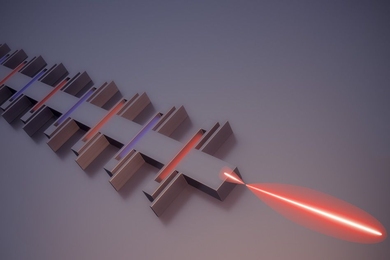
New design boosts the power output of the best-performing chip-scale terahertz laser by 80 percent.

MIT study suggests a new approach to developing treatments for Alzheimer’s disease.

Patients with sleep disorders could be studied nonintrusively at home using wireless signals.
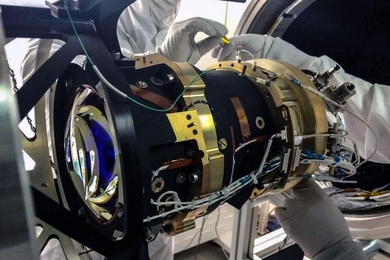
Satellite’s cameras have been delivered by MIT researchers and passed NASA inspection.

Software lets designers exploit the extremely high resolution of 3-D printers.

Researchers gauge a cell’s stiffness, which can reflect cancer or other conditions, simply by watching it.

Without action, climate change could devastate a region home to one-fifth of humanity, study finds.

System can apply a range of styles in real-time, so that the viewfinder displays the enhanced image.
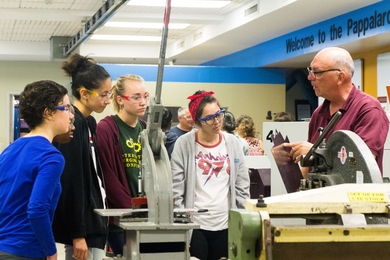
Women make up 49.5 percent of MIT’s undergraduates in mechanical engineering, due to department’s proactive approach, study finds.

Study ties specific interval during an extended period of volcanism to Earth’s most severe mass extinction.

Consumers may tune in to prices when they need to — but recall data poorly, study finds.

Study finds ocean circulation, coupled with trade wind changes, efficiently limits shifting of tropical rainfall patterns.
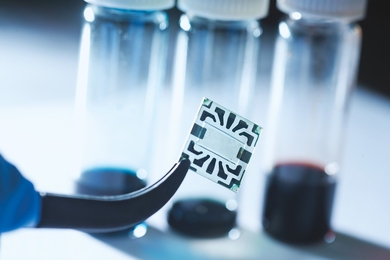
Researchers develop a novel technique using graphene to create solar cells they can mount on surfaces ranging from glass to plastic to paper and tape.

Simple-to-use, low-cost respiratory sensor enables measurement and tracking of personal metabolism.