
Overcoming imperfections
By looking to nature, PhD student Leon Dimas 3-D prints materials that resist flaws and fractures.
By looking to nature, PhD student Leon Dimas 3-D prints materials that resist flaws and fractures.
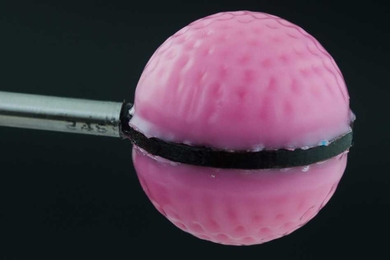
Adding golf ball-like dimples to surfaces could reduce drag and improve efficiency of vehicles.
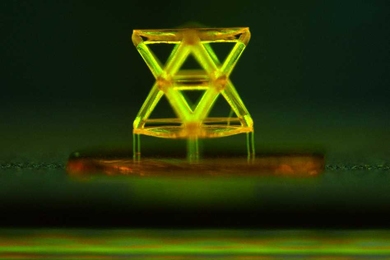
Nanostructured material based on repeating microscopic units has record-breaking stiffness at low density.
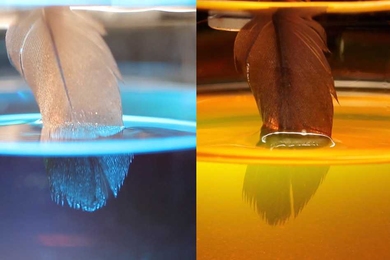
Study reveals how shape and chemistry let feathers shed water after emerging from great depths.
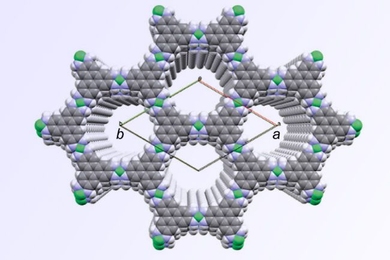
Researchers find a two-dimensional, self-assembling material that might produce solar cells or transistors.

Institute’s programs rank first in 7 engineering, 5 science, and 3 business fields.
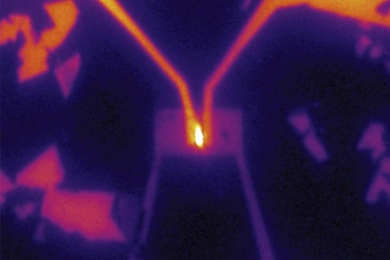
Team creates LEDs, photovoltaic cells, and light detectors using novel one-molecule-thick material.
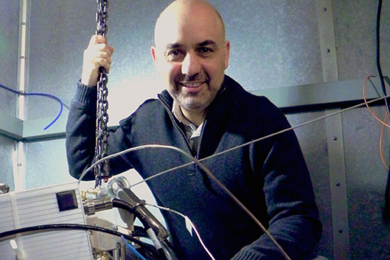
Novel experimental technique reveals exotic behaviors in graphene systems.
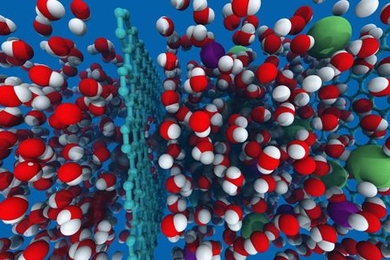
MIT researchers evaluate graphene’s potential for making desalination economically viable.

Project provides a systematic way of exploring the vast realm of unfamiliar materials.
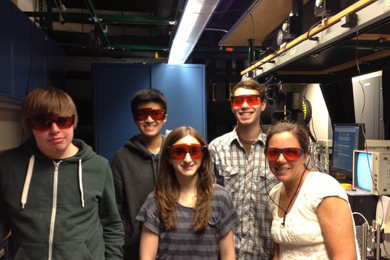
Jill Sewell shepherds the Lambda Project in Professor Keith A. Nelson's lab.
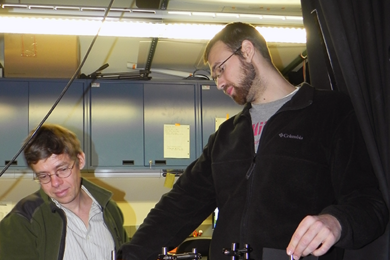
MIT researchers find that Fourier's law of heat conduction breaks down at lengths much longer than previously thought.

Spectroscopy techniques demonstrate ballistic motion at micron length scales, open door to new possibilities for semiconductors, thermoelectrics.
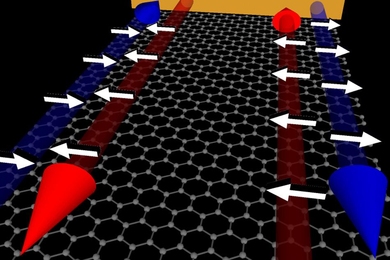
New approach to use of 2-D carbon material opens up unexpected properties, could unleash new uses.