New MIT initiative seeks to transform rare brain disorders research
The Rare Brain Disorders Nexus aims to accelerate the development of novel therapies for a spectrum of uncommon brain diseases.
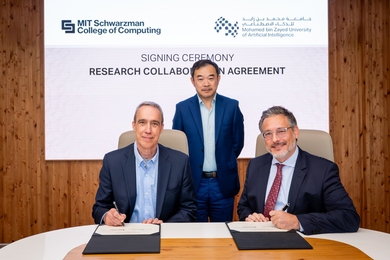
The MIT–MBZUAI Collaborative Research Program will unite faculty and students from both institutions to advance AI and accelerate its use in pressing scientific and societal challenges.
MIT physicist seeks to use award to study magnetoelectric multiferroics that could lead to energy-efficient storage devices.
A new study finds over half the drugs approved this century cite government-funded research in their patents.
Department of Mathematics researchers David Roe and Andrew Sutherland seek to advance automated theorem proving; four additional MIT alumni also awarded.
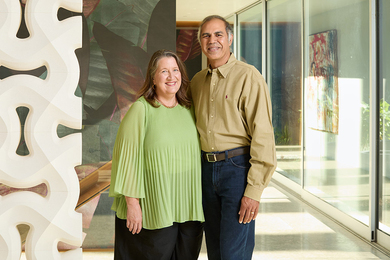
A commitment from longtime supporters Patricia and James Poitras ’63 initiates multidisciplinary efforts to understand and treat complex psychiatric disorders.
The IECP will generate rigorous evidence for fair and effective public safety solutions.
The Fairbairn Menstruation Science Fund will allow researchers to accelerate the understanding and treatment of often-neglected diseases that tend to be more common in women.
Launched with a gift from the Biswas Family Foundation, the Biswas Postdoctoral Fellowship Program will support postdocs in health and life sciences.
The MIT-MGB Seed Program, launched with support from Analog Devices Inc., will fund joint research projects that advance technology and clinical research.
Presentations targeted high-impact intersections of AI and other areas, such as health care, business, and education.
MIT Plasma Science and Fusion Center to establish the Schmidt Laboratory for Materials in Nuclear Technologies.
In an annual tradition, MIT affiliates embarked on a trip to Washington to explore federal lawmaking and advocate for science policy.
Gift from the Leinweber Foundation, in addition to a $5 million commitment from the School of Science, will drive discovery, collaboration, and the next generation of physics leaders.
Over nearly a quarter century, the program has invested $1.3 million in 300 ventures in 60 countries for a transformative legacy in social innovation.