Audio
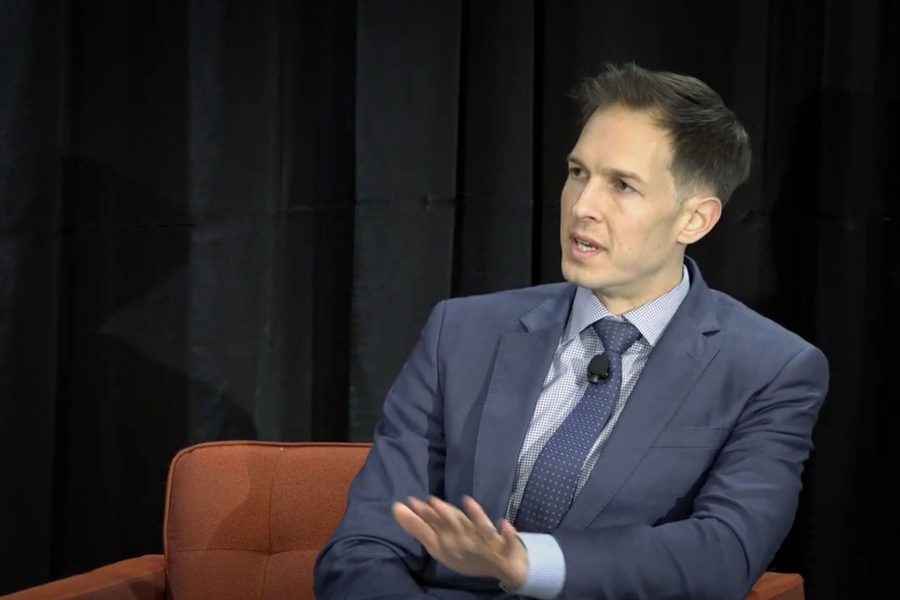
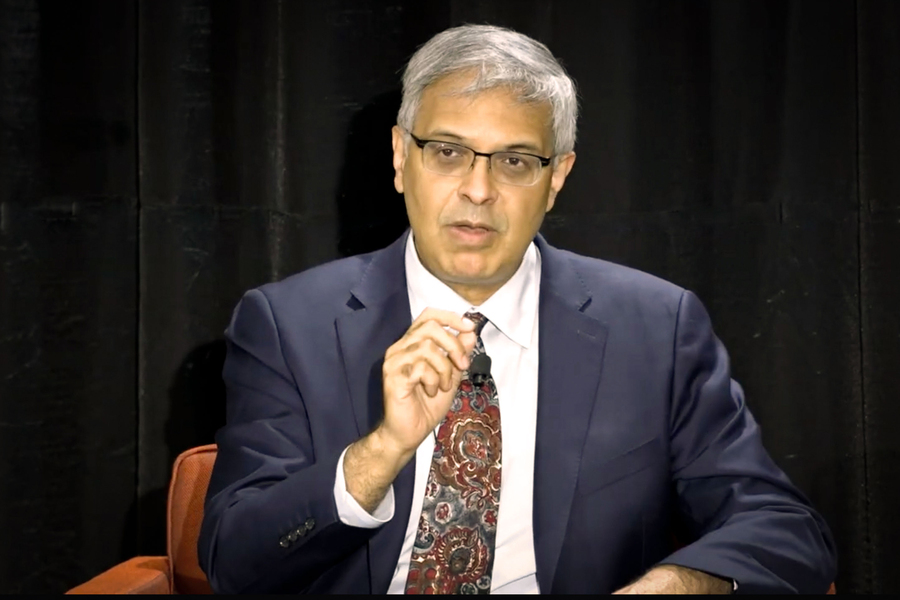
National Institutes of Health (NIH) Director Jay Bhattacharya visited MIT on Friday, engaging in a wide-ranging discussion about policy issues and research aims at an event also featuring Rep. Jake Auchincloss MBA ’16 of Massachusetts.
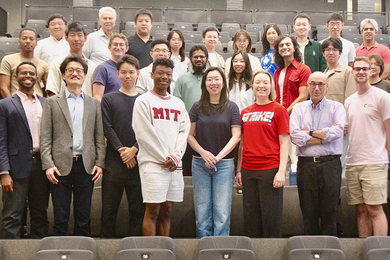
The forum consisted of a dialogue between Auchincloss and Bhattacharya, followed by a question-and-answer session with an audience that included researchers from the greater Boston area. The event was part of a daylong series of stops Bhattacharya and Auchincloss made around Boston, a world-leading hub of biomedical research.
“I was joking with Dr. Bhattacharya that when the NIH director comes to Massachusetts, he gets treated like a celebrity, because we do science, and we take science very seriously here,” Auchincloss quipped at the outset.
Bhattacharya said he was “delighted” to be visiting, and credited the thousands of scientists who participate in peer review for the NIH. “The reason why the NIH succeeds is the willingness and engagement of the scientific community,” he said.
In response to an audience question, Bhattacharya also outlined his overall vision of the NIH’s portfolio of projects.
“You both need investments in ideas that are not tested, just to see if something works. You don’t know in advance,” he said. “And at the same time, you need an ecosystem that tests those ideas rigorously and winnows those ideas to the ones that actually work, that are replicable. A successful portfolio will have both elements in it.”
MIT President Sally A. Kornbluth gave opening remarks at the event, welcoming Bhattacharya and Auchincloss to campus and noting that the Institute’s earliest known NIH grant on record dates to 1948. In recent decades, biomedical research at MIT has boomed, expanding across a wide range of frontier fields.
Indeed, Kornbluth noted, MIT’s federally funded research projects during U.S. President Trump’s first term include a method for making anesthesia safer, especially for children and the elderly; a new type of expanding heart valve for children that eliminates the need for repeated surgeries; and a noninvasive Alzheimer’s treatment using sound and light stimulation, which is currently in clinical trials.
“Today, researchers across our campus pursue pioneering science on behalf of the American people, with profoundly important results,” Kornbluth said.
“The hospitals, universities, startups, investors, and companies represented here today have made greater Boston an extraordinary magnet for talent,” Kornbluth added. “Both as a force for progress in human health and an engine of economic growth, this community of talent is a precious national asset. We look forward to working with Dr. Bhattacharya to build on its strengths.”
The discussion occurred amid uncertainty about future science funding levels and pending changes in the NIH’s grant-review processes. The NIH has announced a “unified strategy” for reviewing grant applications that may lead to more direct involvement in grant decisions by directors of the 27 NIH institutes and centers, along with other changes that could shift the types of awards being made.
Auchincloss asked multiple questions about the ongoing NIH changes; about 10 audience members from a variety of institutions also posed a range of questions to Bhattacharya, often about the new grant-review process and the aims of the changes.
“The unified funding strategy is a way to allow institute direcors to look at the full range of scoring, including scores on innovation, and pick projects that look like they are promising,” Bhattacharya said in response to one of Auchincloss’ queries.
One audience member also emphasized concerns about the long-term effects of funding uncertainties on younger scientists in the U.S.
“The future success of the American biomedical enterprise depends on us training the next generation of scientists,” Bhattacharya acknowledged.
Bhattacharya is the 18th director of the NIH, having been confirmed by the U.S. Senate in March. He has served as a faculty member at Stanford University, where he received his BA, MA, MD, and PhD, and is currently a professor emeritus. During his career, Bhattacharya’s work has often examined the economics of health care, though his research has ranged broadly across topics, in over 170 published papers. He has also served as director of the Center on the Demography and Economics of Health and Aging at Stanford University.
Auchincloss is in his third term as the U.S. Representative to Congress from the 4th district in Massachusetts, having first been elected in 2020. He is also a major in the Marine Corps Reserve, and received his MBA from the MIT Sloan School of Management.
Ian Waitz, MIT’s vice president for research, concluded the session with a note of thanks to Auchincloss and Bhattacharya for their “visit to the greater Boston ecosystem which has done so much for so many and contributed obviously to the NIH mission that you articulated.” He added: “We have such a marvelous history in this region in making such great gains for health and longevity, and we’re here to do more to partner with you.”