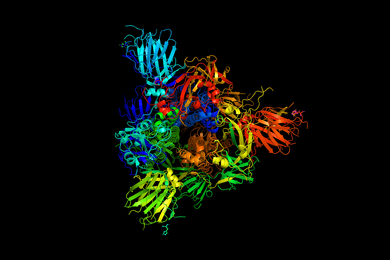
Vibrations of coronavirus proteins may play a role in infection
Study suggests mechanical properties of spike proteins can predict infectivity and lethality of different coronaviruses.
Study suggests mechanical properties of spike proteins can predict infectivity and lethality of different coronaviruses.

Recognition honors research into nuclear structure and reactions.

MIT Schwarzman College of Computing and the Singapore Defense Science and Technology Agency award funding to 13 AI-focused projects.

MIT Task Force on the Work of the Future identifies ways to align new technologies with durable careers.

Graduate student Manon Revel uses quantitative methodologies to investigate how advertising in online publications affects trust in journalism.

Advance could enable artificial intelligence on household appliances while enhancing data security and energy efficiency.

Intelenz co-founder Renzo Zagni credits MIT for the know-how he needed to launch his company and grow its AI-enabled offerings.

Machine learning model predicts probability that a particular urinary tract infection can be treated by specific antibiotics.

Textual analysis of social media posts finds users’ anxiety and suicide-risk levels are rising, among other negative trends.

Results might provide a convenient screening tool for people who may not suspect they are infected.

Letting an algorithm decide which maintenance holes to test for evidence of coronavirus could improve pandemic containment efforts.

MIT conference illustrates technologies developed in response to the pandemic and new opportunities for AI solutions for clinical management.

Researchers are working toward intelligent machines that can sense cognitive fatigue and suggest interventions to help a human improve performance.

Book co-authored by Associate Professor Julie Shah and Laura Major SM ’05 explores a future populated with robot helpers.

The startup OpenSpace is using 360-degree cameras and computer vision to create comprehensive digital replicas of construction sites.